NASA Tests First Deep-Space Internet
November 18, 2008 NASA Tests First Deep-Space Internet

Enlarge

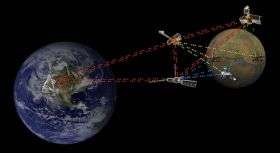
Artist concept of interplanetary internet. Image credit: NASA/JPL

(PhysOrg.com) -- NASA has successfully tested the first deep space communications network modeled on the Internet.

Working as part of a NASA-wide team, engineers from NASA's Jet Propulsion Laboratory in Pasadena, Calif., used software called Disruption-Tolerant Networking, or DTN, to transmit dozens of space images to and from a NASA science spacecraft located about more than 32 million kilometers (20 million miles) from Earth.

"This is the first step in creating a totally new space communications capability, an interplanetary Internet," said Adrian Hooke, team lead and manager of space-networking architecture, technology and standards at NASA Headquarters in Washington.

NASA and Vint Cerf, a vice president at Google, Inc., in Mountain View, Calif., partnered 10 years ago to develop this software protocol. The DTN sends information using a method that differs from the normal Internet's Transmission-Control Protocol/Internet Protocol, or TCP/IP communication suite, which Cerf co-designed.

The Interplanetary Internet must be robust enough to withstand delays, disruptions and disconnections in space. Glitches can happen when a spacecraft moves behind a planet, or when solar storms and long communication delays occur. The delay in sending or receiving data from Mars takes between three-and-a-half to 20 minutes at the speed of light.

Unlike TCP/IP on Earth, the DTN does not assume a continuous end-to-end connection. In its design, if a destination path can't be found, the data packets are not discarded. Instead, each network node keeps custody of the information as long as necessary until it can safely communicate with another node. This store-and-forward method, similar to basketball players safely passing the ball to the player nearest the basket, means that information does not get lost when no immediate path to the destination exists. Eventually, the information is delivered to the end user.

"In space today, an operations team has to manually schedule each link and generate all the commands to specify which data to send, when to send it, and where to send it," said Leigh Torgerson, manager of the DTN Experiment Operations Center at JPL. "With standardized DTN, this can all be done automatically."

Engineers began a month-long series of DTN demonstrations in October. Data were transmitted using NASA's Deep Space Network in demonstrations occurring twice a week. Engineers use NASA's Epoxi spacecraft as a Mars data-relay orbiter. Epoxi is on a mission to encounter Comet Hartley 2 in two years.

"There are 10 nodes on this early interplanetary network," said Scott Burleigh of JPL, lead software-engineer for the demonstrations. "One is the Epoxi spacecraft itself and the other nine, which are on the ground at JPL, simulate Mars landers, orbiters and ground mission-operations centers."

This month-long experiment is the first in a series of planned demonstrations to qualify the technology for use on a variety of upcoming space missions, said Jay Wyatt, manager of the Space Networking and Mission Automation Program Office at JPL. In the next round of testing, a NASA-wide demonstration using new DTN software loaded on board the International Space Station is scheduled to begin next summer.

In the next few years, the Interplanetary Internet could enable many new types of space missions. Complex missions involving multiple landed, mobile and orbiting spacecraft will be far easier to support through the use of the Interplanetary Internet. It could also ensure reliable communications for astronauts on the surface of the moon.

The Deep Impact Networking Experiment is sponsored by the Space Communications and Navigation Office in NASA's Space Operations Mission Directorate in Washington. NASA's Science Mission Directorate and Discovery Program in Washington provided experimental access to the Epoxi spacecraft. The Epoxi mission team provided critical support throughout development and operations.

Provided by NASA


print this article email this article download pdf blog this article bookmark this article     Stumble it Digg this share on Facebook retweet share on Reddit add to delicious
Rate this story - 4.6 /5 (34 votes)

Rank Filter

Move the slider to adjust rank threshold, so that you can hide some of the comments.


Display comments: newest first

  • Ausjin - Nov 18, 2008
    • Rank: 5 / 5 (4)
    Now, this is progress. We can leave the earth behind without losing the best thing the earth has going for it! A 18 month trip to mars is not so bad when you can still check your E-mail.
  • axemaster - Nov 19, 2008
    • Rank: not rated yet
    "The delay in sending or receiving data from Mars takes between three-and-a-half to 20 minutes at the speed of light."

    What? Who wrote this? It doesn't make any sense!

    Anyhow, this is a very good idea. Actually I'm surprised that they didn't have this already.

    Over the next 20 years, they should launch satellites into various solar orbits from, say .5-30 AU to act as signal repeaters. They would just float out in space with big solar panels and a super powerful tight-beam transmitter pointed at Earth, so that way our probes wouldn't have so many communication issues. A real life-saver once human spaceflight gets underway (assuming it does in the next 50 years).
  • axemaster - Nov 19, 2008
    • Rank: not rated yet
    Oh, one other thing - if one knew their exact positions really well, and had them send radio pulses back and forth, you could use the doppler shift between signals in the network to detect gravitational waves!

    And you could of course use them to measure stuff like the solar wind by the same mechanism of course.
  • legendsaber - Nov 20, 2008
    • Rank: not rated yet
    "The delay in sending or receiving data from Mars takes between three-and-a-half to 20 minutes at the speed of light."

    What? Who wrote this? It doesn't make any sense!


    What about it doesn't make sense? It takes between 3 to 20 minutes for data sent from Earth to reach Mars, depending on where each is in orbit.

November 18, 2008 all stories

Comments: 4

4.6 /5 (34 votes)
  • Stumble this up

  • Digg this

  • share this

  • hide
  • Related Stories

  • Researchers test new 'space Internet' system on International Space Station
    created Jul 06, 2009 | popularity not rated yet | comments 0
  • Seattle team wins $900,000 in Space Elevator Games
    created 17 hours ago | popularity not rated yet | comments 0
  • Station Prepares For New Spacecraft, Monitors Debris
    created Nov 06, 2009 | popularity not rated yet | comments 0
  • Rosetta approach on schedule
    created Nov 06, 2009 | popularity not rated yet | comments 0
  • Kepler Mission Update
    created Nov 06, 2009 | popularity not rated yet | comments 0


  • hide
  • Relevant PhysicsForums posts

Other News

Microsoft websites were the most visited in September

Microsoft websites top spots in September: comScore

Technology / Internet

created 16 hours ago | popularity 2.3 / 5 (3) | comments 0

Industry tracker comScore on Friday released a study showing that Internet users in September spent more time at Microsoft websites that at any other online properties.


Brazil blackouts result of cyber hacking: report

Technology / Internet

created 16 hours ago | popularity 2.5 / 5 (2) | comments 0

Massive power outages in Brazil in 2005 and 2007 that impacted millions were caused by cyber hackers attacking control systems, the US television network CBS said Sunday.


The Beatles perform in 1964 at the Olympia in Paris

Bluebeat to battle EMI over Beatles songs

Technology / Internet

created 15 hours ago | popularity 4 / 5 (1) | comments 0

US online music service Bluebeat said it plans to fight British recording label EMI over rights to stream and sell versions of Beatles songs.


airpod

Car That Runs on Compressed Air Questioned by Critics (w/ Video)

Technology / Energy

created Nov 03, 2009 | popularity 3.8 / 5 (18) | comments 26

(PhysOrg.com) -- As electric cars begin breaking into the short-distance vehicle market, one French company thinks that it has an alternative to the electric vehicle: a car that runs on compressed air. Motor ...


Sahara

Will Europe Be Powered by the Sahara

Technology / Energy

created Nov 04, 2009 | popularity 4.1 / 5 (19) | comments 24

(PhysOrg.com) -- Europe has long been interested in developing alternative energy sources. And, one of the more interesting places that some Europeans are looking for solar power is the Sahara. With the vast ...