Professor Finally Publishes Controversial Brain Theory
November 19, 2008 By Lisa Zyga
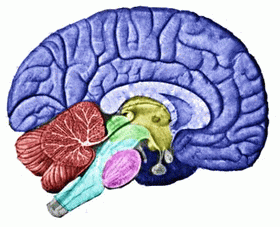
The human brain. A new brain model in which some parts control other parts, developed by Professor Asim Roy, could overcome some of the limitations faced by the more conventional connectionist brain model, and possibly open the doors to autonomous learning systems. Image credit: SW Ranson.
(PhysOrg.com) -- In the late '90s, Asim Roy, a professor of information systems at Arizona State University, began to write a paper on a new brain theory. Now, 10 years later and after several rejections and resubmissions, the paper “Connectionism, Controllers, and a Brain Theory” has finally been published in the November issue of IEEE Transactions on Systems, Man, and Cybernetics – Part A: Systems and Humans.
However, Roy’s controversial ideas on how the brain works and learns probably won’t immediately win over many of his colleagues, who have spent decades teaching robots and artificial intelligence (AI) systems how to think using the classic connectionist theory of the brain. Connectionists propose that the brain consists of an interacting network of neurons and cells, and that it solves problems based on how these components are connected. In this theory, there are no separate controllers for higher level brain functions, but all control is local and distributed fairly equally among all the parts.
In his paper, Roy argues for a controller theory of the brain. In this view, there are some parts of the brain that control other parts, making it a hierarchical system. In the controller theory, which fits with the so-called computational theory, the brain learns lots of rules and uses them in a top-down processing method to operate. In 1997, IBM’s Deep Blue computer, which famously defeated world chess champion Garry Kasparov, operated based on countless rules entered by its programmers.
Despite the success of the rule-based AI system in chess, no AI system has come close to learning and interacting with the world at the human level, using either the connectionist approach or the computational approach. Although the human brain may not serve as the best model for AI systems, a human-like machine should, by its very nature, be patterned after the human brain.
Brains without external babysitters
In his paper, Roy shows that the connectionist theory actually is controller-based, using a logical argument and neurological evidence. He explains that some of the simplest connectionist systems use controllers to execute operations, and, since more complex connectionist systems are based on simpler ones, these too use controllers. If Roy’s logic correctly describes how the brain functions, it could help AI researchers overcome some inherent limitations in connectionist algorithms.
“Connectionism can never create autonomous learning machines, and that’s where its flaw is,” Roy told PhysOrg.com. “Connectionism requires human babysitting of their learning algorithms, and that’s not very brain-like. We don’t guide and control the learning inside our head. Wish we could tweak our brain from outside, but we can’t.”
In his argument, Roy uses examples of a human using a TV remote control or driving a car to demonstrate a general controller-based system. In these systems, the human is the controller, whether changing the TV channels or accelerating the vehicle, while the TV and car are the subservient systems.
In response, connectionists have argued that such systems are not controller-based, but connectionist – or, more specifically, that these are feedback systems, where the components are codependent on each other. In the examples, the TV screen displays the show on that channel, which the human sees and decides whether or not to change the channel again. Or, the car’s speedometer registers 25 mph, which the driver sees and decides whether to accelerate or slow down. This feedback is essential for the human to act, connectionists argue, making the notion of a single controller in the system meaningless.
However, Roy’s response is that the controller doesn’t necessarily need feedback to control the TV or car. The human can act completely arbitrarily without feedback, such as by closing his eyes, and still continuing to change channels and press the accelerator. The key, Roy emphasizes, is that the controller has the ability to act in an arbitrary mode.
Self-supervision
He then examines a simple connectionist learning method called the back-propagation algorithm. This method consists of an interconnected network (for example, of neurons) but also uses an external supervisor when the network makes an error. The supervisor determines which neurons made the error, and then these neurons alter their inputs in an attempt to reduce the system error and come closer to the desired output.
In this algorithm, connectionists see the supervisory abilities as distributed throughout the entire learning system, since the system uses a feed-forward approach to respond to an error in a pre-defined way. But Roy argues that there is a distinct supervisor that has the ability to act in an arbitrary manner, completely neglecting the types of errors the network generates. Therefore, he sees the supervisor as the controller.
Roy acknowledges that only neuroscience – not information science – can determine if connectionist algorithms such as the back-propagation algorithm actually exist in the brain. But if they do, he says that they must rely on controllers.
He highlights evidence from a variety of neuroscience studies that support the existence of controllers in the brain. For example, past research has proposed the existence of control centers of the brain, such as the prefrontal portion of the cerebral cortex. Studies of dopamine and other neural transmitters, as well as the presence of “neurogenesis” (cell birth) in adults, are also compatible with a controller-based brain theory.
Roy clarifies that there is not necessarily a single executive controller in the brain, but rather that multiple distributed controllers could be responsible for different subsystems of the brain. After all, he says, if the connectionist theory is correct and the brain is a network of changing connections, there must be some control mechanism to determine how all those connections are made.
“The controller theory actually takes down a big chunk of connectionism, although not all of it,” Roy said. “The parallel computing idea, within a network of neurons, is still valid. But the controller theory allows one to design and train neural networks in a completely different way than connectionism. So it almost becomes a new science, and we are looking forward to a new generation of human-like learning algorithms.”
Resistance to a new science
Roy’s theory undermines the roots of connectionism, and that’s why his ideas have experienced a tremendous amount of resistance from the cognitive science community. For the past 15 years, Roy has engaged researchers in public debates, in which it’s usually him arguing against a dozen or so connectionist researchers. Roy says he wasn’t surprised at the resistance, though.
“I was attempting to take down their whole body of science,” he explained. “So I would probably have behaved the same way if I were in their shoes.”
One reason why it was so difficult for researchers to accept his theory is that, in cognitive science, terms are not always defined in a very strict way like in other sciences, he explained. He says he ran into many circular arguments with reviewers regarding his paper, and that’s why much of the paper is dedicated to defining what a controller is.
“It’s not that connectionism does not use controllers,” Roy says. “They do, but they use them at the level of individual neurons and call the whole thing as distributed control. And that kind of control is fine with them. They visualize each neuron as ‘deciding’ on its own how to adjust connection strengths during learning, but have a hard time accepting the notion that some neurons in the brain could be sending instructions to some other neurons and tell them what to do. That is, until I showed them that that is exactly what they are doing in their systems, and that there is also growing neuroscience evidence for signals coming from elsewhere in the brain.”
However, Roy’s controller theory may not be quite as at odds with some connectionist’s perspectives as he supposes. Psychology Professor James McClelland at Stanford University, whose early work Roy cites in his paper, thinks that modern connectionist thought allows for some controlling parts of the brain, though not to the extent as in Roy’s model.
“Roy appears to be using a quote from our 1986 book [see below] to mischaracterize our position,” McClelland said. “Work shortly after the publication of our 1986 book began to address the issue of cognitive control. I still favor the view that control is an emergent function of neural populations distributed over several brain areas, but there is no doubt that some parts of the system (most notably, left lateral inferior prefrontal cortex) play a special role in control. Roy's position appears more modular than ours, but I don't think there's anyone who disputes the idea that there are mechanisms that exert some degree of control over cognition.”
Neuroscientist Walter J. Freeman of the University of California at Berkeley also said that he agreed with the notion that there are controllers or guidance systems within the brain. Freeman, who has taught brain sciences at Berkeley since 1959, has developed a model of the brain’s intentional system. The model involves a control loop that predicts future states, future sensory input and future plans of action. The spatiotemporal pattern that implements this plan is transmitted by cortical neurons into the brain stem and spinal cord, using feedback from various parts of the brain. So guidance, control and monitoring of actions play an important part in Freeman’s model.
Autonomous learning machines
No matter exactly where or what the brain controllers are, Roy hopes that his theory will enable research on new kinds of learning algorithms. Currently, restrictions such as local and memoryless learning have limited AI designers, but these concepts are derived directly from that idea that control is local, not high-level. Possibly, a controller-based theory could lead to the development of truly autonomous learning systems, and a next generation of intelligent robots.
“The controller theory gives us much more freedom in creating brain-like learning systems,” he said. “The science is currently stuck, and we have not made any significant progress towards creating robots that can learn on their own like humans.”
The sentiment that the “science is stuck” is becoming common to AI researchers. In July 2007, the National Science Foundation (NSF) hosted a workshop on the “Future Challenges for the Science and Engineering of Learning.” The NSF’s summary of the “Open Questions in Both Biological and Machine Learning” [see below] from the workshop emphasizes the limitations in current approaches to machine learning, especially when compared with biological learners’ ability to learn autonomously under their own self-supervision:
“Virtually all current approaches to machine learning typically require a human supervisor to design the learning architecture, select the training examples, design the form of the representation of the training examples, choose the learning algorithm, set the learning parameters, decide when to stop learning, and choose the way in which the performance of the learning algorithm is evaluated. This strong dependence on human supervision is greatly retarding the development and ubiquitous deployment of autonomous artificial learning systems. Although we are beginning to understand some of the learning systems used by brains, many aspects of autonomous learning have not yet been identified.”
Roy sees the NSF’s call for a new science as an open door for a new theory, and he plans to work hard to ensure that his colleagues realize the potential of the controller model. Next April, he will present a four-hour workshop on autonomous machine learning, having been invited by the Program Committee of the International Joint Conference on Neural Networks (IJCNN).
“At this time, the plan is to show this community that it is feasible to construct machines that can learn on their own like humans,” he said. “I did a similar workshop last week at ANNIE (Artificial Neural Networks in Engineering), and I had people come up to me and say that they would like to automate their learning algorithms in a similar way. So, at this point, the focus is to build a worldwide team of researchers to collaborate on this new science and move aggressively towards building human-like robots (software and hardware) that can learn on their own. The applications of these systems would be limited only by imagination.”
More information: Roy, Asim. “Connectionism, Controllers, and a Brain Theory.” IEEE Transactions on Systems, Man, and Cybernetics – Part A: Systems and Humans, Vol. 38, No. 6, November 2008.
Rumelhart, D. E. and J. L. McClelland, Eds., Parallel Distributed Processing: Explorations in Microstructure of Cognition, vol. 1. Cambridge, MA: MIT Press, 1986, pp. 318–362.
NSF’s summary of the “Open Questions in Both Biological and Machine Learning” http://www.cnl.sal … eport.v4.pdf
ANNIE Conference Web site http://annie.mst.e … NIE2008.html
Copyright 2008 PhysOrg.com.
All rights reserved. This material may not be published, broadcast, rewritten or redistributed in whole or part without the express written permission of PhysOrg.com.
-
'Explorers,' who embrace the uncertainty of choices, use specific part of cortex
7 hours ago |
4.3 / 5 (3) |
0
-
Smartphone training helps people with memory impairment regain independence
7 hours ago |
not rated yet |
0
-
Four-week vaccination regimen knocks out early breast cancer tumors, researchers find
Jan 30, 2012 |
5 / 5 (4) |
0
-
Researchers identify mechanism behind associative memory by exploring insect brains
Jan 26, 2012 |
4.3 / 5 (6) |
4
-
New gene discovery provides clue to brain, eye and lymphatic development
Jan 26, 2012 |
5 / 5 (3) |
0
-
Engineers build first sub-10-nm carbon nanotube transistor
Feb 01, 2012 |
4.9 / 5 (30) |
30
-
Something old, something new: Evolution and the structural divergence of duplicate genes
Jan 31, 2012 |
4.6 / 5 (7) |
1
-
The hidden nanoworld of ice crystals: Revealing the dynamic behavior of quasi-liquid layers
Jan 30, 2012 |
5 / 5 (3) |
1
-
Stock market network reveals investor clustering
Jan 27, 2012 |
3.9 / 5 (23) |
8
-
Of microchemistry and molecules: Electronic microfluidic device synthesizes biocompatible probes
Jan 26, 2012 |
5 / 5 (1) |
0
-
Calling function with no input argument
3 hours ago
-
Force free body diagram problem on gym equipment
4 hours ago
-
Empirical data regarding shower heads and water
12 hours ago
-
feed hold button on CNC lathe
Feb 09, 2012
-
RFAC in Fortran
Feb 09, 2012
-
dynamics 2/32
Feb 08, 2012
- More from Physics Forums - General Engineering
More news stories
Review: Netflix and Hulu's new scripted originals
Within just over a week, Netflix and Hulu are both debuting their first stabs at original scripted programming.
1 hour ago |
not rated yet |
0
India probes Google over 'forex transactions'
Indian authorities are probing whether online giant Google broke domestic foreign-exchange transactions rules while shifting funds abroad, the Press Trust of India reported on Friday.
46 minutes ago |
not rated yet |
0
Germany freezes signing of disputed Internet pact
Germany on Friday halted the signing of a controversial international accord billed as a way to beat online piracy that has sparked angry protests, saying it needed more time to consider it.
57 minutes ago |
not rated yet |
0
Expat French get Internet vote for first time
French citizens will for the first time this year be able to vote in a parliamentary election over the Internet, an experiment that could be extended to other elections if successful.
7 minutes ago |
not rated yet |
0
New error-correcting codes guarantee the fastest possible rate of data transmission
Error-correcting codes are one of the triumphs of the digital age. Theyre a way of encoding information so that it can be transmitted across a communication channel such as an optical fiber o ...
Technology / Computer Sciences
6 hours ago |
5 / 5 (3) |
2
|
Hovering not hard if you're top-heavy, researchers find
Top-heavy structures are more likely to maintain their balance while hovering in the air than are those that bear a lower center of gravity, researchers at New York University's Courant Institute of Mathematical Sciences ...
Grass to gas: Researchers' genome map speeds biofuel development
Researchers at the University of Georgia have taken a major step in the ongoing effort to find sources of cleaner, renewable energy by mapping the genomes of two originator cells of Miscanthus x giganteus, a large perenn ...
Putting the squeeze on planets outside our solar system
(PhysOrg.com) -- Using high-powered lasers, scientists at Lawrence Livermore National Laboratory and collaborators discovered that molten magnesium silicate undergoes a phase change in the liquid state, abruptly ...
Researchers develop new method for creating tissue engineering scaffolds
Researchers at Northwestern University have developed a new method for creating scaffolds for tissue engineering applications, providing an alternative that is more flexible and less time-intensive than current technology.
Molecular profiling reveals differences between primary and recurrent ovarian cancers
There is a need to analyze tumor specimens at the time of ovarian cancer recurrence, according to a new study published in Molecular Cancer Therapeutics. Researchers used a diagnostic technology called molecular profiling to examine ...
C-sections linked to breathing problems in preterm infants
Research conducted at Yale School of Medicine shows that a cesarean (C-section) delivery, which was thought to be harmless, is associated with breathing problems in preterm babies who are small for gestational age.
Nov 19, 2008
Rank: 3.3 / 5 (7)
Nov 19, 2008
Rank: 2.9 / 5 (8)
Nov 19, 2008
Rank: 3.5 / 5 (4)
It seems he is just making these brute force algorithms more efficient - not fundamentally changing the strategy behind machine learning.
Nov 19, 2008
Rank: 3.8 / 5 (11)
This is a sordid state of affairs. I would have thought that the academia value and sought after knowledge, and eager to evaluate the strange, the different, and ultimately, the unknown. Not so. Apparently the top dogs who have tenures, reputation and standing are really tight arsed lot, much tighter than a gnat's anus, and will not allow upstarts who might offer something new to upset the prevailing order and their livelihood ! I think somebody said that the smartest ones on the planet are also more capable of more creative back-stabbing, viciousness and vanity than the rest of us has some truth it it.
They created the "peer review system" to cut the chaff...and more often, the throats of their perceived enemies!
Freedom of thought and expression of it are still an ideal on paper. The reality is, the alpha primate descendants of the species Homo Jealousus Academicus still screw you six ways to Sunday in the name and the game of knowledge!
Nov 19, 2008
Rank: 1.4 / 5 (8)
Absolutely not! And that is the reason Why the AI specialists would never understand nor present a final theory of our Human Mind (or Brain)!
Briefly and neurophysiologically, our Brain controls and regulates both our Consciousness (via the voluntary central nervous system) and the Subconscious or the Unconscious (via the autonomous neuro-endocrino-cardiac system). And our dreams (including wet-dreams) are all modulated by our biologically-unconscious hormonal, neural system -- a "wet" autonomous system that the AI specialists would never be able to emulate, simulate, and/or duplicate by and/or through the brightest theory of their "dry" algorithmic engineering!
For more indepth arguments on this very complex issue, please see my seminal book "Gods, Genes, Conscience" Chapter 15: The Universal Theory of Mind here: http://www.amazon...?ie=UTF8&s=books&qid=1226262931&sr=1-1 (Look Inside) especially Chapter 15.4: Memory Modulation and Recall: A new hypothesis of psychic imagery, perceptivity, creativity, and reflectivity (including how to evaluate and resolve all these very complicated life-mind issues, scientifically and spiritually).
Best wishes, Mong, author "Decoding Scientism" and "Consciousness & the Subconscious" (works in progress since July 2007), "Gods, Genes, Conscience" (2006: www.iuniverse.com...95379907 ) and "Gods, Genes, Conscience: Global Dialogues Now" (since 2006: http://www2.blogg...50569778 ).
Nov 19, 2008
Rank: 2.7 / 5 (6)
If we want an AI system to "spontaneously" learn, then it needs built-in motivation to do so - basically something it can recognize as a reward for doing so. After all, we wouldn't bother thinking about much unless it benefited us (although there does seem to be some thought that occurs, regardless of our desire to do so, which indicates some lack of control over the function).
An AI system will also seem less human-like, because if it is setup to receive the same input under the same conditions, it will have the same response. Humans each have uniqueness in how their systems are assembled, which means that they will perceive things differently. Also, we are prone to forgetfulness and cannot recall with complete clarity - this influences our future perceptions. So, unless we want to build in variability in design and imperfect access to information into these systems, they will never seem quite human.
Thoughts?
Nov 19, 2008
Rank: 2.5 / 5 (4)
Actually, depending on how you define it... Motivation is easy to achieve for a program. Having goals and creating cause effect ruleset based systems can be done by a first year computer science student.
You are more on the right path when you discuss the differences in the interpretation of data from unique humans. It is very hard to create computer programs that come up with a new theory on how the universe is evolving based on the same unrelated data points as given to a human.
The high level extrapolations and combinations that humans create to innovate has not been artificially replicated and cannot be brute forced. As silly as it sounds, if you think of the analogy of how many monkeys randomly typing in a room and for how long would type out Einstein's theory of relativity or Shakespeare etc. Then you would have a more correct understanding of what I mean by trying to brute force innovation. The more difficult the problem you are trying to solve and the more unrelated the data sets... the less applicable any current computing technique we have can produce a meaningful result, because they can't calculate and test every permutation, which I concede, is a dramatic oversimplification of the methods used today.
Nov 19, 2008
Rank: 3.6 / 5 (5)
Actually, I think this demonstrates exactly what this paper is suggesting. A controller in human minds creates the bias that "generally accepted" ideas are correct. People who suggest alternatives to the "generally accepted" methods are often castigated for doing so.
Slowly, we break through "generally accepted" theories (science has tremendously aided us here) but it takes time and lots of evidence!
I don't think it's coincidence that we have concepts that are thousands of years old that don't seem to have any real validity other than mass acceptance...
Nov 19, 2008
Rank: 1.2 / 5 (5)
What is that supposed to mean? Up until that last "throw-a-way line,"x646d63 and I were in accord, but now he/she strikes me as condescending. He/She needs to consider that before something tangible can be made/brought into existence there must first be a "concept." While I have no idea who x646d63 is, and I'm sure he's a fine person, my guess is that he/she is an engineer. As a class engineers have problems with things that they cannot maniuplate (weigh, measure, stretch,hammer, burn, etc.), believing there is a mechanical explanation for everything, therefore, missing all of the really important things in life. I have two conjectures. The first is that the mind is of the brain, but not in the brain. (It's an idea I stole from Mortimer Adler.) the second is that AI, ultimately, is a dead end. While its adherents will construct devices that are more and more clever, they will never fully explain, let alone replicate, the human mind. Or were he talking about Judeo/Christian Theology?
Nov 19, 2008
Rank: 2.3 / 5 (4)
I suspect that man will never be able to create conscious machinery..... And I doubt that his theory is correct even though it is probably a good stepping stone. We are too young as a civilization....
Nov 19, 2008
Rank: 3.4 / 5 (5)
It means that the model is the only thing they achieved as opposed to any real results which could stand for themselves!
It also means the authors think their model won't be able to defend itself.
So generally it looks like all their scientific work is useless and they simply try to hold to their positions by means of politics.
Who cares what model you are using, just make a better circuit.
Besides the whole dispute looks pointless as its pretty damn obvious there are controllers in the brain, after all brain evolved in stages and the older parts were naturally positioned to control the younger ones.
A rough example - unconscious house keeping circuit has top priority, then there are primal instincts which decide general goals like procreation or self preservation, then there's circuit which governs emotions - more subtle control and allows for better cooperation with other pack members, finally there's the youngest part which grants us higher cognitive abilities like speech, resoning and complex values, this one evolved to deal with our complex social environment.
Its obvious that those circuits are not on equal footing, for example when you panic, you are not able to reason clearly.
Brain is a very complex composition of various more or less specialized modules with equally complex hierarchy.
Nov 20, 2008
Rank: 1.3 / 5 (4)
Nov 20, 2008
Rank: 1 / 5 (10)
SEARCH LINKS:COSMOLOGY VEDAS INTERLINKS
1.Resource : Reflectors,3-Tier Consciousness, Source, Fields and Flows
2Noble Cause : Human-Being, Environment, Divine Nature and Harmony
The Physical Nature wobbles between two extremes unable to compromise with Nature's Function.
How does one search for Control ? Nature Leads the way
JNANINAH TATVA DARSINAH- DIVINE KNOWLEDGE INDEXES PHILOSOPHY IN NATURE
Frames of Minds: Human Being has various frames of Minds
1.Biological Frame
2.Philosophical Frame
3.Divine Frame
4.Nature Divine Frame
5.Cosmic Divine Frame
Today Minds are in conflicts due to Horse Nebulae.
One needs to maintain Cool Senses and search for Cosmic Index
Ten Log scale LIGHT YEARS constitutes the Universe
Reproduced from my BOOK-
HEART OF THE UNIVERSE-2007
CONCENTRATION, MEDITATION AND DEDICATION ARE THE KEYS FOR PROGRESS INDEX-
All Books - CONTACT AUTHOR- Copyright © Vidyardhi Nanduri
http://www.ebooko...?Aid=241
http://www.newciv...hp/_v162
Vidyardhi Nanduri
Nov 20, 2008
Rank: 1.4 / 5 (5)
Nov 20, 2008
Rank: 3.3 / 5 (3)
My "throw-away" comment does, in fact, refer to theology and mythology, but also to any other applicable belief systems (like the Big Bang and Global Warming.)
For thousands of years human societies have created, evolved, and ultimately discarded hundreds of theologies and mythologies. Many remain, and all modern ones are evolving with science.
I'm suggesting that part of the brain (a controller, perhaps) may cause us to give special importance to existing theories and concepts rather than allowing us to carefully and objectively analyze them. This would explain why people cling to belief systems even in the face of significant contrary evidence.
Nov 20, 2008
Rank: 2.6 / 5 (5)
Nov 21, 2008
Rank: 1.3 / 5 (3)
Hey buddy, thought is a complex conditional system. There's nothing that differentiates an IF Then statement from a thought process other than complexity.
Nov 22, 2008
Rank: not rated yet
Nov 24, 2008
Rank: not rated yet
It's hard to put it in words, but it makes sense keeping in mind that cells look much more versatile than we thought.
Nov 26, 2008
Rank: 2 / 5 (2)
Dec 19, 2008
Rank: 4 / 5 (1)
No doubt the ideas presented will still be challenged, but the challenges will be at a higher level.
Jan 14, 2009
Rank: 3 / 5 (2)
Sentience and thinking are 2 quite different things.
The etymology of the former is :
Latin sentient-, sentiens, present participle of sentire to perceive, feel
Clearly a non-thinking entity can possess the ability to perceive, including that of SELF-awareness.
Likewise, a thinking entity need not possess such perception, but only the ability to internally contemplate data.
Mar 04, 2009
Rank: 1 / 5 (1)