Track your fitness, environmental impact with new cell phone applications
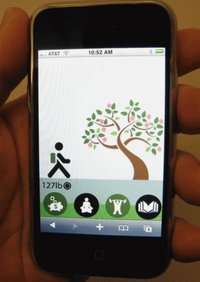
(PhysOrg.com) -- Planning on gobbling a few extra treats this holiday season? Soon, your cell phone may be able to help you maintain your exercise routine and keep the pounds off over winter months, without your having to lift a finger to keep track.
Researchers at the University of Washington and Intel have created two new cell phone applications, dubbed UbiFit and UbiGreen, to automatically track workouts and green transportation. The programs display motivational pictures on the phone's background screen that change the more the user works out or uses eco-friendly means of transportation.
The applications are designed to change people's behavior for the better, said Sunny Consolvo, a recently graduated UW Information School doctoral student and one of UbiFit's creators. In a three-month field experiment, people using UbiFit with the background display kept up their workout routines over the winter holidays, a period when people typically slack off on exercise, while people without the display let their regimen slide.
UbiFit and UbiGreen are part of a larger project at the UW to use mobile computing in everyday activities and long-term goals such as fitness, said project leader James Landay, UW computer science and engineering associate professor. "You can't get fit in a short period of time in one place," he said. "It happens long-term, in many different places and ways."
Current versions of UbiFit and UbiGreen use an external sensing device (the Intel Mobile Sensing Platform) clipped to the user's waist. The device includes an accelerometer to sense the user's movement. The programs could run on phones with built-in accelerometers, such as the iPhone and the new Android G1, with no need for external equipment, Landay said. UbiGreen also relies on changing cell phone tower signals to determine whether a person is taking a trip.
The sensing device determines what the user is doing based on how it gets jiggled around, Landay said -- the localized motion at your waist will be different if you're walking, jogging, or sitting in a car. The sensing device sends signals three times per second via Bluetooth to the cell phone, where the application averages these rapid signals and translates them into, for example, a 20-minute jog or a drive to work.
UbiFit displays an empty lawn at the beginning of the week, and flowers grow as the user works out during the week. Different kinds of workouts yield different colored flowers. Users set weekly workout goals and are rewarded with a butterfly when the goal is met. Users can also enter workout information manually if the sensor made a mistake, they forgot to wear it, or they did an activity that the sensor does not detect.
This background display proved motivational, said Consolvo, who is a researcher at Intel Research Seattle. She ran a field study from November 2007 through January 2008, with 28 participants. The results were presented at the UbiComp conference in Seoul in September. In her study, participants using the UbiFit background screen maintained their workout activity through the holiday months, while people using a version of UbiFit without the display let their workouts slide.
"The background display was definitely one of the biggest wins of our study," Consolvo said.
The design of UbiGreen was inspired by UbiFit, Landay said. The project was presented Nov. 18 at the Behavior, Energy and Climate Change conference in Sacramento, Calif.
UbiGreen automatically logs a trip that involves walking, running or biking using accelerometer data, and uses cell phone tower signals to determine if someone is riding in a vehicle. A quick survey pops up at the end of the trip and the user chooses car, carpool, bus or train. Eventually, the application could be programmed to glean almost all this information just from the accelerometer, Landay said, because the movements of cars, buses and trains are very different from each other.
UbiGreen displays a tree on the cell phone's background that grows leaves, flowers, then fruit as the user makes green choices. Icons light up when a choice saves money, incorporates exercise, or allows the user to multi-task. A green bar and number also display how many pounds of carbon dioxide each trip saves compared to a car ride.
UbiFit and UbiGreen could be released to the public within the next year or two, Landay said, especially as phones with built-in accelerometers become more common.
"The last 30 years of personal computing has been in support of people sitting at their desks," Landay said, "but the next wave will be these little computers that are with us all the time and have an understanding of our context in the physical world."
Learn more about UbiFit at dub.washington.edu/projects/ubifit and UbiGreen at dub.washington.edu/projects/ubigreen .
Provided by University of Washington


