Rare publishing achievement for student provides new insights into the fossil record of whales
November 19th, 2008 Rare publishing achievement for student provides new insights into the fossil record of whales

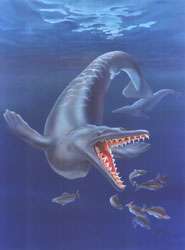
Life restoration of the ancient whale Dorudon atrox that lived about 40 million years ago. Photo by © Darryl Leja

It is extremely unusual for a student to have their work accepted for publication in a prestigious scientific journal. However, Felix Marx, a fourth year student in the Department of Earth Sciences at the University of Bristol has just published his first paper in the Proceedings of the Royal Society, a journal of international significance. Felix studied the quality of the fossil record of whales as part of his third year project. The work was so original and revealing that he was encouraged to publish it.

The new work is part of a debate about the quality of the fossil record. For example, when rocks are exposed, lots of fossils are found, but where rock of a certain period is missing, fossils appear to be absent in the record. Palaeontologists seek to correct for this ‘rock bias’ before carrying out evolutionary studies.

Felix looked at the fossil record of whales, seals and sea cows over the past 60 million years in Europe. In order to do this, he studied geological maps of Europe covering this time and measured the relative areas of rocks of different ages. He then compared these figures with the numbers of species of each marine mammal group.

“Previously it was thought that most of the changes in the number of species could be explained by geological bias,” says Felix, “but my results show that at least some of the changes were caused by genuine reactions of these animals to changes in their biological or physical environments. This was rather unexpected.”

Professor Michael Benton, head of the programme, commented: “Students carry out a quantitative study as part of their training, but they do not normally publish the results. Felix is enthusiastic about fossil whales and other marine mammals and he did some work that has real originality.”

The new findings also mean that the hunt is now on to discover the environmental factors driving the evolution of marine mammal. One of the things that may help understand this was an observation made by Felix that the number of whale and seal species rose and fell almost at the same time, whereas that of sea cows seemed to follow a rather different pattern. These differences may actually reflect their rather different ecological strategies.

“Many whale and seal species are quite similar in a number of ways. They are found all around the world in both the open ocean and close to the coast, they are predators and many of them migrate. By contrast, sea cows are usually plant eaters, prefer shallower waters and are usually found in the tropics,” explains Felix.

More research is necessary to find out whether this idea is correct and, if so, exactly which environmental factors drove these three groups along their different evolutionary paths. Felix is optimistic: “It will take a while to do this, but I have some ideas”.

“The joint Geology-Biology programmes at Bristol have a strong reputation for attracting exceptional students,” says Professor Benton, “and we are keen to encourage them to excel in this way and make their mark at an international level.”

Felix’s paper, ‘Marine mammals through time - when less is more in studying palaeodiversity’ is published today (19 November) in Proceedings of the Royal Society, Series B.

Provided by University of Bristol


print this article email this article download pdf blog this article bookmark this article     Digg this Stumble it share on Facebook share on Reddit add to delicious save to Yahoo! bookmarks
4.3/5 after 9 votes

Rank Filter

Move the slider to adjust rank threshold, so that you can hide some of the comments.


Display comments: newest first

  • Mercury_01 - Nov 19, 2008
    • Rank: not rated yet
    The whales back then were much more terrifying. Perhaps we should throw our world leaders into the ocean to make them more benign.

November 19th, 2008 all stories
Other Sciences / Archaeology & Fossils

Comments: 1
Rank: 4.3/5 after 9 votes

  • Stumble this up

  • Digg this

  • Share it:
  • share on Facebook
  • share on MySpace
  • share on Slashdot
  • rss-newsfeed
  • share on Google
  • share on Reddit
  • add to delicious
  • save to Yahoo! bookmarks
  • share on Windows Live
  • Add to Mixx!
Rating: 4.3/5 after 9 votes


  • Physicists Demonstrate Quantum Memory with Matter Qubits
    Physicists Demonstrate Quantum Memory with Matter Qubits
    Physics / General Physics
    created Jul 03, 2009 | popularity 4.4 / 5 (17) | comments 1
  • 'Holey' Nanosheets for Wastewater Dye Removal
    Nanotechnology / Nanomaterials
    created Jul 01, 2009 | popularity 5 / 5 (5) | comments 1
  • Jellyfish Robot Swims Like its Biological Counterpart
    Jellyfish Robot Swims Like its Biological Counterpart
    Electronics / Robotics
    created Jun 26, 2009 | popularity 4.4 / 5 (8) | comments 1
  • Could Maxwell's Demon Exist in Nanoscale Systems?
    Could Maxwell's Demon Exist in Nanoscale Systems?
    Physics / General Physics
    created Jun 24, 2009 | popularity 4.4 / 5 (18) | comments 29
  • Living Safely with Robots, Beyond Asimov's Laws
    Living Safely with Robots, Beyond Asimov's Laws
    Electronics / Robotics
    created Jun 22, 2009 | popularity 4.6 / 5 (52) | comments 40
  • Other News

    Creation Museum president Ken A. Ham

    Paleontologists brought to tears, laughter by Creation Museum

    Other Sciences / Other

    created Jun 30, 2009 | popularity 4.3 / 5 (44) | comments 124

    For a group of paleontologists, a tour of the Creation Museum seemed like a great tongue-in-cheek way to cap off a serious conference.


    Mummified dinosaur skin yields up new secrets

    Mummified dinosaur skin yields up new secrets

    Other Sciences / Archaeology & Fossils

    created Jul 01, 2009 | popularity 4.7 / 5 (15) | comments 10

    (PhysOrg.com) -- Scientists from The University of Manchester have identified preserved organic molecules in the skin of a dinosaur that died around 66-million years ago.


    Liberal? Conservative? Stanford study says mental nudge can make voters flip-flop

    Liberal? Conservative? Stanford study says mental nudge can make voters flip-flop

    Other Sciences / Social Sciences

    created Jul 02, 2009 | popularity 3.8 / 5 (6) | comments 4

    (PhysOrg.com) -- No doubt you’ve worked hard for your success. But chances are you’ve also had some help and lucky breaks along the way.


    Probing Question: How do Ponzi Schemes work?

    Other Sciences / Economics

    created Jul 02, 2009 | popularity 5 / 5 (2) | comments 2

    Imagine the shock, the horror, and the sheer panic that would come with learning that the financial plan you’d sunk your life savings into was a sham, the financial experts you trusted were crooks, and all your money was ...


    Tourists enjoy a "Pineapple Tour" in Costa Rica

    Costa Rica tops happiness, 'green living' poll

    Other Sciences / Social Sciences

    created Jul 04, 2009 | popularity 3.5 / 5 (4) | comments 0

    Costa Rica is the happiest place on earth, and one of the most environmentally friendly, according to a new survey by a British non-governmental group.