Ultra-wideband radio rides a beam of light
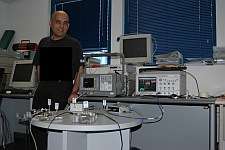
(PhysOrg.com) -- Multiple high-definition videos and other data-rich services may soon stream through homes, offices, ships and planes via new hybrid optical/ultra-wideband-radio systems developed by European researchers.
Moshe Ran, Coordinator of the EU-funded project, UROOF (Photonic components for Ultra-wideband Radio Over Optical Fiber), has a vision. He wants to see streams of high-definition video and other high-bandwidth services flowing through homes, office buildings, and even ships and planes, through a happy marriage of optical and ultra-wideband radio technologies.
“It’s a natural combination that can bring a lot of advantages to the world,” says Ran.
The wireless signals that feed your Bluetooth earbud or let you surf the web from the corner coffee shop fade into the electronic background after ten metres or so. Starting in mid-2006, UROOF researchers set out to find an inexpensive way to stretch that range to hundreds or thousands of metres.
The researchers envisioned a hybrid system, in which ultra-wideband (UWB) radio signals could be transformed into light beams, relayed over long distances via inexpensive optical fibres, and then transformed back to radio again.
“You can’t extend the range over the air,” says Ran. “So if you want to overcome the limitations of the short range, using optical fibre is a very elegant way of doing it.”
The UROOF researchers decided to focus on UWB signals because they can carry a lot of data – some 480 megabits per second, or 20 times faster than dsl.
UROOF technology has the potential to increase broadband capacity by two or three orders of magnitude while at the same time addressing health and safety concerns by reducing signal intensity by a comparable amount.
Fast and faster
The first device the UROOF team set out to build was an access node that would efficiently transform UWB to optical, and optical to UWB.
After trying a variety of approaches, the team homed in on silicon-germanium (SiGe) phototransistors, which currently can process 10 GHz signals, and have the potential to handle much higher bandwidths.
They coupled the SiGe phototransistors to new low-cost, off-the-shelf, vertical-cavity surface-emitting lasers (VCSELs). A VCSEL is a type of diode that emits a laser beam perpendicular to its top surface.
“Right now we are using a state-of-the-art VCSEL that was not available at the start of the project,” says Ran. “We’re using it to show that this technology is viable and available.”
The researchers found that the strength of a UWB signal changes markedly as a user moves toward or away from an antenna. As a result, they had to develop gain-control circuitry to stabilise the input signal.
They have now demonstrated an integrated transceiver, dubbed Access Node 1, at several international forums, most recently at the International Conference on Ultra-wideband, which met in Hanover, Germany in September.
“We showed that with Access Node 1 we can transmit three streams of 480 megabits per second on the same fibre with negligible distortion,” says Ran. “That’s enough to transmit at least three streams of compressed high-definition television.”
Access Node 1 costs less than its developers expected – under $100 (around €74) per unit. The UROOF team has also fabricated an even faster transceiver, not surprisingly called Access Node 2, which uses a different device, called an electroabsorbtion transceiver, or EAT, in which an optical signal is directly modulated by a radio signal.
The UROOF EAT system starts with a central laser that generates an unmodulated optical signal and sends it through a single optical fibre to remote units. In its downlink mode, the central unit receives a UWB radio signal, modulates the optical carrier, and beams it to the remote units. In the uplink mode, a remote EAT modulates the optical signal and sends it back to the central station.
The EAT based Access Node 2 has the potential to carry far more information than Access Node 1, but there is a catch. “With EAT you can approach 60 GHz,” says Ran, “but it is expensive.”
The UROOF team is actively working to increase the bandwidth of Access Node 2 and reduce its cost.
Ran is encouraged by the progress UROOF has made. They have shown that UWB signals can be beamed over hundreds of metres using inexpensive optical technology, with greater bandwidth and longer distances in sight.
“As ultra-wideband technology penetrates the mass market – within the next two years – it will be possible to manufacture an access node that will meet the demand very nicely,” says Ran.
The UROOF project received funding from ICT strand of the EU’s Sixth Framework Programme for research.
Provided by ICT Results


