Mysterious Source of High-Energy Cosmic Radiation Discovered
November 19, 2008 Mysterious Source of High-Energy Cosmic Radiation Discovered

Enlarge

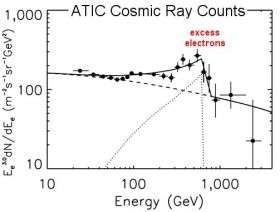
ATIC high-energy electron counts. The triangular curve fitted to the data comes from a model of dark-matter annihilation featuring a Kaluza-Klein particle of mass near 620 GeV. Details may be found in the Nov. 20, 2008, edition of Nature: "An excess of cosmic ray electrons at energies of 300-800 Gev," by J. Chang et al.

(PhysOrg.com) -- Scientists announced Wednesday the discovery of a previously unidentified nearby source of high-energy cosmic rays. The finding was made with a NASA-funded balloon-borne instrument high over Antarctica.

Researchers from the Advanced Thin Ionization Calorimeter (ATIC) collaboration, led by scientists at Louisiana State University, Baton Rouge, published the results in the Nov. 20 issue of the journal Nature. The new results show an unexpected surplus of cosmic ray electrons at very high energy -- 300-800 billion electron volts -- that must come from a previously unidentified source or from the annihilation of very exotic theoretical particles used to explain dark matter.

"This electron excess cannot be explained by the standard model of cosmic ray origin," said John P. Wefel, ATIC project principal investigator and a professor at Louisiana State. "There must be another source relatively near us that is producing these additional particles."

According to the research, this source would need to be within about 3,000 light years of the sun. It could be an exotic object such as a pulsar, mini-quasar, supernova remnant or an intermediate mass black hole.

"Cosmic ray electrons lose energy during their journey through the galaxy," said Jim Adams, ATIC research lead at NASA's Marshall Space Flight Center in Huntsville, Ala. "These losses increase with the energy of the electrons. At the energies measured by our instrument, these energy losses suppress the flow of particles from distant sources, which helps nearby sources stand out."

The scientists point out, however, that there are few such objects close to our solar system.

"These results may be the first indication of a very interesting object near our solar system waiting to be studied by other instruments," Wefel said.

An alternative explanation is that the surplus of high energy electrons might result from the annihilation of very exotic particles put forward to explain dark matter. In recent decades, scientists have learned that the kind of material making up the universe around us only accounts for about five percent of its mass composition. Close to 70 percent of the universe is composed of dark energy (so called because its nature is unknown). The remaining 25 percent of the mass acts gravitationally just like regular matter, but does little else, so it is normally not visible.

The nature of dark matter is not understood, but several theories that describe how gravity works at very small, quantum distances predict exotic particles that could be good dark matter candidates.

"The annihilation of these exotic particles with each other would produce normal particles such as electrons, positrons, protons and antiprotons that can be observed by scientists," said Eun-Suk Seo, ATIC lead at the University of Maryland, College Park.

The 4,300-pound ATIC experiment was designed to be carried to an altitude of about 124,000 feet above Antarctica using a helium-filled balloon about as large as the interior of the New Orleans Superdome. The goal was to study cosmic rays that otherwise would be absorbed into the atmosphere.

For information on NASA's scientific balloon program, visit: http://sites.wff.nasa.gov/code820/

Provided by NASA


print this article email this article download pdf blog this article bookmark this article     Stumble it Digg this share on Facebook retweet share on Reddit add to delicious
Rate this story - 4.3 /5 (44 votes)

Rank Filter

Move the slider to adjust rank threshold, so that you can hide some of the comments.


Display comments: newest first

  • JerryPark - Nov 19, 2008
    • Rank: 3 / 5 (2)
    "Mysterious Source of High-Energy Cosmic Radiation Discovered"

    So what, precisely, was discovered?

    The article poses questions and possible causes of observations. What was the discovery?
  • Graeme - Nov 19, 2008
    • Rank: 5 / 5 (4)
    What was discovered is the bump on the energy spectrum of electrons. The explanation or source of it was not discovered, so the heading is misleading. It looks as if there is more complexity in the spectrum of energy, so further study of this would be worthwhile. The decaying dark matter explanation sounds very dubious however!
  • JerryPark - Nov 19, 2008
    • Rank: 3.2 / 5 (5)
    "The decaying dark matter explanation sounds very dubious however!"

    Yes, but scientists seem to be desparate to find evidence of dark matter. Everything must be twisted to support the dark matter kludge.
  • Adam - Nov 19, 2008
    • Rank: 3.3 / 5 (4)
    Dark Matter isn't a "kludge". It's a finding forced on researchers by a luminosity deficit in clusters and galaxies BUT only if gravity works the way we presently understand it. Gravity might not, but it's worth investigating all avenues - like annihilating WIMPs as the new cosmic-ray data hints. We just don't have enough data to say either way thus ALL observations and theories are worth a look if they fit the data.
  • out7x - Nov 20, 2008
    • Rank: 2.6 / 5 (5)
    gravity does not explain the velocity of stars around the galaxy. Thus dark matter was invented.
  • holmstar - Nov 20, 2008
    • Rank: not rated yet
    gravity does not explain the velocity of stars around the galaxy. Thus dark matter was invented.


    Unless gravity acts differently over great distances. Perhaps gravity-wells the size of galaxies behave differently.

    Alternatively, I've never been entirely convinced that the missing mass is non-baryonic. Maybe it IS normal matter that just isn't visible for some reason.
  • D666 - Nov 20, 2008
    • Rank: not rated yet
    Unless gravity acts differently over great distances. Perhaps gravity-wells the size of galaxies behave differently.


    The point being that when current theories don't explain observations, scientists try to find a theory that does. I've never been able to understand the attitude of people who think that this is somehow nefarious. Would you rather that they just kept insisting on newtonian physics regardless of observations?
  • zevkirsh - Nov 20, 2008
    • Rank: not rated yet
    ive talked to a great and upcoming theoretical physicist named peter graham from standford and he says this is a big deal, so , apparently, this is a big deal.
    zeev
  • RTT - Nov 20, 2008
    • Rank: not rated yet
    "Alternatively, I've never been entirely convinced that the missing mass is non-baryonic. Maybe it IS normal matter that just isn't visible for some reason."

    You mean something like there is not enough light in the space between stars and such to reflect on the dust in space?
  • Zachrey - Nov 20, 2008
    • Rank: not rated yet
    Is the sensor they used to detect the electrons directional? Can they tell which direction the mysterious electrons came from?

    Thanks!
    Zac
  • denijane - Nov 25, 2008
    • Rank: not rated yet
    Back to my opinion that with expanding the detection band, we will discover many many more "bursts". Sure, the article implies that the source is in the solar system, but that's highly dependent-we already have seen TeV emissions from GRBs.
    And I cannot but laugh when I read the last part-I mean, "there are theories which predict...". There are theories which consider Man was created 5000 years ago! If you ask me, until the moment we see a proof quantum gravity works, it's simply not worth mentioning. "Sounds nice" is not like explain nicely.
    And there are actually much more simple theories that could solve many problems, on "general relativity" level. But let's see what will come out of them.

    http://tothefutur...post.com

November 19, 2008 all stories

Comments: 11

4.3 /5 (44 votes)
  • Stumble this up

  • Digg this

  • share this

  • hide
  • Related Stories

  • The Stars My Destination
    created Nov 10, 2009 | popularity not rated yet | comments 0
  • Fermi Telescope Detects Gamma-Ray From 'Star Factories' in Other Galaxies
    created Nov 02, 2009 | popularity not rated yet | comments 0
  • Starburst galaxy sheds light on longstanding cosmic mystery
    created Nov 02, 2009 | popularity not rated yet | comments 0
  • With stimulus aid, scientists hope to mimic nature's dynamos
    created Oct 09, 2009 | popularity not rated yet | comments 0
  • Heart of a galaxy emits gamma rays
    created Oct 02, 2009 | popularity not rated yet | comments 0


  • hide
  • Relevant PhysicsForums posts

  • Are Active Noise Control Stereo Possible?
    created 4 hours ago
  • New Supercomputer at Brown University
    created 14 hours ago
  • Difference between Magnus effect and Bernoulli
    created 17 hours ago
  • Equations
    created 20 hours ago
  • More from Physics Forums - General Physics

Other News

A view of a superconducting solenoid magnet at the European Organization for Nuclear Research (CERN) near Geneva

CERN atom-smasher restarts after 14-month hiatus: official

Physics / General Physics

created 10 hours ago | popularity 4.5 / 5 (11) | comments 0

The world's biggest atom-smasher, shut down after its inauguration in September 2008 amid technical faults, restarted on Friday, a spokesman for the European Organisation for Nuclear Research said.


Tapering a Free-Electron Laser to Extract More Juice

Tapering a Free-Electron Laser to Extract More Juice

Physics / General Physics

created 10 hours ago | popularity not rated yet | comments 0

(PhysOrg.com) -- Researchers from the NSLS and Science Applications International Corporation (SAIC) have demonstrated a technique that could be used to significantly improve the quantity and quality of light ...


Ultra-Powerful Laser Reproduces How Star's Jets Travel through Interstellar Space

Ultra-Powerful Laser Reproduces How Star's Jets Travel through Interstellar Space

Physics / General Physics

created 11 hours ago | popularity 4.2 / 5 (5) | comments 0

(PhysOrg.com) -- A multi-trillion-watt laser at the University of Rochester has simulated a stellar jet -- an outpouring of matter from a fledgling star -- with unprecedented realism.


The LHC promises to unlock scientific mysteries about the creation of the Universe and the fundamental nature of matter

Giant atom-smasher set to restart this weekend: CERN

Physics / General Physics

created 19 hours ago | popularity 4 / 5 (4) | comments 8

The world's biggest atom-smasher, which was shut down soon after its inauguration amid technical faults, is set to restart this weekend, the European Organisation for Nuclear Research said on Friday.


UCSB physicists move one step closer to quantum computing

UCSB physicists move one step closer to quantum computing

Physics / Quantum Physics

created 14 hours ago | popularity 5 / 5 (6) | comments 0

Physicists at UC Santa Barbara have made an important advance in electrically controlling quantum states of electrons, a step that could help in the development of quantum computing. The work is published ...