Where there's wildfire smoke, there's toxicity
November 20th, 2008 A Smoky Beach

Enlarge

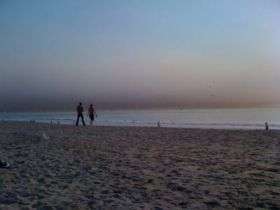
Smoke from wildfires on distant inland hills pours over the ocean at Venice Beach, Calif., Nov. 16. Credit: Viterbi School of Engineering

The health threat to city dwellers posed by Southern California wildfires like those of November 2008 may have been underestimated by officials.

Detailed particulate analysis of the smoke produced by previous California wild fires indicates that the composition posed more serious potential threats to health than is generally realized, according to a new paper analyzing particulate matter (PM) from wildfires in Southern California.

The paper, entitled "Physicochemical and Toxicological Profile of Particulate Matter (PM) in Los Angeles during the October 2007 Southern California Wildfires," will appear in Environmental Science and Technology. It confirms earlier studies by air polllution specialist Constantinos Sioutas of the USC Viterbi School of Engineering, who is also co-director of the Southern California Particle Center.

For the study Sioutas and colleagues from USC, the University of Wisconsin-Madison and RIVM (the National Institute of Health and the Environment of the Netherlands) analyzed the particular matter gathered during the fall 2007 blazes.

"Fire emissions produce a significantly larger aerosol in size than typically seen in urban environments during periods affected by traffic sources, which emit mostly ultrafine particles," Sioutas said.

"Staying indoors may not provide protection from smoke particles in the absence of air conditioning or the ability to recirculate filtered indoor air. This is because the fire particles can penetrate indoor structures more readily than particles from vehicular emissions."

According to Sioutas, the fires produce a dangerous mix. "The chemical composition of particles during the fire episodes is different than that during 'normal' days impacted by traffic sources.

"Tracers of biomass burning (e.g. potassium and levoglucosan) were elevated by two-fold during the fire periodm" he said. "Water-soluble organic carbon (WSOC) was also higher during the fire event. This makes these particles from wood smoke more bioavailable, thus more readily absorbable by our system than particulate matter from traffic sources."

The ability of the particulates to penetrate structures, even if windows are closed, and their potential ability to be absorbed by human tissues are a matter of concern. "More aggressive measures to avoid smoke seem to deserve study, including distribution of masks and evacuation to air conditioned environments, and closure of non-smoke secured schools," said Sioutas, who holds the school's Fred Champion Professorship of Civil and Environmental Engineering.

Source: University of Southern California


print this article email this article download pdf blog this article bookmark this article     Digg this Stumble it share on Facebook share on Reddit add to delicious save to Yahoo! bookmarks
2.5/5 after 2 votes

Rank Filter

Move the slider to adjust rank threshold, so that you can hide some of the comments.


Display comments: newest first


November 20th, 2008 all stories
Space & Earth / Environment

Comments: 1
Rank: 2.5/5 after 2 votes

  • Stumble this up

  • Digg this

  • Share it:
  • share on Facebook
  • share on MySpace
  • share on Slashdot
  • rss-newsfeed
  • share on Google
  • share on Reddit
  • add to delicious
  • save to Yahoo! bookmarks
  • share on Windows Live
  • Add to Mixx!
Rating: 2.5/5 after 2 votes


  • Physicists Demonstrate Quantum Memory with Matter Qubits
    Physicists Demonstrate Quantum Memory with Matter Qubits
    Physics / General Physics
    created Jul 03, 2009 | popularity 4.4 / 5 (17) | comments 1
  • 'Holey' Nanosheets for Wastewater Dye Removal
    Nanotechnology / Nanomaterials
    created Jul 01, 2009 | popularity 5 / 5 (5) | comments 1
  • Jellyfish Robot Swims Like its Biological Counterpart
    Jellyfish Robot Swims Like its Biological Counterpart
    Electronics / Robotics
    created Jun 26, 2009 | popularity 4.4 / 5 (8) | comments 1
  • Could Maxwell's Demon Exist in Nanoscale Systems?
    Could Maxwell's Demon Exist in Nanoscale Systems?
    Physics / General Physics
    created Jun 24, 2009 | popularity 4.4 / 5 (18) | comments 29
  • Living Safely with Robots, Beyond Asimov's Laws
    Living Safely with Robots, Beyond Asimov's Laws
    Electronics / Robotics
    created Jun 22, 2009 | popularity 4.6 / 5 (52) | comments 40
  • Other News

    Steam billows from the cooling towers at a nuclear power generating station in Byron

    Tropical zone expanding due to climate change: study

    Space & Earth / Earth Sciences

    created 1hour ago | popularity 5 / 5 (2) | comments 0

    Climate change is rapidly expanding the size of the world's tropical zone, threatening to bring disease and drought to heavily populated areas, an Australian study has found.


    US ambitions to send astronauts back to the moon as a prelude to missions to Mars have been put in doubt

    Forty years ago man first walked on the moon

    Space & Earth / Space Exploration

    created 22 hours ago | popularity 4.3 / 5 (4) | comments 2

    Forty years ago on July 20, 1969, American astronaut Neil Armstrong realized the oldest dream of human civilizations when he became the first man to walk on the moon.


    The least sea ice in 800 years

    The least sea ice in 800 years

    Space & Earth / Earth Sciences

    created Jul 01, 2009 | popularity 4.1 / 5 (64) | comments 60

    New research, which reconstructs the extent of ice in the sea between Greenland and Svalbard from the 13th century to the present indicates that there has never been so little sea ice as there is now. The ...


    Gas around young galaxy

    Intense heat killed the Universe's would-be galaxies, researchers say

    Space & Earth / Astronomy

    created Jul 01, 2009 | popularity 3.4 / 5 (21) | comments 27

    (PhysOrg.com) -- Our Milky Way galaxy only survived because it was already immersed in a large clump of dark matter which trapped gases inside it, scientists led by Durham University's Institute for Computational ...


    Scientists' Drill Hits Magma: Only Third Time on Record

    Scientists' Drill Hits Magma: Only Third Time on Record

    Space & Earth / Earth Sciences

    created Jun 29, 2009 | popularity 4.7 / 5 (22) | comments 21

    (PhysOrg.com) -- Scientists drilling a borehole deep into Iceland’s rocky crust to explore new methods of using geothermal energy hit a major roadblock on Thursday: Their drill ran into molten rock at a depth ...