Fountain of Youth to be found in the anthill?
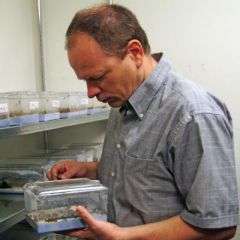
Aging – we are all doing it. It is relentless and terminal. Auguries and alchemists, mendicants and magicians, philosophers and science fiction writers, researchers and plastic surgeons have employed all their various arts in the pursuits of "turning back the clock." Yet, we stand in modern times with a span of a century to our name, at most.
Technological wizardry abounds, so why do the factors that determine life span still elude us?
If you ask Arizona State University researcher Juergen Liebig, he would point to his favorite study animal, the ant, to provide answers. Liebig is one of a trio of scientists who are taking an audacious approach to studying gene regulation, using the ant to model human aging, with support from a Howard Hughes Medical Institute (HHMI) $40 million pilot program, The Collaborative Innovation Awards.
As its name suggests, the award will allow scientists to attack problems that one person can't solve, according to Jack Dixon, HHMI vice president and chief scientific officer. "We were looking for projects that could really represent breakthroughs and change the way we think."
One of eight teams selected, Liebig, assistant professor in School of Life Sciences and member of the Center for Social Dynamics and Complexity in ASU's College of Liberal Arts and Sciences, will partner with team leader Danny Reinberg, a Howard Hughes Medical Institute investigator at the New York University School of Medicine, and colleague Shelley Berger of the Wistar Institute, both top researchers in the field of epigenetics.
The eight collaborative projects collectively engage 33 researchers and 16 institutions in the United States and Chile.
What can ants, not typically known for long life, tell us about human aging? Potentially much, says Liebig. Ants in a colony are genetically closely related, yet these sisters' body types, behavior and purpose can become specialized and vastly different. Queens typically arise as the single reproductive female in an ant colony, living for as long as 30 years in some species. As head of the colony they stay in the nest dedicated to perform one major task, egg-laying, for their whole life. Workers on the other hand perform brood care, colony maintenance, and complex foraging tasks. Among the workers additional behavioral and morphological differences may exist. Some individuals are larger and more robust with a focus on colony defense, which earned them the name soldiers. How can such big differences arise in each of these ant types' longevity and behavior without some real differences in their DNA?
According to Liebig and his collaborators, the answer can be found in the rising field of epigenetics – the study of inherited changes in the activity of genes - for example, when they turned on or off; changes not caused by alterations in the DNA sequence.
Epigenetic changes occur during normal development and tissue differentiation, and correlate with certain disease states in humans, such as cancer. "But, little is known about the molecular basis for epigenetic changes that underlie aging or behavior," Liebig says. "One advantage of using ants as models is that as individuals they follow very different behavioral and developmental trajectories, and these changes are plastic."
It is this behavioral and developmental plasticity that drew the collaborators to work together. Liebig studies three species of ants, each which allows the HHMI team to examine a different aspect of how epigenetic factors can influence outcomes in behavior, morphology, and longevity.
Harpegnathos saltator (literally meaning "jumping sickle jaw") is a primitive species of ant where workers are able to perform either reproductive or helper tasks. A worker can become a reproductive functional queen, if the original queen dies or is removed. Such a trait is not found in "higher" order ants because these species have become structurally specialized. Carpenter ants, Camponotus floridanus, allow Liebig, Reinberg and Berger to examine what epigenetic factors or genes control longevity. Queens in this species are structurally specialized, growing large and also long-lived. Finally, using ants from the genus Pheidole, whose soldier caste development can be artificially induced, allows the researchers to closely examine (and potentially manipulate) what genes are expressed or repressed, and identify the factors regulating structural specialization and behavior.
The first task for the collaborative team will be to get the complete sequences of the genomes for these three ant species. Reinberg is currently identifying partners specialized to do this task. Then the group will examine the gene expression profiles of the different castes (worker, queen, soldier).
"This collaboration is fortuitous," says Liebig. "Danny and Shelley were looking for a model system to study epigenetic factors of differences in ant behavior and development. They contacted my colleague Bert Hölldobler, who knew I was looking for geneticists interested in differential gene expression in behavior, aging, and development in ants."
Hölldobler is the Pulitzer Prize winning coauthor of "The Ants," and leading expert in ant communication and social organization.
Liebig notes that the project is risky. For example, the complete sequence of the ant genome has never been achieved before.
"Often potential research partners are reluctant to cross barriers in scientific specialties and there is not funding for such risky ventures when there is interest to do them," Liebig says. "The beauty of this project is that the HHMI Collaborative Innovation Awards create the opportunity for us to blend our skills to develop a new approach and model system for the study of behavior and aging."
Arizona State University has become the world leader in the study of social insects, and study of their levels of organization from organism to society, according to luminary Edward O. Wilson. Liebig believes that the study of social insects and using them as models for human systems has the potential to transform understanding about aging, sociobiology, neurobiology, learning and memory and behavior.
Liebig believes his collaborators on the HHMI project would agree. "Social insect societies are remarkable in that their specialization extends beyond the organism level, to function at the level of the 'superorganism,'" Liebig notes. "In that way, the division of labor seen between reproductive and non-reproductive individuals is analogous to cellular specialization in different organs in a multicellular organism. The prediction is that epigenetic regulation may determine behavioural castes in ant colonies."
"Who knows? Separating these effects may even give us the tools and understanding to look at what regulates longevity in humans," Liebig adds.
Source: Arizona State University


