Surgeons perform world's first pediatric robotic bladder reconstruction
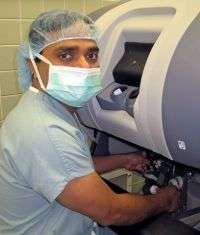
A 10-year-old Chicago girl born with an abnormally small bladder that made her incontinent has become the first patient to benefit from a new robotic-assisted bladder-reconstruction method developed by surgeons at the University of Chicago Medical Center.
The surgeons describe their innovative technique in the December 2008 issue of the journal Urology. They have now performed the operation, using the DaVinci robotic surgical system, six times, with good results and no significant complications.
The first patient, treated Feb. 21, 2008, suffered from a very small, spasmodic bladder, a birth defect that led to gradual kidney damage and loss of urinary control.
"We refer to this condition as neurogenic bladder," said team leader Mohan S. Gundeti, MD, assistant professor of surgery and chief of pediatric urology at the University of Chicago's Comer Children's Hospital. "Her bladder could barely hold six ounces. Worse, it produced frequent involuntary contractions, which forced the urine back up into the kidneys, where it slowly but inevitably causes damage, including frequent infections."
The girl always felt that she urgently had to go to the bathroom. She stopped drinking juice or soda. She even cut back on water, to less than two cups a day. Medication helped a little, but despite two years of trying different treatments, the problem continued to get worse and began to cause kidney damage, which made surgery necessary.
Although Gundeti had performed the operation to enlarge and relax a tiny spasmodic bladder many times, it had never been done robotically--an approach that has produced quicker recovery, less pain and minimal scars in other procedures.
"This is a major, lengthy operation," he said, "essentially five smaller procedures done in sequence."
Known as an augmentation ileocystoplasty with Mitrofanoff appendicovesicostomy, the surgery normally begins with a big incision, about six inches long, from above the navel down to the pubic area, followed by placement of retractors to pull the stomach muscles out of the way.
"The robotic approach enabled us to avoid that entire incision, which causes significant post-operative pain, presents an infection risk and leaves a big scar," Gundeti said.
Instead, the robotic tools enter the abdomen through five small, dime-sized holes. In this operation, the surgeons use about 12 inches of intestine to reconstruct a larger bladder, "more than twice the original size," said Gundeti. "Plus, it can no longer contract with the same force."
Then they converted the appendix into a "continent conduit," a drain for the new, expanded bladder, with one end implanted into the wall of the bladder and the other end leading outside the body through small outlet in the lower abdomen. A skin flap covers the fleshy appendix opening.
"No one had ever done the full operation this way," Gundeti said. "It requires a lot of familiarity with both the open operation and considerable laparoscopic experience."
This first case took about ten hours, compared to six-to-eight hours for an open procedure. The team included Gundeti and adult urologists Arieh Shalhav and Gregory Zagaja, as well as follows, residents and the nursing team. The team was able to reduce OR time in the subsequent cases.
After such a long, complicated operation, "I expected my daughter to be covered with bandages and gauze and tape, to have a big swollen belly with a big wound," the patient's mother recalled. "But there was none of that. I was stunned. Her belly was flat and normal, no bandages, not even a band-aid, just a few little cuts that looked like they had been covered with glue. Oh, I thought, she's going to like this. No big scars. She could wear a bikini."
"I would not want her to wear a bikini," she added, "but she could."
"Patients like surgery without significant scars," Gundeti said. "We also hope to show that in addition to the benefit of no big wound to heal, just five small punctures, there is less risk of infection, quick recovery and less pain."
Pain management for this case consisted of oral medications, rather than the traditional morphine and epidural anesthesia, which is contraindicated in young patients who have had previous spine surgery.
The patient started drinking clear liquids six hours after surgery and eating within 24 hours, which she "greatly appreciated," Gundeti said. She went home about four days after her surgery and within six weeks was completely continent, day and night. "This is a great benefit for the child and her family," Gundeti said.
Although she still has empty her bladder with a regular catheter, it is now easier to do and is far more reliable at retaining urine.
"She hasn't had a leak since then," her mother said. "She can drink water, or juice, even soda. She's enjoying the freedom she never had."
Source: University of Chicago Medical Center


