Dell Talking About 80-Core Chip Processor
November 20, 2008 by John Messina weblog
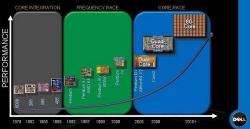
Dell slide shown Tuesday at SC08 (Credit: Dell Computer)

Dell slide shown Tuesday at SC08 (Credit: Dell Computer)

(PhysOrg.com) -- This week Michael Dell (CEO of Dell) gave a slide presentation that included Intelīs recently developed 80-core processor. This isn't the first time that the 80-core chip was mentioned in a conference.

Two years ago CEO of Intel, Paul Otellini, made a promise of delivering an 80-core processor within the next five years. He had also noted that the chips should be able to swap data at a terabyte a second (see video).


Video: Intel tests chip design with 80-core processor

This does not mean that future designs of the x86 chip is dead. We will continue to see more and more cores with increased performance and without more power required. The trend, for Intel, is to pack more computing power into smaller machines thereby creating desktop sized supercomputers.

Intel's intention is to continue to bring out many-core processors including its upcoming Larrabee graphics chip and future server processors that may reach 32 cores. Currently, Intelīs Dunnington processor gets the prize for the most cores.

Đ 2008 PhysOrg.com

4.2 /5 (43 votes)  

Filter


Move the slider to adjust rank threshold, so that you can hide some of the comments.


Display comments: newest first

ShadowRam
Nov 20, 2008

Rank: 2 / 5 (6)
This is not the direction to go.

Optimal solution = Main Core.. 2 or 3 cores..
and a Massive Parallel Co-processor..

(See nVidia CUDA)

If Intel goes this route.. AMD and ATI's merge to make a processor as I mentioned above will destory Intel...
gmurphy
Nov 20, 2008

Rank: 3.3 / 5 (4)
I program on cuda platforms, they're very powerful but very inflexible. Memory latency is huge so its better to do local computation where possible but the local cache for each multi processor is only 16kb. If intel can produce the goods, it would be very useful for developers, period.
GrayMouser
Nov 20, 2008

Rank: 2.3 / 5 (3)
Reminds me of the Transputer chip based systems.
And the Butterfly Machine. Of course, with the Butterfly Machine, they found out that the configuration of the processors (grid, hypercube, etc.) didn't make a lot of difference in the time it took to solve problems.
fleem
Nov 20, 2008

Rank: 2 / 5 (1)
Right about the memory latency. The vast majority of parallel applications need at least a little main memory accesses PER CORE. 80 cores will want a LOT of memory accesses, and they won't get them in the same chip. There are some apps that crunch for a long time on the same little bit of data, but not many.
Star_Gazer
Nov 20, 2008

Rank: 1 / 5 (1)
This is not the direction to go.

Optimal solution = Main Core.. 2 or 3 cores..
and a Massive Parallel Co-processor..

(See nVidia CUDA)

If Intel goes this route.. AMD and ATI's merge to make a processor as I mentioned above will destory Intel...


thats why Cell CPU in my PS3 uses 1 main core and 8SPEs
lengould100
Nov 21, 2008

Rank: 5 / 5 (1)
An 80 core cpu needs an OS which can dedicate assign specific groups of CPU to specific operating threads continuously, with each group having direct access to RAM and I/O. Interesting problem...
lengould100
Nov 21, 2008

Rank: not rated yet
Processors should be grouped into 20 groups of 1 to 3 processors (average 2). Remaining processors available to be assigned as helpers to any group which is working too hard. Each group gets its own on-chip cache and stacks. OS then asigns threads to groups according to priority.
lengould100
Nov 21, 2008

Rank: not rated yet
If the system had available guaranteed maximum access delays to disk and etc., then at least one of the groups should be capable of critical real-time control... sweet. Robots, auto automation, ... needs a coprocessor for analog and real-world interfaces...
thematrix606
Nov 21, 2008

Rank: not rated yet
Does this mean I will finally be able to get 30 fps in Crysis? Hardware will finally catch up games! Yay, about time :)
jonnyboy
Jan 24, 2009

Rank: not rated yet
An 80 core cpu needs an OS which can dedicate assign specific groups of CPU to specific operating threads continuously, with each group having direct access to RAM and I/O. Interesting problem...


which, of course, brings up the problem of controlling and coordinating all the different accesses to the memory.

Sounds like a slow death to me
Rank 4.2 /5 (43 votes)
Relevant PhysicsForums posts
  • to find power factor of the ac circuit given only the source and load voltages
    created1 hour ago
  • Charge Controllers
    created1 hour ago
  • Working of Pulse Input Speed Indicator
    created4 hours ago
  • Some questions about Radio signals.
    created5 hours ago
  • Simple railgun
    created7 hours ago
  • Need assistance building sound controlled LEDS
    created8 hours ago
  • More from Physics Forums - Electrical Engineering

More news stories

Google might launch Drive for cloud storage soon

(PhysOrg.com) -- Google's next big move, according to the Wall Street Journal, is a cloud storage service called Drive. Hardly first to the plate, Google is simply catching up to introducing its cloud reposi ...

Technology / Internet

created 19 hours ago | popularity 4.8 / 5 (5) | comments 5 | with audio podcast report

Iran blocks email, restricts net access: reports

Iran has further restricted access to the Internet and blocked popular email services for the past few days, in a move a top lawmaker said could "cost the regime dearly," media reports said on Sunday.

Technology / Internet

created 12 hours ago | popularity 5 / 5 (2) | comments 5

Walney offshore wind farm is world's biggest (for now)

(PhysOrg.com) -- The Walney wind farm on the Irish Sea--characterized by high tides, waves and windy weather--officially opened this week. The farm is treated in the press as a very big deal as the Walney ...

Technology / Energy & Green Tech

created Feb 11, 2012 | popularity 4.1 / 5 (14) | comments 59 | with audio podcast weblog

Navy to begin tests on electromagnetic railgun prototype launcher

The Office of Naval Research (ONR)'s Electromagnetic (EM) Railgun program will take an important step forward in the coming weeks when the first industry railgun prototype launcher is tested at a facility ...

Technology / Engineering

created Feb 06, 2012 | popularity 4.6 / 5 (20) | comments 95 | with audio podcast

New power source discovered

(PhysOrg.com) -- Researchers at the Massachusetts Institute of Technology (MIT) and RMIT University have made a breakthrough in energy storage and power generation.

Technology / Energy & Green Tech

created Feb 10, 2012 | popularity 4.6 / 5 (52) | comments 51 | with audio podcast


Scientists discover molecular secrets of 2,000-year-old Chinese herbal remedy

For roughly two thousand years, Chinese herbalists have treated Malaria using a root extract, commonly known as Chang Shan, from a type of hydrangea that grows in Tibet and Nepal. More recent studies suggest that halofuginone, ...

New method to examine batteries -- MRI from the inside

There is an ever-increasing need for advanced batteries for portable electronics, such as phones, cameras, and music players, but also to power electric vehicles and to facilitate the distribution and storage of energy derived ...

A mitosis mystery solved: How chromosomes align perfectly in a dividing cell

Although the process of mitotic cell division has been studied intensely for more than 50 years, Whitehead Institute researchers have only now solved the mystery of how cells correctly align their chromosomes during symmetric ...

Lab study raises questions over nano-particle impact

Tests involving chickens have raised questions about the impact on health from engineered nano-particles, the ultra-fine grains commonly used in drugs and processed foods, scientists said on Sunday.

Starve a virus, feed a cure? Findings show how some cells protect themselves against HIV

A protein that protects some of our immune cells from the most common and virulent form of HIV works by starving the virus of the molecular building blocks that it needs to replicate, according to research published online ...

Researchers find extensive RNA editing in human transcriptome

In a new study published online in Nature Biotechnology, researchers from BGI, the world's largest genomics organization, reported the evidence of extensive RNA editing in a human cell line by analysis of RNA-seq data, demons ...