Sea level rise alters bay's salinity
November 20, 2008
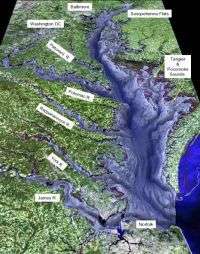
This is a map of the Chesapeake Bay estuary. Credit: NOAA
While global-warming-induced coastal flooding moves populations inland, the changes in sea level will affect the salinity of estuaries, which influences aquatic life, fishing and recreation.
Researchers from Penn State and the University of Maryland Center for Environmental Science are studying the Chesapeake Bay to see how changes in sea level may have affected the salinity of various parts of the estuary.
"Many have hypothesized that sea-level rise will lead to an increase in estuarine salinity, but the hypothesis has never been evaluated using observations or 3-D models of estuarine flow and salinity," says Timothy W. Hilton, graduate student in meteorology at Penn State.
"The Chesapeake is very large, the largest estuary in the U.S. and it is very productive," says Raymond Najjar, associate professor of meteorology. "It has been the site of many large fisheries and supported many fishermen. A lot of money has gone into cleaning up the bay and reducing nutrient and sediment inputs. Climate change might make this work easier, or it could make it harder."
The Chesapeake is naturally saltier near its mouth and fresher near the inflow of rivers. The researchers, who also included Ming Li and Liejun. Zhong of the University of Maryland Center for Environmental Science, studied the Chesapeake Bay, using two complementary approaches, one based on a statistical analysis of historical data and one based on a computer model of the bay's flow and salinity.
They looked at historical data for the Susquehanna River as it flows into the Chesapeake Bay from 1949 to 2006. The flow of this fresh water into the bay naturally changes salinity. After accounting for the change in salinity due to rivers, the researchers found an increasing trend in salinity. The researchers reported their results in a recent edition of Journal of Geophysical Research.
The team then ran a hydrodynamic model of the Bay using present-day and reduced sea level conditions. The salinity change they found was consistent with the trend determined from the statistical analysis, supporting the hypothesis that sea-level rise has significantly increased salinity in the Bay. However, the Penn State researchers note that historical salinity data is limited and sedimentation reshapes the bed of the Bay. There are also cyclical effects partially due to Potomac River flow, Atlantic Shelf salinity and winds.
"Salt content affects jelly fish, oysters, sea grasses and many other forms of aquatic life," says Hilton. "The Chesapeake Bay is a beautiful place, used for recreation and for people's livelihoods. It is a real jewel on the East Coast and changes in salinity can alter its uses. Our research improves our understanding of the influence of climate change on the Bay and can therefore be used to improve costly restoration strategies."
Source: Penn State


However in the body of the article it says, "The team then ran a hydrodynamic model of the Bay using present-day and reduced sea level conditions. The salinity change they found was consistent with the trend determined from the statistical analysis, supporting the hypothesis that sea-level rise has significantly increased salinity in the Bay. However, the Penn State researchers note that historical salinity data is limited and sedimentation reshapes the bed of the Bay. There are also cyclical effects partially due to Potomac River flow, Atlantic Shelf salinity and winds."
The last two sentences completely wipes out this shaky hypothesis based on admittedly flawed models, 1)Salinity records limited, 2) Changing sedimentation confounds models, 3)Flow changes in the Potomac also affect salinity. Even with the unknown salinity changes and differing sedimentation, the aquatic life is doing just fine.
2) How much has the land subsided in that area?
3) Are the any dams or canals upriver diverting water from the bay (much as it done in the SF bay)?
Dams & canals, yes; diverting from the bay, no.
Where in the article was such a claim asserted?
The term "global warming" refers to an alleged condition that has appeared very recently, does it not? Therefore the following statement refers to a recent contribution to sea level rise, does it not?:
"While global-warming-induced coastal flooding moves populations inland..."
http://www.telegr...?image=1
We should switch this one for global warming....
There is more data to indicate that global warming is not solely caused by "man made" emissions.... Could be methane, mooooo...
Most likely it is part of the natural cycle and the solar fusion model cant account it....
Nope; that won't do.
The article makes NO claim that the rate of change in the level of said bay is accelerating.
If you lived in the Chesapeake Bay watershed, or did a bit of research, you'd know that your quoted statement is false.
If this is the case, and global warming has not been constant over the past few decades, (which according to publications it has not), then the statement "While global-warming-induced coastal flooding moves populations inland, the changes in sea level will affect the salinity of estuaries, which influences aquatic life, fishing and recreation." is falsely linking global warming and sea rise in the Chesapeak bay area.
A more likely detriment to the wildlife is over-fishing, recreation, and industrial run off.
Moron writes a blow hard article showing that as flow is decreased in one direction diffusion accelerates in the other.
Moron Realizes no one cares.
Moron Adds the words "global warming induced".
Bigger Morons with deeper pockets fund further research.
Now everyone understands this link. I wonder if that works on post? Global warming induced bank account increases?
Well, fleem, mikiwud, MikeB, Xorays7, GrayMouser & Velanarris, since you all obviously take issue with my brief note, now's the time to substantiate your objections.
Do any of you actually KNOW anything about the health of said watershed?
No; it is linking changes in sea levels with changes in salinity. It makes no assertion, implied or otherwise, that global warming is either the sole cause of changes in sea level, or that it is the prevailing cause with respect to the Chesapeake.
You and your ilk need to get your pre-conceived notions out of your eyes so that you can read more clearly.
Deepsand, yes it does. Look at the article header. "While global-warming-induced coastal flooding moves populations inland, the changes in sea level will affect the salinity of estuaries, which influences aquatic life, fishing and recreation."
As for the situation in the Chesapeak watershed, yes I do know what's going on. Most of the problems involve poltion, and over fishing. Check the Chesapeak Bay Programs' sites. here are quite a few). The majority of them mention very little about salinity changes.
Translation: "Physorg editors, will you PLEASE stop publishing articles that conflict with my religious beliefs? My religious faith in global warming denialism shakes each time I have to read about what real scientists doing real science are learning about the consequences of human-induced global warming."
In the 1600s, when the bay was pristine, explorers marveled at its productivity. The clear waters revealed endless fields of underwater grasses that teemed with fish and crabs, and Capt. John Smith described oyster reefs so prodigious they posed a threat to navigation.
That abundance may never return, but there have been some remarkable achievements.
Thirty years after the bay was on the verge of collapse, rockfish are thriving. The decline of the bay's famed blue crabs has slowed, and biologists believe the crab population is poised to rebound. The amount of nitrogen dumped into the bay from sewage treatment plants fell from about 80 million pounds in 1985 to 63 million pounds in 2000."
Is it perfect? No. Has it improved? Yes, definitely. The American people have done a tremendous job fighting pollution, and we will continue that job if the money is not diverted on a quixotic war to lower the parts/million of a beneficial trace gas.
I am wondering if noein is short for "no einstein". This is not a putdown but only an honest question.
Looking forward to your response,
Mike
The nature of the bay is changing due to natural changes in the surrounding environment. The composition bay's plant and animal life will change to match the new environment.
Do you feel that everything has to stay the same as it was when you (or your father, or his father, etc.) were born? That is both unnatural and irrational.