Iowa State researchers to develop national energy/transportation model and plan
November 20, 2008
Planning Better Energy and Transporation Systems

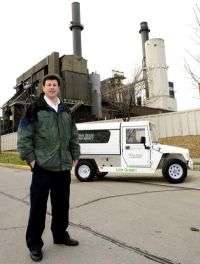
James McCalley, an Iowa State University professor of electrical and computer engineering, will lead a four-year, $1.98 million study of the country's energy and transportation infrastructure. The study will consider how new technologies, such as this electric vehicle, can best be mixed with elements of the existing power system, such as this coal-fired power plant, to produce cost-effective, sustainable and resilient energy and transportation systems. Photo by Bob Elbert/Iowa State University

You're starting with working equipment full of expensive parts. So you don't want to throw everything away and start over. You want to put together just the right combination of existing parts and new pieces to make the most cost-effective, sustainable and resilient machine possible.

In this case, the machine is the country's energy and transportation infrastructure.

McCalley, Iowa State University's Murray J. and Ruth Harpole Professor in Electrical and Computer Engineering, is leading a research team that will develop new and better infrastructure designs for the country's energy and transportation systems. They'll do that by developing computer models of the country's and the state's energy and transportation systems. They'll use the models to help develop a 40-year national plan to optimize those systems in terms of future power technologies, energy transport and storage, and hybrid power systems while balancing cost, sustainability and resiliency.

The project -- called "NETSCORE-21," "The 21st Century National Energy and Transportation Infrastructures Balancing Sustainability, Costs, and Resiliency Research Project" -- is supported by a four-year, $1.98 million grant from the National Science Foundation.

The project's research team will consider all of America's energy options, including biofuels, wind, hydro, tidal, geothermal, nuclear, coal, hydrogen, solar, biomass, natural gas and petroleum, together with new and old freight and passenger transportation technologies.

"Our intent is to say, 'We don't think there's a single silver bullet here,'" McCalley said. "We need all of these. What we need to decide is how much of each and when."

The Iowa State research team working to advance those decisions includes Arun Somani, Distinguished Professor, department chair and Jerry R. Junkins Chair in Electrical and Computer Engineering; Dionysios Aliprantis, an assistant professor of electrical and computer engineering; Lizhi Wang, an assistant professor of industrial and manufacturing systems engineering; Konstantina Gkritza, an assistant professor of civil, construction and environmental engineering; and Robert C. Brown, the Gary and Donna Hoover Chair in Mechanical Engineering, Anson Marston Distinguished Professor in Engineering and Iowa Farm Bureau director of Iowa State's Bioeconomy Institute. The project will also include more than 50 Iowa State students and 22 project advisors from across the country.

"We looked around and said, 'Who's looking at national energy and transportation infrastructures from a systematic view?'" McCalley said. "There are not many models out there."

The model created by the Iowa State researchers will highlight the growing interdependencies of the country's energy and transportation systems.

"The country's most heavy users of energy are the electric and transportation systems," McCalley said. "Now with hybrid-electric vehicles and hybrid-electric trains, these two historically independent energy systems are gradually coming together."

The NETSCORE-21 project is designed to help leaders understand the implications of the new technologies and new interdependencies.

McCalley said the research could provide Congress, the U.S. Department of Energy, the Environmental Protection Agency, industries and other decision makers with a national blueprint for better energy and transportation infrastructures. And that could help drive federal policy, research and investment over the next 40 years.

Source: Iowa State University


Rank 3 /5 (1 vote)
Relevant PhysicsForums posts
  • Calling function with no input argument
    created3 hours ago
  • Force free body diagram problem on gym equipment
    created4 hours ago
  • Empirical data regarding shower heads and water
    created12 hours ago
  • feed hold button on CNC lathe
    createdFeb 09, 2012
  • RFAC in Fortran
    createdFeb 09, 2012
  • dynamics 2/32
    createdFeb 08, 2012
  • More from Physics Forums - General Engineering

More news stories

Review: Netflix and Hulu's new scripted originals

Within just over a week, Netflix and Hulu are both debuting their first stabs at original scripted programming.

Technology / Business

created 1 hour ago | popularity not rated yet | comments 0

India probes Google over 'forex transactions'

Indian authorities are probing whether online giant Google broke domestic foreign-exchange transactions rules while shifting funds abroad, the Press Trust of India reported on Friday.

Technology / Internet

created 46 minutes ago | popularity not rated yet | comments 0

Germany freezes signing of disputed Internet pact

Germany on Friday halted the signing of a controversial international accord billed as a way to beat online piracy that has sparked angry protests, saying it needed more time to consider it.

Technology / Internet

created 57 minutes ago | popularity not rated yet | comments 0

Expat French get Internet vote for first time

French citizens will for the first time this year be able to vote in a parliamentary election over the Internet, an experiment that could be extended to other elections if successful.

Technology / Internet

created 7 minutes ago | popularity not rated yet | comments 0

New error-correcting codes guarantee the fastest possible rate of data transmission

Error-correcting codes are one of the triumphs of the digital age. They’re a way of encoding information so that it can be transmitted across a communication channel — such as an optical fiber o ...

Technology / Computer Sciences

created 6 hours ago | popularity 5 / 5 (3) | comments 2 | with audio podcast


Hovering not hard if you're top-heavy, researchers find

Top-heavy structures are more likely to maintain their balance while hovering in the air than are those that bear a lower center of gravity, researchers at New York University's Courant Institute of Mathematical Sciences ...

Grass to gas: Researchers' genome map speeds biofuel development

Researchers at the University of Georgia have taken a major step in the ongoing effort to find sources of cleaner, renewable energy by mapping the genomes of two originator cells of Miscanthus x giganteus, a large perenn ...

Putting the squeeze on planets outside our solar system

(PhysOrg.com) -- Using high-powered lasers, scientists at Lawrence Livermore National Laboratory and collaborators discovered that molten magnesium silicate undergoes a phase change in the liquid state, abruptly ...

Researchers develop new method for creating tissue engineering scaffolds

Researchers at Northwestern University have developed a new method for creating scaffolds for tissue engineering applications, providing an alternative that is more flexible and less time-intensive than current technology.

Molecular profiling reveals differences between primary and recurrent ovarian cancers

There is a need to analyze tumor specimens at the time of ovarian cancer recurrence, according to a new study published in Molecular Cancer Therapeutics. Researchers used a diagnostic technology called molecular profiling to examine ...

C-sections linked to breathing problems in preterm infants

Research conducted at Yale School of Medicine shows that a cesarean (C-section) delivery, which was thought to be harmless, is associated with breathing problems in preterm babies who are small for gestational age.