Discovery of giant roaming deep sea protist provides new perspective on animal evolution
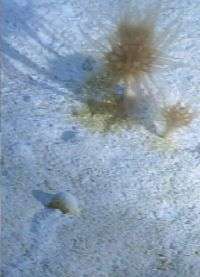
Groove-like tracks on the ocean floor made by giant deep-sea single-celled organisms could lead to new insights into the evolutionary origin of animals, says biologist Mikhail "Misha" Matz from The University of Texas at Austin.
Matz and his colleagues recently discovered the grape-sized protists and their complex tracks on the ocean floor near the Bahamas. This is the first time a single-celled organism has been shown to make such animal-like traces.
The finding is significant, because similar fossil grooves and furrows found from the Precambrian era, as early as 1.8 billion years ago, have always been attributed to early evolving multicellular animals.
"If our giant protists were alive 600 million years ago and the track was fossilized, a paleontologist unearthing it today would without a shade of doubt attribute it to a kind of large, multicellular, bilaterally symmetrical animal," says Matz, an assistant professor of integrative biology. "We now have to rethink the fossil record."
The team's discovery was published online today in Current Biology and will appear in a subsequent print issue.
Most animals, from humans to insects, are bilaterally symmetrical, meaning that they can be roughly divided into halves that are mirror images.
The bilateral animals, or "Bilateria," appeared in the fossil record in the early Cambrian about 542 million years ago, quickly diversifying into all of the major animal groups, or phyla, still alive today. This rapid diversification, known as the Cambrian explosion, puzzled Charles Darwin and remains one of the biggest questions in animal evolution to this day.
Very few fossils exist of organisms that could be the Precambrian ancestors of bilateral animals, and even those are highly controversial. Fossil traces are the most accepted evidence of the existence of these proto-animals.
"We used to think that it takes bilateral symmetry to move in one direction across the seafloor and thereby leave a track," explains Matz. "You have to have a belly and a backside and a front and back end. Now, we show that protists can leave traces of comparable complexity and with a very similar profile."
With their find, Matz and his colleagues argue that fossil traces cannot be used alone as evidence that multicellular animals were evolving during the Precambrian, slowly setting the stage for the Cambrian explosion.
"I personally think now that the whole Precambrian may have been exclusively the reign of protists," says Matz. "Our observations open up this possible way of interpreting the Precambrian fossil record."
He says the appearance of all the animal body plans during the Cambrian explosion might not just be an artifact of the fossil record. There are likely other mechanisms that explain the burst-like origin of diverse multicellular life forms.
DNA analysis confirmed that the giant protist found by Matz and his colleagues in the Bahamas is Gromia sphaerica, a species previously known only from the Arabian Sea.
They did not observe the giant protists in action, and Matz says they likely move very slowly. The sediments on the ocean floor at their particular location are very stable and there is no current—perfect conditions for the preservation of tracks.
Matz says the protists probably move by sending leg-like extensions, called pseudopodia, out of their cells in all directions. The pseudopodia then grab onto mud in one direction and the organism rolls that way, leaving a track.
He aims to return to the location in the future to observe their movement and investigate other tracks in the area.
Matz says the giant protists' bubble-like body design is probably one of the planet's oldest macroscopic body designs, which may have existed for 1.8 billion years.
"Our guys may be the ultimate living fossils of the macroscopic world," he says.
Source: University of Texas at Austin


