Deep blue research digs up evolutionary past
November 20, 2008 Deep blue research digs up evolutionary past

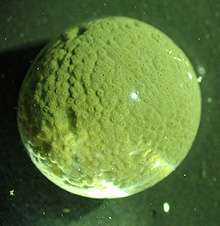
A giant protist, found off the coast of the Bahamas, which is shedding new light on the evolution of multi-cellular organisms.

(PhysOrg.com) -- University of Queensland deep sea research has dug up an insight into the evolutionary past of some of the earliest animals.

Professor Justin Marshall, from UQ's Queensland Brain Institute and School of Biomedical Sciences, was part of an international team who found grape-like balls – called giant protists – off the coast of the Bahamas that throw into doubt long-held views about the evolution of multi-cellular organisms.

“We saw these single-cell organisms leave tracks that are similar to tracks found in the fossil record which were believed to have been made by multi-cellular organisms,” Professor Marshall said.

“This is the first evidence that organisms other than multi-cellular animals can produce such traces.

“The discovery throws into doubt when people believe multi-cellular life began.”

The fossil record of tracks like these date back 1.8 billion years, way before the earliest fossil record of the animals themselves which are found in the early Cambrian period of around 542 million years ago.

Professor Marshall said the organisms, were spotted during a deep sea expedition last year, but it was only by chance the scientists knew they had stumbled upon something unique.

“The tracks they made were like long furrows in the sea floor,” he said.

“Initially we thought the tracks might have been made by the ocean currents, but we saw them roll themselves along the sea floor, even up hills.

“We recognised the tracks these animals had made as similar to those known only from the fossil records. One of us remembered a paleontological book cover he had seen.”

“It was just one of those things, as we were not there looking for this at all. It really just shows the nature of science how we can stumble upon these things.

He said the deep sea research involved colleagues from America and use of the Harbour Branch Oceanographic Institute in an expedition called “Deep Scope” to the depths off the Bahamas to 1km.

“This really shows the importance of going to places where people have not been before,” he said.

The research was recently published in the scientific journal Current Biology.

Link: http://www.cell.com/current-biology/home

Provided by University of Queensland


print this article email this article download pdf blog this article bookmark this article     Stumble it Digg this share on Facebook retweet share on Reddit add to delicious
Rate this story - 4.3 /5 (6 votes)


November 20, 2008 all stories

Comments: 0

4.3 /5 (6 votes)
  • Stumble this up

  • Digg this

  • share this

  • hide
  • Related Stories


Other News

Variable Temperatures Leave Insects wtih a Frosty Reception

Biology / Plants & Animals

created 9 hours ago | popularity not rated yet | comments 0

(PhysOrg.com) -- For the first time, scientists at The University of Western Ontario have shown that insects exposed to repeated periods of cold will trade reproduction for immediate survival.


When camouflage is a plant's best protection

Rare woodland plant uses 'cryptic coloration' to hide from predators

Biology / Plants & Animals

created 11 hours ago | popularity 4.3 / 5 (3) | comments 0

It is well known that some animal species use camouflage to hide from predators. Individuals that are able to blend in to their surroundings and avoid being eaten are able to survive longer, reproduce, and ...


Cells defend themselves from viruses, bacteria with armor of protein errors

Biology / Cell & Microbiology

created 13 hours ago | popularity 5 / 5 (7) | comments 0

When cells are confronted with an invading virus or bacteria or exposed to an irritating chemical, they protect themselves by going off their DNA recipe and inserting the wrong amino acid into new proteins to defend them ...


'Safety valve' protects photosynthesis from too much light

Biology / Cell & Microbiology

created 13 hours ago | popularity 4.7 / 5 (3) | comments 0

Photosynthetic organisms need to cope with a wide range of light intensities, which can change over timescales of seconds to minutes. Too much light can damage the photosynthetic machinery and cause cell death. Scientists ...


Researchers discover biological basis of 'bacterial immune system'

Biology / Cell & Microbiology

created 13 hours ago | popularity 4.7 / 5 (3) | comments 0

Bacteria don't have easy lives. In addition to mammalian immune systems that besiege the bugs, they have natural enemies called bacteriophages, viruses that kill half the bacteria on Earth every two days.