Hubble Resolves Puzzle about Loner Starburst Galaxy
November 20, 2008
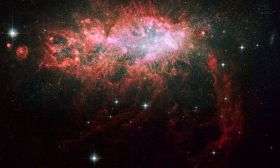
Starburst Galaxy NGC 1569

Enlarge

Starburst Galaxy NGC 1569. Image Credit: NASA, ESA, the Hubble Heritage Team (STScI/AURA), and A. Aloisi (STScI/ESA)

(PhysOrg.com) -- Astronomers have long puzzled over why a small, nearby, isolated galaxy is pumping out new stars faster than any galaxy in our local neighborhood.

Now NASA's Hubble Space Telescope has helped astronomers solve the mystery of the loner starburst galaxy, called NGC 1569, by showing that it is one and a half times farther away than astronomers thought.

The extra distance places the galaxy in the middle of a group of about 10 galaxies centered on the spiral galaxy IC 342. Gravitational interactions among the group's galaxies may be compressing gas in NGC 1569 and igniting the star-birthing frenzy.

"Now the starburst activity seen in NGC 1569 makes sense, because the galaxy is probably interacting with other galaxies in the group," said the study's leader, Alessandra Aloisi of the Space Telescope Science Institute in Baltimore, Md., and the European Space Agency. "Those interactions are probably fueling the star birth."

The farther distance not only means that the galaxy is intrinsically brighter, but also that it is producing stars two times faster than first thought. The galaxy is forming stars at a rate more than 100 times higher than the rate in the Milky Way. This high star-formation rate has been almost continuous for the past 100 million years.

Discovered by William Herschel in 1788, NGC 1569 is home to three of the most massive star clusters ever discovered in the local universe. Each cluster contains more than a million stars.

"This is a prime example of the type of massive starbursts that drive the evolution of galaxies in the distant and young universe," said team member Roeland van der Marel of the Space Telescope Science Institute. "Starburst galaxies can only be studied in detail in the nearby universe, where they are much rarer. Hubble observations of our galactic neighborhood, including this study, are helping astronomers put together a complete picture of the galaxies in our local universe. Put the puzzle pieces in the right place, as for NGC 1569, and the picture makes much more sense."

Aloisi and her team actually discovered the new distance by accident. They were using Hubble's Advanced Camera for Surveys to hunt in NGC 1569 for the kind of red giant stars (stars near the ends of their lives) that shine because of fusion of helium nuclei in their cores. These stars are dimmer than bright red giants without helium burning, but when detected, they can be used to estimate the galaxy's age.

"When we found no obvious trace of them, we suspected that the galaxy was farther away than originally believed," said Aaron Grocholski of the Space Telescope Science Institute and the lead author on a paper describing the results. "We could only see the brightest red giant stars, but we were able to use these stars to recalibrate the galaxy's distance." Bright red giants are reliable "standard candles" for measuring distance because they all shine at the same brightness. Once astronomers know a star's true brightness, they can calculate its distance from Earth.

Previous estimates of the galaxy's distance made with ground-based telescopes were unreliable because they looked at the galaxy's crowded core and were unable to resolve individual red giant stars.

The Hubble study observed both the galaxy's cluttered core and its sparsely populated outer fringes. The sharpness of Hubble's Advanced Camera pinpointed individual red giants, which led to a precise distance to the galaxy. Astronomers measured the galaxy's distance at nearly 11 million light-years away, about 4 million light-years farther than the old distance.

"This was a serendipitous discovery," Aloisi said. "Hubble didn't go deep enough to see the faintest red giant stars we were hunting for because the galaxy is farther away than we thought. However, by capturing the entire population of the brightest red giant stars, we were able to calculate a precise distance to NGC 1569 and resolve the puzzle about the galaxy's extreme starburst activity."

The results were published in the Oct. 20 issue of the Astrophysical Journal Letters.

Provided by Hubble Center

4.5 /5 (22 votes)  

Filter


Move the slider to adjust rank threshold, so that you can hide some of the comments.


Display comments: newest first

earls
Nov 20, 2008

Rank: 1 / 5 (6)
Look for an influx of electrical current. It's like a collision in a particle accelerator.
yyz
Nov 22, 2008

Rank: 3 / 5 (2)
" A New Hubble Space Telescope Distance to NGC 1569:Starburst Properties and IC 342 Group Membership" by Grocholski, AJ et al. was submitted to Astrophysical Journal Letters(ApJL) in July, 2008. This short paper discusses the findings mentioned in the above article and should be available to interested readers through a Google search. A highly recommended, short, simple explanation of these new HST-ACS observations of this remarkable starburst system. The HST images are icing on the cake!
Rank 4.5 /5 (22 votes)
Related Stories
Relevant PhysicsForums posts
  • Titan's lack of impact craters
    created15 hours ago
  • Real pictures of black hole eating a star?
    createdFeb 08, 2012
  • Hypothetical way to travel faster than light, but not technically exceed lightspeed
    createdFeb 06, 2012
  • How do scientists monitor the Sun's activity?
    createdFeb 05, 2012
  • Search patterns in observational studies
    createdFeb 05, 2012
  • Derivation of Pogson's law
    createdFeb 03, 2012
  • More from Physics Forums - General Astronomy

More news stories

Deconstructing a mystery: What caused Snowmaggedon?

In the quiet after the storms, streets and cars had all but disappeared under piles of snow. The U.S. Postal Service suspended service for the first time in 30 years. Snow plows struggled to push the evidence ...

Space & Earth / Earth Sciences

created 10 hours ago | popularity 4.7 / 5 (3) | comments 1 | with audio podcast

New views show old NASA Mars landers

(PhysOrg.com) -- The High Resolution Imaging Science Experiment (HiRISE) camera on NASA's Mars Reconnaissance Orbiter recorded a scene on Jan. 29, 2012, that includes the first color image from orbit showing ...

Space & Earth / Space Exploration

created 18 hours ago | popularity 4.9 / 5 (7) | comments 7 | with audio podcast

Researchers create 3-D laser maps that show how earthquake changes landscape

Geologists have a new tool to study how earthquakes change the landscape down to a few inches, and it's giving them insight into how earthquake faults behave. In the Feb. 10 issue of the journal Science, a team ...

Space & Earth / Earth Sciences

created 12 hours ago | popularity 5 / 5 (4) | comments 0 | with audio podcast

Ocean microbe communities changing, but long-term environmental impact is unclear

As oceans warm due to climate change, water layers will mix less and affect the microbes and plankton that pump carbon out of the atmosphere – but researchers say it's still unclear whether these processes ...

Space & Earth / Earth Sciences

created 12 hours ago | popularity 5 / 5 (2) | comments 2 | with audio podcast

Black holes and star formation

(PhysOrg.com) -- It has long been recognized that galaxy mergers or even close interactions can play a vital role in shaping the morphology of galaxies. One way they can do so, it is thought, is by triggering ...

Space & Earth / Astronomy

created 17 hours ago | popularity 4.1 / 5 (7) | comments 5 | with audio podcast


'Dark plasmons' transmit energy

Microscopic channels of gold nanoparticles have the ability to transmit electromagnetic energy that starts as light and propagates via "dark plasmons," according to researchers at Rice University.

FDA-approved drug rapidly clears amyloid from the brain, reverses Alzheimer's symptoms in mice

Neuroscientists at Case Western Reserve University School of Medicine have made a dramatic breakthrough in their efforts to find a cure for Alzheimer's disease. The researchers' findings, published in the journal Science, show t ...

Hydrogen from acidic water: Researchers develop potential low cost alternative to platinum for splitting water

A technique for creating a new molecule that structurally and chemically replicates the active part of the widely used industrial catalyst molybdenite has been developed by researchers with the Lawrence Berkeley ...

Ultraviolet protection molecule in plants yields its secrets

Lying around in the sun all day is hazardous not just for humans but also for plants, which have no means of escape. Ultraviolet (UV) radiation from the sun can damage proteins and DNA inside cells, leading ...

Anyone can learn to be more inventive, cognitive researcher says

There will always be a wild and unpredictable quality to creativity and invention, says Anthony McCaffrey, a cognitive psychology researcher at the University of Massachusetts Amherst, because an "Aha moment" is rare and ...

Soraa LED light may dim 50-watt halogen rivals

(PhysOrg.com) -- Soraa, a Fremont, California company founded in 2008, this week launched its first product, a light that uses LEDS (light emitting diodes). The "Soraa LED MR16 lamp" is the "perfect" replacement ...