Mars Express observes aurorae on the red planet
November 21, 2008
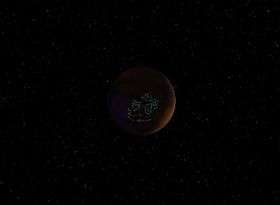
An artist's impression of how the 'green' aurorae may look to an observer orbiting on the night-side of Mars. Credits: M. Holmström (IRF)
(PhysOrg.com) -- Scientists using ESA's Mars Express have produced the first crude map of aurorae on Mars. These displays of ultraviolet light appear to be located close to the residual magnetic fields generated by Mars's crustal rocks. They highlight a number of mysteries about the way Mars interacts with electrically charged particles originating from the Sun.
The aurorae on Mars were discovered in 2004 using the SPICAM ultraviolet and infrared atmospheric spectrometer on board Mars Express. They are a powerful tool with which scientists can investigate the composition and structure of the Red Planet's atmosphere.
Now Francois Leblanc, from the Service d'Aéronomie, IPSL/CNRS, France and colleagues have announced the results of coordinated observation campaigns using SPICAM, the MARSIS sub-surface sounding radar altimeter's radar, and the energetic neutral atoms analyser, ASPERA's electron spectrometer on Mars Express.
They have observed nine new auroral emission events, which have allowed them to make the first crude map of auroral activity on Mars. They see that the aurorae seem to be located near regions where the martian magnetic field is the strongest. MARSIS had previously observed higher-than-expected electrons in similar regions. This suggests, although it does not prove, that the magnetic fields help to create the aurorae.
On Earth, aurorae are more commonly known as the northern and southern lights. They are confined to the polar regions and shine brightly at visible as well as ultraviolet wavelengths. The existence of similar aurorae is well known on the giant planets of the Solar System. They occur wherever a planet's magnetic field channels electrically charged particles into the atmosphere.
In all of these planets, the magnetic fields are large-scale structures generated deep in the interior of the planet. Mars lacks such a large-scale internal mechanism. Instead, it just generates small pockets of magnetism where areas of rocks in the crust of Mars are themselves magnetic. This results in many magnetic pole-type regions all over Mars.
The aurorae are caused by charged particles, in this case most probably electrons, colliding with molecules in the atmosphere. The electrons almost certainly come from the Sun, which constantly blows out electrically charged particles into space. Known as the solar wind, this constant stream of particles provides the source of electrons to generate the aurorae, as suggested by MARSIS and ASPERA.
But how the electrons are accelerated to sufficiently high energies to spark aurorae on Mars remains a mystery. "It may be that magnetic fields on Mars connect with the solar wind, providing a road for the electrons to travel along," says Leblanc.
Any future astronauts expecting a spectacular light show, similar to aurorae on Earth, may be in for a disappointment. "We're not sure whether the aurorae will be bright enough to be observed at visible wavelengths," says Leblanc.
This is because the molecules responsible for the visible light show on Earth – molecular and atomic oxygen and molecular nitrogen – are not abundant enough in the martian atmosphere. SPICAM is designed to work at ultraviolet wavelengths and cannot see whether visible light is being emitted as well.
Nevertheless, there is plenty of work for the scientists to do. "There's now a large domain of physics that we have to explore in order to understand the aurorae on Mars. Thanks to Mars Express we have a lot of very good measurements to work with," says Leblanc.
Ref. ‘Observations of aurorae by SPICAM ultraviolet spectrograph on board Mars Express: Simultaneous ASPERA-3 and MARSIS measurements’ by F. Leblanc et al. was published on 22 August 2008 in the Journal of Geophysical Research.
Provided by European Space Agency
-
ESA extends key missions studying Mars, Venus and Earth’s magnetosphere
Feb 10, 2009 |
4 / 5 (2) |
0
-
Northern lights glimmer with unexpected trait
Apr 25, 2008 |
4.4 / 5 (13) |
2
-
Rosetta and New Horizons watch Jupiter in joint campaign
Mar 30, 2007 |
4.8 / 5 (4) |
0
-
Rosetta, New Horizons team up
Mar 02, 2007 |
5 / 5 (3) |
0
-
Plasma thruster tested for Mars mission
Jan 03, 2006 |
4.6 / 5 (111) |
0
-
Engineers build first sub-10-nm carbon nanotube transistor
Feb 01, 2012 |
4.9 / 5 (31) |
30
-
Something old, something new: Evolution and the structural divergence of duplicate genes
Jan 31, 2012 |
4.6 / 5 (7) |
1
-
The hidden nanoworld of ice crystals: Revealing the dynamic behavior of quasi-liquid layers
Jan 30, 2012 |
5 / 5 (3) |
1
-
Stock market network reveals investor clustering
Jan 27, 2012 |
3.9 / 5 (23) |
8
-
Of microchemistry and molecules: Electronic microfluidic device synthesizes biocompatible probes
Jan 26, 2012 |
5 / 5 (1) |
0
-
Scale of the Universe
12 hours ago
-
Titan's lack of impact craters
Feb 09, 2012
-
Real pictures of black hole eating a star?
Feb 08, 2012
-
Hypothetical way to travel faster than light, but not technically exceed lightspeed
Feb 06, 2012
-
How do scientists monitor the Sun's activity?
Feb 05, 2012
-
Search patterns in observational studies
Feb 05, 2012
- More from Physics Forums - General Astronomy
More news stories
Humans may have helped the decline of African rainforests 3000 years ago
(PhysOrg.com) -- Large areas of rainforests in Central Africa mysteriously disappeared over three thousand years ago, to be replaced by savannas. The prevailing theory has been that the cause was a change ...
Could Venus be shifting gear?
(PhysOrg.com) -- ESAs Venus Express spacecraft has discovered that our cloud-covered neighbour spins a little slower than previously measured. Peering through the dense atmosphere in the infrared, the ...
Space & Earth / Space Exploration
19 hours ago |
5 / 5 (7) |
8
|
NASA budget will axe Mars deal with Europe: scientists
US President Barack Obama's budget proposal to be submitted next week for 2013 will cut NASA's budget by 20 percent and eliminate a major partnership with Europe on Mars exploration, scientists said Thursday.
Space & Earth / Space Exploration
22 hours ago |
5 / 5 (2) |
19
Mars Science Laboratory computer issue resolved
(PhysOrg.com) -- Engineers have found the root cause of a computer reset that occurred two months ago on NASA's Mars Science Laboratory and have determined how to correct it.
Space & Earth / Space Exploration
20 hours ago |
4.7 / 5 (6) |
4
|
Two new moons for Jupiter
Advances in technology have lead to the discovery of new planets outside of our Solar System, and now even new moons in our own backyard.
Space & Earth / Space Exploration
19 hours ago |
4 / 5 (1) |
7
Anonymous knocks CIA website offline (Update)
The website of the Central Intelligence Agency was inaccessible on Friday after the hacker group Anonymous claimed to have knocked it offline.
New error-correcting codes guarantee the fastest possible rate of data transmission
Error-correcting codes are one of the triumphs of the digital age. Theyre a way of encoding information so that it can be transmitted across a communication channel such as an optical fiber o ...
Small modular reactor design could be a 'SUPERSTAR'
(PhysOrg.com) -- Though most of today's nuclear reactors are cooled by water, we've long known that there are alternatives; in fact, the world's first nuclear-powered electricity in 1951 came from a reactor ...
New power source discovered
(PhysOrg.com) -- Researchers at the Massachusetts Institute of Technology (MIT) and RMIT University have made a breakthrough in energy storage and power generation.
The power of estrogen -- male snakes attract other males
A new study has shown that boosting the estrogen levels of male garter snakes causes them to secrete the same pheromones that females use to attract suitors, and turned the males into just about the sexiest ...
Google users warned of threat to smartphone wallets
Users of Google smartphone wallets were being warned on Friday that there is a way to crack pass codes intended to thwart thieves from going on illicit shopping sprees.
Nov 21, 2008
Rank: 5 / 5 (1)
Nice to see more evidence for aurorae on additional planets. I'm looking to hear more about "magnetic portals" and "flux transfer events" on extraterrestrial planets as well.
Nov 21, 2008
Rank: not rated yet
Nov 21, 2008
Rank: 3 / 5 (2)