Putting an end to turbulence
November 21, 2008 Putting an end to turbulence

Enlarge

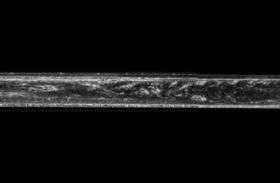
A turbulent eddy flowing through a thin glass pipe. The flow is laminar in front of and behind the eddy. Image: Max Planck Institute for Dynamics and Self-Organization

When a flow reaches a certain speed, things get turbulent: The fluid or the gas no longer flows in an orderly fashion but whirls around wildly. However, in contrast to what researchers assumed until now, this state is not permanent. Scientists from the Max Planck Institute for Dynamics and Self-Organization in Göttingen, Germany, and the Technical University in Delft, Netherlands, have shown that in pipe flows, all turbulence will disappear with time. The new measurements are significantly more precise than all previous experiments and computer simulations concerned with this question. (Physical Review Letters, November 21st 2008)

Turbulent flows in pipes are of importance for many every-day applications. What they all have in common is their appearance: They travel down the pipe bubbling and gurgling like a mountain stream. The flow only calms down when its speed is reduced. Scientists call this calmer state laminar. Crucial for the difference between laminar and turbulent flow are the inner forces that link the water molecule to each other. Only if the influence of these inner forces is smaller than the influence of the forces that accelerate the flow can turbulence appear.

Until now, scientists assumed that a turbulent flow travelling with a constant speed will always remain turbulent. However, scientists from Göttingen and Delft have now found evidence that points to the contrary. "Our measurements show that every turbulent flow in a pipe will inevitably become laminar", says Dr. Björn Hof from the Max Planck Institute for Dynamics and Self-Organization. Depending on the exact geometry of the pipe this transition may take many years. But just like a ball inside a hollow, that always rolls back into the equilibrium position, only the laminar flow is stable.

For their measurements the scientists let water flow through glass pipes of up to 14 meters length and only a few millimetres in diameter. With the help of a short water pulse from the side they created a turbulent eddy in the otherwise perfectly laminar flow. They then monitored closely, how this eddy changed as it travelled down the pipe. From the probability with which it reached the end of the pipe they could derive the basic principles that govern turbulence.

"In order to discern whether turbulence is stable or only has an extremely long lifetime, our measurements had to be very exact", says Hof. For example, it was crucial to keep the temperature of the water absolutely constant during the experiment. The measuring accuracy which the scientists achieved in this way exceeded all previous experiments. Even computer simulations cannot provide such precise data.

It is still unclear whether the new results also hold true for flows outside of pipes. But even now the results could help in ending turbulence in pipes in a controlled way. "Turbulent flow consumes more energy than do laminar ones. In many applications such as oil pipelines they are therefore bothersome", explains Hof. Since the flows aspire to turn laminar on their own, it could be possible to shorten the long lifetime of the turbulence with the help of a small perturbation. This could help save energy.

Citation: Björn Hof, Alberto de Lozar, Dirk Jan Kuik, and Jerry Westerweel, Repeller or Attractor? Selecting the Dynamical Model for the Onset of Turbulence in a Pipe Flow, Physical Review Letters, Vol. 101, No. 21, Art. 214501, Nov. 21st 2008

Source: Max-Planck-Gesellschaft


print this article email this article download pdf blog this article bookmark this article     Stumble it Digg this share on Facebook retweet share on Reddit add to delicious
Rate this story - 4.5 /5 (33 votes)

Rank Filter

Move the slider to adjust rank threshold, so that you can hide some of the comments.


Display comments: newest first

  • Alizee - Nov 21, 2008
    • Rank: 1 / 5 (3)
    In laminar flow vortices with dissolve in calm fluid due the speed gradient along pipe wall. Until stable regime is laminar, it's nothing strange, the stirred fluid will get into laminar flow less or more later.

November 21, 2008 all stories

Comments: 1

4.5 /5 (33 votes)
  • Stumble this up

  • Digg this

  • share this

  • hide
  • Related Stories

  • New wind tunnel operates quietly at Mach 6, helps shape future aircraft
    created Jan 06, 2006 | popularity not rated yet | comments 0
  • Colorado county copes with methane mystery
    created Nov 02, 2009 | popularity not rated yet | comments 0
  • The robot children
    created Sep 15, 2009 | popularity not rated yet | comments 0
  • Shuttle to carry 'Constrained Vapor Bubble' experiment to International Space Station
    created Aug 25, 2009 | popularity not rated yet | comments 0
  • Using less energy for more water
    created Aug 05, 2009 | popularity not rated yet | comments 0


  • hide
  • Relevant PhysicsForums posts

  • Work
    created 59 minutes ago
  • I need some help with this project (optics and lens design)
    created 2 hours ago
  • black hole gravity
    created 2 hours ago
  • Photoelectric effect
    created 5 hours ago
  • More from Physics Forums - General Physics

Other News

The LHC tunnel

Peckish bird briefly downs big atom smasher

Physics / General Physics

created 1hour ago | popularity 5 / 5 (1) | comments 1

A peckish bird briefly knocked out part of the world's biggest atom smasher by causing a chain reaction with a piece of bread, the European Organisation for Nuclear Research (CERN) said Monday.


Russian physicist Ginzburg dead at 93: academy

Physics / General Physics

created 2 hours ago | popularity not rated yet | comments 0

Nobel Physics prize winner Vitaly Ginzburg, who helped develop the Soviet hydrogen bomb, has died at the age of 93, the Russian Academy of Sciences said Monday.


Stars Fueled by Dark Matter Could Hold Secrets to the Universe

Stars Fueled by Dark Matter Could Hold Secrets to the Universe

Physics / General Physics

created Nov 03, 2009 | popularity 4.5 / 5 (51) | comments 41

(PhysOrg.com) -- The first stars in the universe may have been very different from the stars we see today, yet they may hold clues to understanding some of the mysterious features of the universe. These "dark ...


Second Law of Thermodynamics May Explain Economic Evolution

Second Law of Thermodynamics May Explain Economic Evolution

Physics / General Physics

created Nov 02, 2009 | popularity 4.3 / 5 (31) | comments 28

(PhysOrg.com) -- Terms such as the "invisible hand," laissez-faire policy, and free-market principles suggest that economic growth and decline in capitalist societies seem to be somehow self-regulated. Now, ...


High-performance plasmas may make reliable, efficient fusion power a reality

High-performance plasmas may make reliable, efficient fusion power a reality

Physics / Plasma Physics

created Nov 02, 2009 | popularity 4.7 / 5 (40) | comments 34

In the quest to produce nuclear fusion energy, researchers from the DIII-D National Fusion Facility have recently confirmed long-standing theoretical predictions that performance, efficiency and reliability ...