A new world of research possibilities with 'Emerging Model Organisms'
November 21, 2008 Emerging Model Organisms

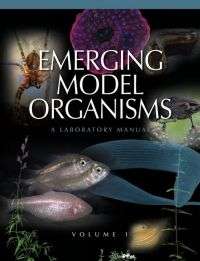
A representative collection of the emerging model organisms described in the book are shown. Clockwise, from the top, are the comb jelly (Ctenophora), the sea lamprey (Petromyzon marinus), an example of Darwin's finches (the Galapagos finches), the nematode Pristionchus pacificus, the leech (Helobdella robusta), the garden snapdragon (Antirrhinum majus), surface and cave individuals of the Mexican Cave Fish (Astyanax mexicanus), and the American wandering spider (Cupiennius salei). Credit: Cold Spring Harbor Laboratory Press

How can moss help us to treat Alzheimer's disease? What can the lamprey immune system tell us about evolution? Can genetic studies of snapdragon populations help with efforts to conserve rare species? What can quail teach us about human aging, reproduction, and hereditary diseases? Will studies of choanoflagellates unravel the origins of animals?

To answer these and other questions in biology, scientists are increasing the array of experimental model organisms. These novel species—some relatively new to the laboratory and others undergoing a recent expansion—are the focus of Emerging Model Organisms, a new laboratory manual just released by Cold Spring Harbor Laboratory Press.

Emerging Model Organisms is a catalog of diverse species that will be useful for extending research in new directions. In this volume, leading experts provide chapters on 23 emerging model systems, ranging from bat and butterfly to cave fish and choanoflagellates, and from cricket and finch to quail, snail, and tomato.

Until recently, a small number of organisms—such as E. coli, fruit fly, Arabidopsis, C. elegans, and mouse—have been the primary focus of research in molecular, cellular, and developmental biology. But in the last few years, due in part to technical advances, the reduced costs of genome sequencing, and increased interest in evolution, the range of organisms used for research has greatly expanded. Emerging Model Organisms introduces the reader to this new generation of model organisms that provide opportunities to address new and unusual questions in biology, especially in the areas of evolution and development.

Each chapter includes a detailed explanation of why the system is useful for research, along with information on care and culture of the organism, its genetics and genomics, and a set of basic protocols for working with it in the laboratory. The book is geared towards research scientists at all levels—from graduate students to principal investigators.

For a complete table of contents and list of species in Emerging Model Organisms, Volume 1, see http://www.cshlpress.com/link/emop.htm. Subsequent releases of the Emerging Model Organisms series, already in preparation, will focus on additional species. Emerging Model Organisms is also available online from the methods journal Cold Spring Harbor Protocols (http://www.cshprotocols.org/emo).

Source: Cold Spring Harbor Laboratory


print this article email this article download pdf blog this article bookmark this article     Stumble it Digg this share on Facebook retweet share on Reddit add to delicious
Rate this story - 4 /5 (2 votes)


November 21, 2008 all stories

Comments: 0

4 /5 (2 votes)
  • Stumble this up

  • Digg this

  • share this

  • hide
  • Related Stories


Other News

Penguins and sea lions help produce new atlas

Penguins and sea lions help produce new atlas

Biology / Ecology

created 29 minutes ago | popularity not rated yet | comments 0

Recording hundreds of thousands of individual uplinks from satellite transmitters fitted on penguins, albatrosses, sea lions, and other marine animals, the Wildlife Conservation Society (WCS) and BirdLife ...


Birds 'See' Earth's Magnetic Field

Birds 'See' Earth's Magnetic Field

Biology / Plants & Animals

created 1hour ago | popularity 5 / 5 (1) | comments 0

When birds migrate over long distances -- sometimes thousands of miles -- they usually end up in exactly the same place year after year. Such accurate feats of navigation, accomplished by millions of birds ...


Investigating muscle repair, scientists follow their noses

Investigating muscle repair, scientists follow their noses

Biology / Cell & Microbiology

created 1hour ago | popularity 5 / 5 (1) | comments 0

When muscle cells need repair, they use odor-detecting tools found in the nose to start the process, researchers have discovered.


Simple test could offer cheap solution to detecting landmines

Biology / Cell & Microbiology

created 1hour ago | popularity not rated yet | comments 0

Scientists have developed a simple, cheap, accurate test to find undetected landmines.


Right-handed chimpanzees provide clues to the origin of human language

Biology / Plants & Animals

created 3 hours ago | popularity 3 / 5 (1) | comments 0

Most of the linguistic functions in humans are controlled by the left cerebral hemisphere. A study of captive chimpanzees at the Yerkes National Primate Research Center (Atlanta, Georgia), reported in the January 2010 issue ...