Scientists See New Mechanism for Superconductivity
November 21, 2008 Scientists See New Mechanism for Superconductivity

Enlarge

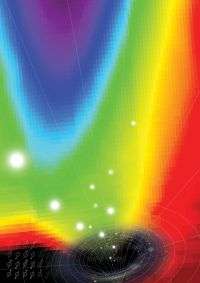
Quantum Blackhole (in condensed matter): When materials are tuned to a critical point at absolute zero temperature, quantum effects dictate universal behavior in material properties. The presence of a singular point is revealed through its unusual electronic properties outside a new form of matter that hides the singularity. Image: Los Alamos National Laboratory

(PhysOrg.com) -- Los Alamos National Laboratory researchers have posited an explanation for superconductivity that may open the door to the discovery of new, unconventional forms of superconductivity.

In a November 20 Nature letter, research led by Tuson Park and Joe D. Thompson describes a new explanation for superconductivity in non-traditional materials—one that describes a potentially new state of matter in which the superconducting material behaves simultaneously as a nonmagnetic material and a magnetic material.

Superconducting materials carry a current without resistance, usually when cooled to temperatures nearing the liquid point of helium (nearly 452 degrees below zero Fahrenheit). Superconductors are extremely important materials because they hold promise for carrying electricity from one place to another without current loss or providing indefinite electric storage capacity. However, the cost of cooling materials to such extremely low temperatures currently limits the practicality of superconductors. If superconductors could be designed to operate at temperatures closer to room temperature, the results would be revolutionary.

Traditional theories of superconductivity hold that electrons within certain nonmagnetic materials can pair up when jostled together by atomic vibrations known as phonons. In other words, phonons provide the "glue" that makes superconductivity possible.

Park and his colleagues now describe a different type of "glue" giving rise to superconducting behavior.

Park and his colleagues cooled a compound of Cerium, Rhodium and Indium to just above absolute zero, nearly minus 459 degrees Fahrenheit. At this temperature, the material exhibits superconducting behavior. However, they also subjected the crystal to pressure changes and a magnetic field to perturb the alignment of electrons within the material.

"We introduced very high quantum fluctuations in the material," Park said. "In other words, we made the electrons like a traffic jam, where it would be very difficult for them to move."

This electronic traffic jam would discourage electron pairing by phonons; nevertheless, the material continued to exhibit superconducting behavior.

Based on the material's behavior under different pressures and temperatures, researchers believe that the material reaches a quantum critical point near absolute zero. At this quantum critical point, the material retained properties of a metal with highly ordered electrons and highly disordered ones—a previously undescribed state of matter.

Park and his colleagues believe that this quantum critical point provides a mechanism to pair electrons into a quantum state that gives rise to superconducting behavior. In other words, the research helps explain a mechanism for superconductivity without phonons.

"This quantum critical point could be analogous to a black hole," said Park. "We can see what is happening at or near the event horizon—superconductivity—but we cannot yet see inside to understand why."

A new mechanism for the electron-pairing glue that gives rise to superconductivity could allow researchers to design new materials that exhibit superconducting materials at higher temperatures, perhaps even opening the door to the "Holy Grail" of superconducting materials—one that works at room temperature.

Provided by Los Alamos National Laboratory


print this article email this article download pdf blog this article bookmark this article     Stumble it Digg this share on Facebook retweet share on Reddit add to delicious
Rate this story - 4.4 /5 (30 votes)

Rank Filter

Move the slider to adjust rank threshold, so that you can hide some of the comments.


Display comments: newest first

  • tkjtkj - Nov 21, 2008
    • Rank: 3.7 / 5 (3)
    i've no idea what to make of this
    at all....

    to me,its un-ratable.
  • Alizee - Nov 21, 2008
    • Rank: 1.7 / 5 (6)
    In brief, scientists are believing on phonon-mediated superconductivity. But the Los Alamos NL researchers are proposing another mechanism, based on so called "quantum jam" or "Mottness". By this mechanism the electrons are stuck in a Mott insulating state and cannot move around. By removing a few of the electrons by process called "hole doping" the remaining electrons can start to flow from one atom to the next. This mechanism doesn't requires the Cooper pair formation necesarilly, the quantum jam would discourage electron pairing by phonons, instead.

    AWT proposes a much intuitive explanation: a high-pressure mechanism, analogous to liquefication of some metals or polymers under high pressure, which is common for every sufficiently dense particle system, including the interior of dense stars and the vacuum.
  • Alizee - Nov 21, 2008
    • Rank: 1.7 / 5 (6)
    By AWT the "Holy Grail" approach should consist in formation of dense 3D network of heavilly compressed electrons near hole stripes within superconductor lattice. Such stripes would behave like high-pressure superconductive pipes for electrons, because repulsive forces of neigbouring atoms are negligible with compare to repulsive forces of electrons itself, so that the electrons would without friction here.

    The same effect could be achieved by compressing of free electrons inside of real pipe or thin layer of conductive material - after reaching of critical pressure, the core of pipe should conduct electrons superfluously.
  • Sophos - Nov 25, 2008
    • Rank: not rated yet
    electron pairing did strike me as a bit hokey as an explanation.

November 21, 2008 all stories

Comments: 4

4.4 /5 (30 votes)
  • Stumble this up

  • Digg this

  • share this

  • hide
  • Related Stories


  • hide
  • Relevant PhysicsForums posts

Other News

Restored machine to explore mysteries of Big Bang (AP)

Restored machine to explore mysteries of Big Bang

Physics / General Physics

created 15 hours ago | popularity 4.4 / 5 (13) | comments 9

(AP) -- Scientists are preparing the world's largest atom smasher to explore the depths of matter after successfully restarting the $10 billion machine following more than a year of repairs.


nuclear power plant

Doubts raised on nuclear industry viability

Physics / General Physics

created Nov 19, 2009 | popularity 3.1 / 5 (20) | comments 19

(PhysOrg.com) -- The investment in nuclear power has been growing around the world over the last few years, being viewed as a means for countries to control their energy security, avoid the price fluctuations ...


Researchers Find Innate Correlations Among Different Power Law Phenomena

Researchers Find Innate Correlations Among Different Power Law Phenomena

Physics / General Physics

created Nov 17, 2009 | popularity 4.3 / 5 (15) | comments 13

(PhysOrg.com) -- Studying the patterns that emerge in natural and social phenomena is a popular area of research, although usually individual phenomena are studied separately from each other. In a recent study, ...


Scientists demonstrate 'universal' programmable quantum processor

Scientists demonstrate 'universal' programmable quantum processor

Physics / Quantum Physics

created Nov 15, 2009 | popularity 4.6 / 5 (21) | comments 11

Physicists at the National Institute of Standards and Technology have demonstrated the first "universal" programmable quantum information processor able to run any program allowed by quantum mechanics -- th ...


Proton's party pals may alter its internal structure

Proton's party pals may alter its internal structure

Physics / General Physics

created Nov 18, 2009 | popularity 4.6 / 5 (20) | comments 9

A recent experiment at the DOE's Thomas Jefferson National Accelerator Facility has found that a proton's nearest neighbors in the nucleus of the atom may modify the proton's internal structure.