Solar Wind Rips Up Martian Atmosphere
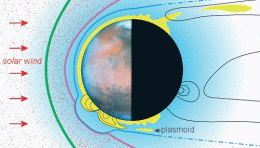
Researchers have found new evidence that the atmosphere of Mars is being stripped away by solar wind. It's not a gently continuous erosion, but rather a ripping process in which chunks of Martian air detach themselves from the planet and tumble into deep space. This surprising mechanism could help solve a longstanding mystery about the Red Planet.
"It helps explain why Mars has so little air," says David Brain of UC Berkeley, who presented the findings at the 2008 Huntsville Plasma Workshop on October 27th.
Billions of years ago, Mars had a lot more air than it does today. (Note: Martian "air" is primarily carbon dioxide, not the nitrogen-oxygen mix we breathe on Earth.) Ancient martian lake-beds and river channels tell the tale of a planet covered by abundant water and wrapped in an atmosphere thick enough to prevent that water from evaporating into space. Some researchers believe the atmosphere of Mars was once as thick as Earth's. Today, however, all those lakes and rivers are dry and the atmospheric pressure on Mars is only 1% that of Earth at sea-level. A cup of water placed almost anywhere on the Martian surface would quickly and violently boil away—a result of the super-low air pressure.
So where did the air go? Researchers entertain several possibilities: An asteroid hitting Mars long ago might have blown away a portion of the planet's atmosphere in a single violent upheaval. Or the loss might have been slow and gradual, the result of billions of years of relentless "sand-blasting" by solar wind particles. Or both mechanisms could be at work.
Brain has uncovered a new possibility--a daily ripping process intermediate between the great cataclysm and slow erosion models. The evidence comes from NASA's now-retired Mars Global Surveyor (MGS) spacecraft.
In 1998, MGS discovered that Mars has a very strange magnetic field. Instead of a global bubble, like Earth's, the Martian field is in the form of magnetic umbrellas that sprout out of the ground and reach beyond the top of Mars' atmosphere. These umbrellas number in the dozens and they cover about 40% of the planet’s surface, mainly in the southern hemisphere.
For years, researchers thought the umbrellas protected the Martian atmosphere, shielding pockets of air beneath them from erosion by the solar wind. Surprisingly, Brain finds that the opposite can be true as well: "The umbrellas are where coherent chunks of air are torn away."
Addressing his colleagues at the Workshop, he described how he made the discovery just a few months ago:
Brain was scrolling through archival data from Global Surveyor's particles and fields sensors. "We have measurements from 25,000 orbits," he says. During one of those orbits, MGS passed through the top of a magnetic umbrella. Brain noticed that the umbrella's magnetic field had linked up with the magnetic field in the solar wind. Physicists call this "magnetic reconnection." What happened next is not 100% certain, but Global Surveyor's readings are consistent with the following scenario: "The joined fields wrapped themselves around a packet of gas at the top of the Martian atmosphere, forming a magnetic capsule a thousand kilometers wide with ionized air trapped inside," says Brain. "Solar wind pressure caused the capsule to 'pinch off' and it blew away, taking its cargo of air with it." Brain has since found a dozen more examples. The magnetic capsules or "plasmoids" tend to blow over the south pole of Mars, mainly because most of the umbrellas are located in Mars' southern hemisphere.
Brain isn't ready to declare the mystery solved. "We're still not sure how often the plasmoids form or how much gas each one contains." The problem is, Mars Global Surveyor wasn't designed to study the phenomenon. The spacecraft was only equipped to sense electrons, not the heavier ions which would make up the bulk of any trapped gas. "Ions and electrons don't always behave the same way," he cautions. Also, MGS sampled the umbrellas at fixed altitudes and at the same local time each day. "We need to sample many altitudes and times of day to truly understand these dynamic events."
In short, he told the audience, "we need more data."
Brain is pinning his hopes on a new NASA mission named MAVEN. Short for "Mars Atmosphere and Volatile Evolution," MAVEN is an upper atmosphere orbiter currently approved for launch to Mars in 2013. The probe is specifically designed to study atmospheric erosion. MAVEN will be able to detect electrons, ions and neutral atoms; it will be able to measure both magnetic and electric fields; it will travel around Mars in an elliptical orbit, piercing magnetic umbrellas at different altitudes, angles, and times of day; and it will explore regions both near and far from the umbrellas, giving researchers the complete picture they need.
If magnetized chunks of air are truly being torn free, MAVEN will see it happening and measure the atmospheric loss rate. "Personally, I think this mechanism is important," says Brain, "but MAVEN may yet prove me wrong."
Meanwhile, the Mystery of the Missing Martian Air is shaping up to be a ripping good yarn.
Source: Dr. Tony Phillips, Science@NASA


