Researcher discovers corals resist disease
November 21, 2008 Researcher finds first ever evidence of natural disease resistance in corals

Enlarge

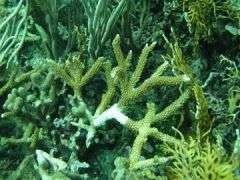
(PhysOrg.com) -- In recent years, tropical coral reefs have become drastically altered by disease epidemics. In a new study published by PLoS ONE, lead author Steven V. Vollmer, assistant professor of biology at the Marine Science Center at Northeastern University, finds that acroporid corals listed on the US Endangered Species List due to epidemics of White Band Disease can recover because up to six percent of the remaining corals are naturally resistant to the disease. This is the first evidence of natural disease resistance in tropical reef corals.

The Carribean-wide mass die-offs of acroporid corals and urchins have been major contributors to the rapid decline of coral reefs. Reef-building corals have generally been susceptible to the global rise in marine diseases. As foundation species on tropical reefs, the impacts of White Band Disease (WBD) and other coral diseases have rippled throughout the ecosystem. Recuperation of these formerly dominant corals has been slow.

Despite its extreme impacts, much about the causes and ecology of WBD remains poorly understood.

“Understanding disease resistance in these corals is a critical link to restoring populations of these once prevailing corals throughout their habitat,” said Vollmer. “Our study has shown that there are disease resistant corals, which means that these corals and thus the shallow water reefs of the Caribbean can be recovered.”

The study, titled “Natural Disease Resistance in Threatened Staghorn Corals” examines the potential for natural resistance to WBD in the staghorn coral. Using genotype information and field monitoring of WBD, the study found that six percent of staghorn coral genotypes are naturally resistant to WBD.

These resistant staghorn coral strains might explain why pockets of coral have been able to survive the WBD epidemic. Identifying, protecting and farming these disease resistant corals provides a clear avenue to recover these corals.

Provided by Northeastern University


print this article email this article download pdf blog this article bookmark this article     Stumble it Digg this share on Facebook retweet share on Reddit add to delicious
Rate this story - 4.5 /5 (6 votes)


November 21, 2008 all stories

Comments: 0

4.5 /5 (6 votes)
  • Stumble this up

  • Digg this

  • share this

  • hide
  • Related Stories

  • Coral bleaching increases chances of coral disease
    created Oct 01, 2009 | popularity not rated yet | comments 0
  • Great Barrier Reef under serious threat: report
    created Sep 02, 2009 | popularity not rated yet | comments 0
  • Hawaii protecting coral reefs with big fines
    created Aug 02, 2009 | popularity not rated yet | comments 0
  • Caribbean coral reefs flattened
    created Jun 10, 2009 | popularity not rated yet | comments 0
  • In the turf war against seaweed, coral reefs more resilient than expected
    created Jun 01, 2009 | popularity not rated yet | comments 0


Other News

Variable Temperatures Leave Insects wtih a Frosty Reception

Biology / Plants & Animals

created 7 hours ago | popularity not rated yet | comments 0

(PhysOrg.com) -- For the first time, scientists at The University of Western Ontario have shown that insects exposed to repeated periods of cold will trade reproduction for immediate survival.


When camouflage is a plant's best protection

Rare woodland plant uses 'cryptic coloration' to hide from predators

Biology / Plants & Animals

created 9 hours ago | popularity 4.3 / 5 (3) | comments 0

It is well known that some animal species use camouflage to hide from predators. Individuals that are able to blend in to their surroundings and avoid being eaten are able to survive longer, reproduce, and ...


Cells defend themselves from viruses, bacteria with armor of protein errors

Biology / Cell & Microbiology

created 10 hours ago | popularity 5 / 5 (7) | comments 0

When cells are confronted with an invading virus or bacteria or exposed to an irritating chemical, they protect themselves by going off their DNA recipe and inserting the wrong amino acid into new proteins to defend them ...


Researchers discover biological basis of 'bacterial immune system'

Biology / Cell & Microbiology

created 11 hours ago | popularity 4.7 / 5 (3) | comments 0

Bacteria don't have easy lives. In addition to mammalian immune systems that besiege the bugs, they have natural enemies called bacteriophages, viruses that kill half the bacteria on Earth every two days.


'Safety valve' protects photosynthesis from too much light

Biology / Cell & Microbiology

created 10 hours ago | popularity 5 / 5 (2) | comments 0

Photosynthetic organisms need to cope with a wide range of light intensities, which can change over timescales of seconds to minutes. Too much light can damage the photosynthetic machinery and cause cell death. Scientists ...