Plants grow bigger and more vigorously through changes in their internal clocks
November 23rd, 2008 Hybrid Vigor

Enlarge

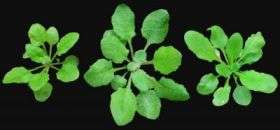
The hybrid Arabidopsis (center) is larger than its parents (left and right), an example of hybrid vigor. Credit: Jeff Chen/Nature

Hybrid plants, like corn, grow bigger and better than their parents because many of their genes for photosynthesis and starch metabolism are more active during the day, report researchers from The University of Texas at Austin in a new study published in the journal Nature.

Their research has relevance in many areas of agriculture, and could result in new methods to increase biomass for biofuels and seed production for animal feedstock and human consumption.

It has long been known that hybrid plants such as hybrid corn are more vigorous than their parents. They are larger and have more biomass and bigger seeds. The same is true for plants that are polyploid, meaning that they have two or more sets of chromosomes. Over 70 percent of all flowering plants, including many important agricultural crops such as wheat, cotton, canola, sugarcane and banana, are naturally polyploid.

Until now, the molecular mechanisms for hybrid and polyploid vigor have largely been unknown.

"Before this discovery, no one really knew how hybridization and polyploidy led to increased vigor," says lead author Dr. Jeffrey Chen, the D. J. Sibley Centennial Professor of Plant Molecular Genetics. "This is certainly not the only mechanism behind this phenomenon, but it is a big step forward."

The key, Chen and his colleagues studying Arabidopsis plants found, is the increased expression of genes involved in photosynthesis and starch metabolism in hybrids and polyploids. These genes were expressed at high levels during the day, several-fold increases over their parents.

The hybrids and polyploids exhibited increased photosynthesis, higher amounts of chlorophyll and greater starch accumulation than their parents, all of which led to their growing larger.

Also, growth vigor was higher in allotetraploid plants (polyploids formed by combining two different Arabidopsis species) than standard hybrids (formed through combining the same species).

The research team discovered a direct connection between circadian clock regulators and growth vigor in both hybrids and polyploids. Circadian clocks control growth, metabolism and fitness in plants and animals.

They found that some of these regulators, known as transcriptional repressors, were more repressed during the day in the hybrids and polyploids, leading to increases in their photosynthesis and starch accumulation.

"This connection was a bit of surprise, but it makes a lot of sense," says Chen.

With this knowledge, Chen says they can now develop genomic and biotechnological tools to find and make better hybrids and polyploids.

"We can think about screening parent plants for these genes and selecting the ones to make the best hybrids," says Chen. "This could all be done through traditional breeding techniques and could have a huge impact on generating higher biomass crops for biofuels and increasing yield in many food crops."

The hybrid vigor or "heterosis" phenomenon was first observed by Charles Darwin in 1876, and was extensively studied in corn in the early 1900s. All corn in the U.S. is hybrid.

Many of the important polyploid crops, such as wheat and cotton, are known as allopolyploids, because they are formed from two or more different species. Chen and his colleagues study standard hybrid and allopolyploid Arabidopsis, cotton and corn.

Source: University of Texas at Austin


print this article email this article download pdf blog this article bookmark this article     Digg this Stumble it share on Facebook share on Reddit add to delicious save to Yahoo! bookmarks
4.8/5 after 8 votes


November 23rd, 2008 all stories
Biology /

Comments: 0
Rank: 4.8/5 after 8 votes

  • Stumble this up

  • Digg this

  • Share it:
  • share on Facebook
  • share on MySpace
  • share on Slashdot
  • rss-newsfeed
  • share on Google
  • share on Reddit
  • add to delicious
  • save to Yahoo! bookmarks
  • share on Windows Live
  • Add to Mixx!
Rating: 4.8/5 after 8 votes

  • Related Stories

  • New, light-driven nanomotor is simpler, more promising, scientists say
    created Jun 04, 2009 | popularity not rated yet | comments 0
  • Toyota rolls out new Prius to fend off rivals
    created May 18, 2009 | popularity not rated yet | comments 0
  • Yellow submarine to try again for Atlantic glide
    created Apr 19, 2009 | popularity not rated yet | comments 0
  • Evolutionary origin of bacterial chromosomes revealed
    created Mar 26, 2009 | popularity not rated yet | comments 0
  • Early agriculture left traces in animal bones
    created Mar 23, 2009 | popularity not rated yet | comments 0

Tags

plants, hybrids

  • Physicists Demonstrate Quantum Memory with Matter Qubits
    Physicists Demonstrate Quantum Memory with Matter Qubits
    Physics / General Physics
    created Jul 03, 2009 | popularity 4.4 / 5 (17) | comments 1
  • 'Holey' Nanosheets for Wastewater Dye Removal
    Nanotechnology / Nanomaterials
    created Jul 01, 2009 | popularity 5 / 5 (5) | comments 1
  • Jellyfish Robot Swims Like its Biological Counterpart
    Jellyfish Robot Swims Like its Biological Counterpart
    Electronics / Robotics
    created Jun 26, 2009 | popularity 4.4 / 5 (8) | comments 1
  • Could Maxwell's Demon Exist in Nanoscale Systems?
    Could Maxwell's Demon Exist in Nanoscale Systems?
    Physics / General Physics
    created Jun 24, 2009 | popularity 4.4 / 5 (18) | comments 29
  • Living Safely with Robots, Beyond Asimov's Laws
    Living Safely with Robots, Beyond Asimov's Laws
    Electronics / Robotics
    created Jun 22, 2009 | popularity 4.6 / 5 (52) | comments 40
  • Other News

    California water plan aims to save Puget Sound orcas

    Biology / Ecology

    created 15 hours ago | popularity not rated yet | comments 0

    A plan to restore salmon runs on California's Sacramento River also could help revive killer whale populations 700 miles to the north in Puget Sound, as federal scientists struggle to protect endangered species in a complex ...


    Scientists 'rebuild' giant moa using ancient DNA

    Biology / Plants & Animals

    created Jul 01, 2009 | popularity 5 / 5 (10) | comments 12

    (PhysOrg.com) -- Scientists have performed the first DNA-based reconstruction of the giant extinct moa bird, using prehistoric feathers recovered from caves and rock shelters in New Zealand.


    Pacific Giant Salamander (Dicamptodon tenebrosus)

    Salamanders, regenerative wonders, heal like mammals, people

    Biology / Microbiology

    created Jul 01, 2009 | popularity 5 / 5 (20) | comments 11

    The salamander is a superhero of regeneration, able to replace lost limbs, damaged lungs, sliced spinal cord -- even bits of lopped-off brain. But it turns out that remarkable ability isn't so mysterious after ...


    Genetically modified trees

    Anti-biotech groups obstruct forest biotechnology

    Biology / Biotechnology

    created Jun 30, 2009 | popularity 3.7 / 5 (7) | comments 5

    The potential of forest biotechnology to help address significant social and environmental issues is being "strangled at birth" by the rigid opposition of some groups and regulations that effectively preclude ...


    Super-sleepers could help super-sizers!

    Super-sleepers could help super-sizers!

    Biology / Plants & Animals

    created Jun 29, 2009 | popularity 5 / 5 (2) | comments 4

    Burrowing frogs can survive buried for several years without food or water. Scientists have discovered that the metabolism of their cells changes radically during the dormancy period allowing the frogs to ...