Polymers 'battered' with nanoparticles could create self healing paints and clever packaging
November 24, 2008 Battered Polymers

Enlarge

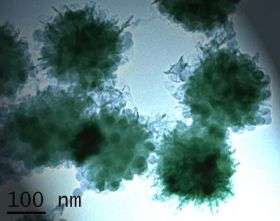
Battered polymers. Image: Dr. Stefan Bon

Research chemists at the University of Warwick have devised an elegant process which simply and cheaply covers small particles of polymer with a layer of silica-based nanoparticles. The final result provides a highly versatile material that can be used to create a range of high performance materials such as: self healing paints, and clever packaging that can be tailored to let precise levels of water, air or both pass in a particular direction.

The research, led by Dr Stefan Bon of University of Warwick's Department of Chemistry, has created a "soap free emulsion polymerization process" which makes colloid particles of polymer dispersed in water and in one simple step introduces nanometre sized silica based particles to the mix. These silica based nanoparticles (about 25 nanometre in size) then coats the polymer colloids with a layer "battering" it almost like a fish can be battered in bread crumbs.

This process creates a very versatile polymer latex product. It can be used to create scratch resistant paints in which the scratches heal themselves. It can be fine tuned to produce polymer based packaging which will allow water or air to pass through the packaging in tailored ways. The resultant rough textured spherical shapes also lend themselves to the creation of sheets with polymer that present much more surface area than usual allowing more efficient interaction with other materials.

The versatility of this process did not stop there. By exposing the material to a second simple step which deposited another polymer layer on top of the already silica based nanoparticles "battered" polymers the researchers were able to produce particles with an even greater range of properties and uses. The image shows such a multi-layered polymer colloid and was taken with a transmission electron microscope.

Industrialists will be interested not just in the versatility of the end product but the ease and cost effectiveness of the process. The Warwick research team has worked on a number of other processes that coated polymers in forms of protection but they all required a number of steps to produce the end result. This new process cuts dramatically the time needed to create such materials and its single step can already be produced on a mass scale with currently used industrial equipment.

The amount of material that one can harvest from the process will also impress industrialists as the Warwick team showed that the useful product can easily be made up to around 45% of the volume of each water-based solution used in their process. This compares with figures of as of little as 1 to 10 % for comparable multi-step processes that make these complex particles.

Citation: The research paper by Patrick J. Colver, Catheline A. L. Colard, and Stefan A. F. Bon at the University of Warwick is entitled Multilayered Nanocomposite Polymer Colloids Using Emulsion Polymerization Stabilized by Solid Particles in the Journal of the American Chemical Society. See http://pubs.acs.org/doi/abs/10.1021/ja807242k

Source: University of Warwick


print this article email this article download pdf blog this article bookmark this article     Stumble it Digg this share on Facebook retweet share on Reddit add to delicious
Rate this story - 4.4 /5 (20 votes)

Rank Filter

Move the slider to adjust rank threshold, so that you can hide some of the comments.


Display comments: newest first

  • moj85 - Nov 24, 2008
    • Rank: not rated yet
    First step toward self-healing armor?

November 24, 2008 all stories

Comments: 1

4.4 /5 (20 votes)
  • Stumble this up

  • Digg this

  • share this

  • hide
  • Related Stories

  • Icy exposure creates armored polymer high tech foams
    created Jul 28, 2009 | popularity not rated yet | comments 0
  • How chromosomes meet in the dark -- Switch that turns on X chromosome matchmaking
    created Dec 27, 2008 | popularity not rated yet | comments 0
  • A glass apart
    created Jun 05, 2008 | popularity not rated yet | comments 0
  • Nanotech clay armour creates fire resistant hard wearing latex emulsion paints
    created Jul 26, 2007 | popularity not rated yet | comments 0
  • Artificial snot enhances electronic nose
    created Apr 30, 2007 | popularity not rated yet | comments 0


  • hide
  • Relevant PhysicsForums posts

  • Ceramic Powder processing progress - urgent
    created 4 hours ago
  • Thin Film Laboratory resources
    created 15 hours ago
  • Theoretical air URGENT
    created Nov 26, 2009
  • photoconductivity of polymers
    created Nov 25, 2009
  • More from Physics Forums - Materials & Chemical Engineering

Other News

Nanowire Formation

Nanowires key to future transistors, electronics

Nanotechnology / Nanophysics

created Nov 26, 2009 | popularity 4.8 / 5 (8) | comments 1

(PhysOrg.com) -- A new generation of ultrasmall transistors and more powerful computer chips using tiny structures called semiconducting nanowires are closer to reality after a key discovery by researchers ...


Water droplets direct self-assembly process in thin-film materials

Nanotechnology / Nanomaterials

created Nov 23, 2009 | popularity 5 / 5 (4) | comments 2

You can think of it as origami - very high-tech origami. Researchers at the University of Illinois have developed a technique for fabricating three-dimensional, single-crystalline silicon structures from thin films by coupling ...


Using superconducting probes to get a picture of what it's like inside CNTs

Nanotechnology / Nanophysics

created Nov 20, 2009 | popularity 4.4 / 5 (9) | comments 0

(PhysOrg.com) -- "Carbon nanotubes are exciting for fundamental physics, and for potential technological applications," Nadya Mason tells PhysOrg.com. "However, we are generally limited in the way that we can study them. ...


Peptides control crystal growth with 'switches, throttles and brakes'

Peptides control crystal growth with 'switches, throttles and brakes'

Nanotechnology / Bio & Medicine

created Nov 23, 2009 | popularity 4.8 / 5 (5) | comments 0

(PhysOrg.com) -- By producing some of the highest resolution images of peptides attaching to mineral surfaces, scientists have a deeper understanding how biomolecules manipulate the growth crystals. This research ...


Fast, easy, and highly sensitive arsenic detection with gold nanoparticles

Nanotechnology / Nanomaterials

created Nov 25, 2009 | popularity 5 / 5 (1) | comments 0

(PhysOrg.com) -- Mention of arsenic poisoning usually brings to mind underhanded murder. However, the danger of arsenic poisoning from contaminated drinking water is far greater. Low concentrations of arsenic are found in ...