Los Alamos observatory fingers cosmic ray 'hot spots'
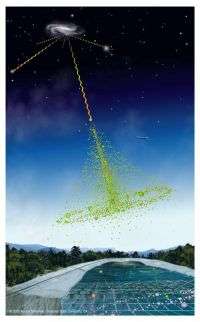
November 24th, 2008 Paticle Shower Depiction

Enlarge

Simulated shower hitting the Milagro Detector. Credit: 2000 aurore simonnet

A Los Alamos National Laboratory cosmic-ray observatory has seen for the first time two distinct hot spots that appear to be bombarding Earth with an excess of cosmic rays. The research calls into question nearly a century of understanding about galactic magnetic fields near our solar system.

Joining an international team of collaborators, Los Alamos researchers Brenda Dingus, Gus Sinnis, Gary Walker, Petra Hüntemeyer and John Pretz published the findings today in Physical Review Letters.

"The source of cosmic rays has been a 100-year-old problem for astrophysicists," Pretz said. "With the Milagro observatory, we identified two distinct regions with an excess of cosmic rays. These regions are relatively tiny bumps on the background of cosmic rays, which is why they were missed for so long. This discovery calls into question our understanding of cosmic rays and raises the possibility that an unknown source or magnetic effect near our solar system is responsible for these observations."

Cosmic rays are high-energy particles that move through our Galaxy from sources far away. No one knows exactly where cosmic rays come from, but scientists theorize they might originate from supernovae—massive stars that explode— from quasars or perhaps from other exotic, less-understood or yet-to-be-discovered sources within the universe.

Researchers used Los Alamos' Milagro cosmic-ray observatory to peer into the sky above the northern hemisphere for nearly seven years starting in July 2000. The observatory is unique in that it monitors the entire sky above the northern hemisphere. Because of its design and field of view, Milagro was able to record over 200 billion cosmic-ray collisions with the Earth's atmosphere.

"Our observatory is unique in that we can detect events of low enough energies that we were able to record enough cosmic-ray encounters to see a statistically significant fractional excess coming from two distinct regions of the sky," Dingus said.

Because cosmic rays are charged particles, magnetic fields from the Milky Way and our solar system change the flight paths of the particles so much that researchers had not been able to pinpoint their exact origin. Consequently, traditional wisdom has held that cosmic-ray events appear uniformly throughout the sky.

But because Milagro was able to record so many cosmic-ray events, researchers for the first time were able to see statistical peaks in the number of cosmic-ray events originating from specific regions of the sky near the constellation Orion. The region with the highest hot spot of cosmic rays is a concentrated bulls eye above and to the right visually of Orion, near the constellation Taurus. The other hot spot is a comma-shaped region visually occurring near the constellation Gemini.

The researchers created a graphic depiction of the hot spots that makes them appear as a pair of red cosmic rashes in a field of stars.

Milagro scientists are currently working with researchers in Mexico to build a second-generation observatory known as the High-Altitude Water Cherenkov (HAWC) experiment. If built, the HAWC observatory could help researchers solve the mystery of cosmic-ray origin.

Source: Los Alamos National Laboratory


print this article email this article download pdf blog this article bookmark this article     Digg this Stumble it share on Facebook share on Reddit add to delicious save to Yahoo! bookmarks
4.7/5 after 29 votes

Rank Filter

Move the slider to adjust rank threshold, so that you can hide some of the comments.


Display comments: newest first

  • Velanarris - Nov 24, 2008
    • Rank: 2.3 / 5 (3)
    I wonder if the SETI guys have taken a look at these.
  • NeilFarbstein - Nov 24, 2008
    • Rank: 2.8 / 5 (4)
    dont advance theories rashly
  • Mercury_01 - Nov 25, 2008
    • Rank: 1 / 5 (1)
    I can finger more hot spots than this satellite can.
  • E_L_Earnhardt - Nov 25, 2008
    • Rank: 1 / 5 (1)
    ood Work! - Worth the effort! The nature of these particular rays have had a negative effect on our planet's life forms! Ploting sources and perhaps orbiting shields is well worth while!
  • Velanarris - Nov 26, 2008
    • Rank: 1 / 5 (1)
    dont advance theories rashly


    Says the founder of the vulvox system, permafrost salting method, and don't forget methane sequestration through phytocapping permafrost.

    Throw up your horrid company's website address again Neil.
  • Noumenon - Nov 27, 2008
    • Rank: not rated yet
    ood Work! - Worth the effort! The nature of these particular rays have had a negative effect on our planet's life forms! Ploting sources and perhaps orbiting shields is well worth while!


    And what planet is that?
  • theophys - Nov 28, 2008
    • Rank: 4 / 5 (1)
    I can't see this making a large difference in day to day life. It would make an interesting topic for desperate doctoral students in need of a thesis, however. Yay for useless yet interesting information!

November 24th, 2008 all stories
Physics / General Physics

Comments: 7
Rank: 4.7/5 after 29 votes

  • Stumble this up

  • Digg this

  • Share it:
  • share on Facebook
  • share on MySpace
  • share on Slashdot
  • rss-newsfeed
  • share on Google
  • share on Reddit
  • add to delicious
  • save to Yahoo! bookmarks
  • share on Windows Live
  • Add to Mixx!
Rating: 4.7/5 after 29 votes

  • Related Stories

  • A Super-Efficient Particle Accelerator
    created Jul 01, 2009 | popularity not rated yet | comments 0
  • Milky Way's super-efficient particle accelerators caught in the act
    created Jun 25, 2009 | popularity not rated yet | comments 0
  • Keck Study Sheds New Light on "Dark" Gamma-ray Bursts
    created Jun 08, 2009 | popularity not rated yet | comments 0
  • Ghost remains after black hole eruption
    created May 28, 2009 | popularity not rated yet | comments 0
  • The cosmos is green: Researchers catch nature in the act of 'recycling' a star (w/Animations)
    created May 21, 2009 | popularity not rated yet | comments 0


  • Physicists Demonstrate Quantum Memory with Matter Qubits
    Physicists Demonstrate Quantum Memory with Matter Qubits
    Physics / General Physics
    created Jul 03, 2009 | popularity 4.4 / 5 (17) | comments 1
  • 'Holey' Nanosheets for Wastewater Dye Removal
    Nanotechnology / Nanomaterials
    created Jul 01, 2009 | popularity 5 / 5 (5) | comments 1
  • Jellyfish Robot Swims Like its Biological Counterpart
    Jellyfish Robot Swims Like its Biological Counterpart
    Electronics / Robotics
    created Jun 26, 2009 | popularity 4.4 / 5 (8) | comments 1
  • Could Maxwell's Demon Exist in Nanoscale Systems?
    Could Maxwell's Demon Exist in Nanoscale Systems?
    Physics / General Physics
    created Jun 24, 2009 | popularity 4.4 / 5 (18) | comments 29
  • Living Safely with Robots, Beyond Asimov's Laws
    Living Safely with Robots, Beyond Asimov's Laws
    Electronics / Robotics
    created Jun 22, 2009 | popularity 4.6 / 5 (52) | comments 40
  • Other News

    UQ researchers break the law -- of physics

    Physics / General Physics

    created 14 minutes ago | popularity not rated yet | comments 0

    (PhysOrg.com) -- Two UQ Science researchers have proved two famous physical laws that have been widely used for the past 25 years do not always work.


    Scientists create first electronic quantum processor

    Scientists create first electronic quantum processor

    Physics / General Physics

    created Jun 28, 2009 | popularity 4.8 / 5 (54) | comments 41

    A team led by Yale University researchers has created the first rudimentary solid-state quantum processor, taking another step toward the ultimate dream of building a quantum computer.


    Science journals

    How to Spot an Influential Paper Based on its Citations

    Physics / General Physics

    created Jul 04, 2009 | popularity 4 / 5 (9) | comments 6

    (PhysOrg.com) -- At first it may seem that the number of citations received by a published scientific paper is directly related to that paper's quality of content. The higher the quality, the more people read ...


    Fermilab's CDF observes Omega-sub-b baryon

    Fermilab's CDF observes Omega-sub-b baryon

    Physics / General Physics

    created Jun 29, 2009 | popularity 4.7 / 5 (17) | comments 7

    (PhysOrg.com) -- At a recent physics seminar at the Department of Energy’s Fermi National Accelerator Laboratory, Fermilab physicist Pat Lukens of the CDF experiment announced the observation of a new particle, ...


    New insights, and a new angle, on high-temperature superconductivity

    New insights, and a new angle, on high-temperature superconductivity

    Physics / Superconductivity

    created Jun 29, 2009 | popularity 4.8 / 5 (13) | comments 6

    (PhysOrg.com) -- A Princeton-led research team has revealed surprising information about how electron behavior influences the conduction of electricity in a class of high-temperature superconductors. An increased ...