Exercise helps overweight children reduce anger expression
November 24, 2008
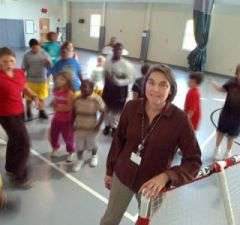
Regular exercise seems to reduce anger expression in overweight but otherwise healthy children, Medical College of Georgia researchers say. According to Dr. Catherine Davis, clinical health psychologist in the MCG School of Medicine, aerobic exercise may be an effective strategy to help overweight kids reduce anger expression and aggressive behavior. Credit: Phil Jones
Regular exercise seems to reduce anger expression in overweight but otherwise healthy children, researchers said.
The first published study on the topic looked at 208 typically sedentary 7- to 11-year-olds who participated in a 10-15 week afterschool aerobic exercise program or maintained their usual inactive routine. The Pediatric Anger Expression Scale, used to gauge common anger expressions such as slamming doors and hitting, was given before and after the program.
"Exercise had a significant impact on anger expression in children," said Dr. Catherine Davis, clinical health psychologist in the Medical College of Georgia School of Medicine. "This finding indicates that aerobic exercise may be an effective strategy to help overweight kids reduce anger expression and aggressive behavior."
The finding fits with evidence that exercise reduces depression and anxiety in children and with what's considered common knowledge that exercise helps adults manage anger, she said.
It also gives parents and other caregivers another reason to get and keep children moving. "I think it's reasonable to encourage children to exercise for a lot of good reasons," said Dr. Davis whose research on overweight children has shown regular physical activity not only reduces fatness but improves cognition and reduces insulin resistance – which can lead to diabetes.
"I think if teachers could see that exercise helps kids control their behavior and get along, they would be the top proponents of physical activity for kids," said Dr. Davis, noting that other studies suggests overweight children are more likely to be bullies and to be bullied. High levels of anger and hostility have been associated with delinquency in children, cardiovascular disease in adults and metabolic syndrome - which can lead to heart attack, stroke and diabetes - in adolescents.
The new finding, published in the November issue of Pediatric Exercise Science, appears to apply to overweight children generally, regardless of factors such as race, gender, socioeconomic status or even fitness or fatness levels, the researchers wrote. In fact, even though all participants in the exercise portion lost a significant amount of weight, they remained overweight at the study's conclusion.
With help from a five-year $3.6 million grant from the National Heart, Lung and Blood Institute, Dr. Davis already is looking to see if the finding holds in a similar group of children, who are part of a study on the impact of exercise on cognition. The goal is to determine if it was the exercise or participation in an after-school program that made the difference.
Extra attention from adults and time away from usual routines that could include disagreements with siblings and watching violence on television definitely could have a psychological impact. "With a psychological outcome like cognition or anger control, positive interaction with adults can make a big difference," Dr. Davis said.
In the published study, only the exercising children came to MCG's Georgia Prevention Institute after school. In the new study, both groups are coming to the institute, with non-exercisers enjoying arts, crafts and games. "We are trying to make it so the only difference is exercise," said Dr. Davis.
Source: Medical College of Georgia
-
Study links quality of mother-toddler relationship to teen obesity
Dec 26, 2011 |
not rated yet |
0
-
Quality of parent-toddler relationship could affect risk for childhood obesity
Apr 19, 2011 |
not rated yet |
0
-
Why your diet makes you angry
Apr 12, 2011 |
2.5 / 5 (2) |
2
-
Review confirms benefits of outdoor exercise
Feb 04, 2011 |
not rated yet |
0
-
Scientist studies emotion in psychology, art and acting to help autistics
Mar 25, 2010 |
not rated yet |
0
-
Engineers build first sub-10-nm carbon nanotube transistor
Feb 01, 2012 |
4.9 / 5 (31) |
30
-
Something old, something new: Evolution and the structural divergence of duplicate genes
Jan 31, 2012 |
4.6 / 5 (7) |
1
-
The hidden nanoworld of ice crystals: Revealing the dynamic behavior of quasi-liquid layers
Jan 30, 2012 |
5 / 5 (3) |
1
-
Stock market network reveals investor clustering
Jan 27, 2012 |
3.9 / 5 (23) |
8
-
Of microchemistry and molecules: Electronic microfluidic device synthesizes biocompatible probes
Jan 26, 2012 |
5 / 5 (1) |
0
-
Classical and Quantum Mechanics via Lie algebras
Apr 15, 2011
- More from Physics Forums - Independent Research
More news stories
Injured boomers beware: Know when to see doctor
(AP) -- It happened to nurse Jane Byron years after an in-line skating fall, business owner Haralee Weintraub while doing "men's" push-ups, and avid cyclist Gene Wilberg while lifting a heavy box.
1 hour ago |
not rated yet |
0
FDA-approved drug rapidly clears amyloid from the brain, reverses Alzheimer's symptoms in mice
Neuroscientists at Case Western Reserve University School of Medicine have made a dramatic breakthrough in their efforts to find a cure for Alzheimer's disease. The researchers' findings, published in the journal Science, show t ...
Medicine & Health / Neuroscience
Feb 09, 2012 |
4.9 / 5 (53) |
21
|
Green tea found to reduce disability in the elderly
(Medical Xpress) -- A lot of research has been done over the past several years looking into the health benefits of green tea. As a result, scientists have found that regular consumption of the beverage leads ...
Teen school drop-outs three times as likely to be on benefits in later life
Teen school drop-outs are almost three times as likely to be on benefits in later life as their peers who complete their schooling, indicates research published online in the Journal of Epidemiology and Community Health.
Feb 06, 2012 |
not rated yet |
13
To perform with less effort, practice beyond perfection
Whether you are an athlete, a musician or a stroke patient learning to walk again, practice can make perfect, but more practice may make you more efficient, according to a surprising new University of Colorado Boulder study.
Medicine & Health / Neuroscience
Feb 09, 2012 |
4.4 / 5 (15) |
6
|
Google might launch Drive for cloud storage soon
(PhysOrg.com) -- Google's next big move, according to the Wall Street Journal, is a cloud storage service called Drive. Hardly first to the plate, Google is simply catching up to introducing its cloud reposi ...
Latin America mining boom clashes with conservation
Latin America is experiencing a mining boom as prices rise fuelled by a hike in global demand, but the region is also being hit by a wave of violent protests, strikes and rallies by environmentalists.
Love a click away in Indonesia's Twitter Republic
He was a geeky kid from Yogyakarta, she a glamorous city girl in Jakarta. In a country with one of the world's most vibrant social networking scenes they fell in love on Twitter.
Europeans protest controversial Internet pact
Tens of thousands of people marched in protests in more than a dozen European cities Saturday against a controversial anti-online piracy pact that critics say could curtail Internet freedom.
Walney offshore wind farm is world's biggest (for now)
(PhysOrg.com) -- The Walney wind farm on the Irish Sea--characterized by high tides, waves and windy weather--officially opened this week. The farm is treated in the press as a very big deal as the Walney ...
Navy to begin tests on electromagnetic railgun prototype launcher
The Office of Naval Research (ONR)'s Electromagnetic (EM) Railgun program will take an important step forward in the coming weeks when the first industry railgun prototype launcher is tested at a facility ...