Robo-lizards help prove long-standing signaling theory
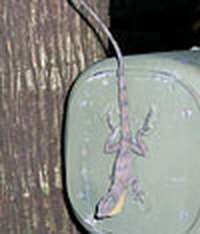
(PhysOrg.com) -- Like teachers who rap a ruler before announcing homework in noisy classrooms, Puerto Rican anole lizards perform eye-catching pushups before beginning head-bobbing displays that advertise their territory and status, according to a new study by researchers at the University of California, Davis.
With the help of robotic lizards that mimic their flesh-and-blood counterparts, research associate Terry Ord and professor emerita Judy Stamps, both with the Department of Evolution and Ecology, have shown for the first time that animals in noisy environments can use visual displays to grab their neighbors' attention before initiating a more information-rich performance. The study will be published in the November 24 Proceedings of the National Academy of Sciences (PNAS).
"What's really interesting is that the anoles are in some way assessing the environmental variables that are likely to affect the detection of their signals," Ord said, "and they are tailoring their behavior accordingly."
The work confirms a nearly 30-year-old hypothesis that when the environment is noisy, animals might use conspicuous signals, or "alerts," to let neighbors know that a message is forthcoming.
Audible alerts, like trills or barks, have been documented in only one species, towhees, but studies suggest that coyotes and tree frogs also issue them. Until now, however, no one has shown that mute species can use body language to do the same thing, said Ord, who also holds a postdoctoral fellowship at Harvard University's Museum of Comparative Zoology.
"It's a real formidable task for animals to be communicating out in the real world," Ord explained. "Not only is there a lot of acoustic noise, but there's visual noise, as well. The trouble for an animal that tries to send an information-rich signal under low-light conditions or when the wind is blowing branches and leaves around is that the signal will not transmit very far. To solve that conundrum, the theory goes, you start the communication with a conspicuous component to attract the attention of your receivers."
Scientists working with audible alerts have the advantage of being able to use recorded songs and calls in the field. But to study body language in yellow-chinned anoles (Anolis gundlachi) living in Puerto Rico's deep, shaded forests, Ord had to design and build realistic models that could dip, bend and unfurl flaps of skin on their chins, known as dewlaps. His hand-painted latex constructions were so realistic they fooled humans and anoles alike.
Ord housed small motors powered by packs of AA batteries in a box below his robotic lizards, then programmed the models to precisely imitate the typical four-legged pushups and head-bobbing displays performed by anoles. He also programmed two alternate sequences: displays with head bobs only (no pushups), and displays that began with quick dewlap extensions, a behavior not typically performed by this species.
Then the researcher planted his creations in a Puerto Rican forest and observed how neighboring anoles responded to the various displays. After viewing and analyzing more than 300 responses, Ord and Stamps concluded that pushups are an alert that the lizards mostly use only when necessary, such as when their neighbors are far away or when the light is dim.
They also found that both the pushups and rapid dewlap extensions prompted neighboring lizards to orient themselves more quickly to the displaying robots than when head bobs were performed without these alerts. The fact that the lizards responded to the atypical, but eye-catching dewlap extensions confirmed the hypothesis that any high-speed movement at the onset of a display could function as an effective alert.
By adding animals that use visual alerts to the roster of species already suspected of using audible alerts, the case can be made that alert signals represent a significant example of evolutionary convergence, Ord noted.
"This is interesting," he said, "because it's an example of very different species converging on a similar strategy."
Provided by University of California - Davis


