Sweet molecule could lead us to alien life
November 25, 2008
Sweet molecule could lead us to alien life

Enlarge

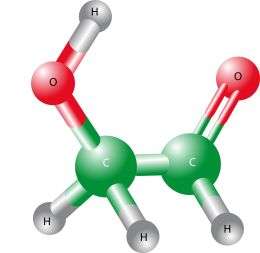
Model of the glycolaldehyde molecule. Credit:IRAM

(PhysOrg.com) -- Scientists have detected an organic sugar molecule that is directly linked to the origin of life, in a region of our galaxy where habitable planets could exist. The discovery, part funded by the UK's Science and Technology Facilities Council (STFC), is published today (25th November) on the Astro-ph website.

The international team of researchers, including a researcher at University College London (UCL), used the IRAM radio telescope in France to detect the molecule in a massive star forming region of space, some 26000 light years from Earth.

Dr Serena Viti, one of the paper's authors from University College London, said, "This is an important discovery as it is the first time glycolaldehyde, a basic sugar, has been detected towards a star-forming region where planets that could potentially harbour life may exist."

The molecule – glycolaldehyde - has previously only been detected towards the centre of our galaxy where conditions are extreme compared to the rest of the galaxy. This new discovery, in an area far from the galactic centre, also suggests that the production of this key ingredient for life could be common throughout the galaxy. This is good news in our search for alien life, as a wide spread of the molecule improves the chances of it existing along side other molecules vital to life and in regions where Earth-like planets may exist.

The team were able to detect glycolaldehyde by using the telescope to observe the region with high-angular resolution and at different wavelengths. The observations confirmed the presence of three lines of glycolaldegyde towards the most central part of the core of the region

Glycolaldehyde, the simplest of the monosaccharide sugars, can react with the substance propenal to form ribose, a central constituent of Ribonucleic acid (RNA), thought to be the central molecule in the origin of life.

Professor Keith Mason, Chief Executive of the Science and Technology Facilities Council (STFC), said, "The discovery of an organic sugar molecule in a star forming region of space is very exciting and will provide incredibly useful information in our search for alien life. Research like this, combined with the vast array of other astronomical projects involving UK researchers, is continually expanding our knowledge of the Universe and keeping the UK at the forefront of astronomy."

Online version of the Astrophysical Journal paper: http://babbage.sis … bs/0811.3821

Source: Science and Technology Facilities Council

4.6 /5 (47 votes)  

Filter


Move the slider to adjust rank threshold, so that you can hide some of the comments.


Display comments: newest first

superhuman
Nov 25, 2008

Rank: 1.7 / 5 (6)
Actually, its as if we already found alien life!
I mean it has two carbon and two oxygen atoms, it has to be alive!
jyro
Nov 25, 2008

Rank: 1.2 / 5 (5)
Are these aliens like the wicked witch of the West, water melts them.
tkjtkj
Nov 26, 2008

Rank: 1 / 5 (2)
Are these aliens like the wicked witch of the West, water melts them.


Not exactly: See, they're 26,000
lightyears away .. so they
disappear after about a year's
travel , which is about as long as
any human can tolerate being with
another !
Velanarris
Nov 26, 2008

Rank: not rated yet
Are these aliens like the wicked witch of the West, water melts them.


Not exactly: See, they're 26,000
lightyears away .. so they
disappear after about a year's
travel , which is about as long as
any human can tolerate being with
another !
I know a lot of documented hermits who would disagree with you on that.
Keter
Nov 26, 2008

Rank: not rated yet
I'm curious about what else was found in the spectral analysis and in what proportions. What they've announced is finding just one building-block of potential life, and a very narrow segment of potential life, at that. RNA may not be required for life, just for life as we currently know it.

[giggling @ jyro] Yeah, if you had a big block of glycoaldehyde, water probably would melt it. ;o)
Rank 4.6 /5 (47 votes)
Relevant PhysicsForums posts
  • Titan's lack of impact craters
    created11 hours ago
  • Real pictures of black hole eating a star?
    createdFeb 08, 2012
  • Hypothetical way to travel faster than light, but not technically exceed lightspeed
    createdFeb 06, 2012
  • How do scientists monitor the Sun's activity?
    createdFeb 05, 2012
  • Search patterns in observational studies
    createdFeb 05, 2012
  • Derivation of Pogson's law
    createdFeb 03, 2012
  • More from Physics Forums - General Astronomy

More news stories

Deconstructing a mystery: What caused Snowmaggedon?

In the quiet after the storms, streets and cars had all but disappeared under piles of snow. The U.S. Postal Service suspended service for the first time in 30 years. Snow plows struggled to push the evidence ...

Space & Earth / Earth Sciences

created 6 hours ago | popularity 4.7 / 5 (3) | comments 1 | with audio podcast

Researchers create 3-D laser maps that show how earthquake changes landscape

Geologists have a new tool to study how earthquakes change the landscape down to a few inches, and it's giving them insight into how earthquake faults behave. In the Feb. 10 issue of the journal Science, a team ...

Space & Earth / Earth Sciences

created 8 hours ago | popularity 5 / 5 (4) | comments 0 | with audio podcast

Ocean microbe communities changing, but long-term environmental impact is unclear

As oceans warm due to climate change, water layers will mix less and affect the microbes and plankton that pump carbon out of the atmosphere – but researchers say it's still unclear whether these processes ...

Space & Earth / Earth Sciences

created 8 hours ago | popularity 5 / 5 (1) | comments 2 | with audio podcast

New views show old NASA Mars landers

(PhysOrg.com) -- The High Resolution Imaging Science Experiment (HiRISE) camera on NASA's Mars Reconnaissance Orbiter recorded a scene on Jan. 29, 2012, that includes the first color image from orbit showing ...

Space & Earth / Space Exploration

created 14 hours ago | popularity 4.9 / 5 (7) | comments 5 | with audio podcast

NASA's TRMM satellite sees Cyclone Jasmine in 3-D

Data from NASA's TRMM satellite was used to create a 3-Dimensional look at Cyclone Jasmine, currently moving through the South Pacific Ocean.

Space & Earth / Earth Sciences

created 5 hours ago | popularity not rated yet | comments 0


'Dark plasmons' transmit energy

Microscopic channels of gold nanoparticles have the ability to transmit electromagnetic energy that starts as light and propagates via "dark plasmons," according to researchers at Rice University.

Hydrogen from acidic water: Researchers develop potential low cost alternative to platinum for splitting water

A technique for creating a new molecule that structurally and chemically replicates the active part of the widely used industrial catalyst molybdenite has been developed by researchers with the Lawrence Berkeley ...

Ultraviolet protection molecule in plants yields its secrets

Lying around in the sun all day is hazardous not just for humans but also for plants, which have no means of escape. Ultraviolet (UV) radiation from the sun can damage proteins and DNA inside cells, leading ...

FDA-approved drug rapidly clears amyloid from the brain, reverses Alzheimer's symptoms in mice

Neuroscientists at Case Western Reserve University School of Medicine have made a dramatic breakthrough in their efforts to find a cure for Alzheimer's disease. The researchers' findings, published in the journal Science, show t ...

Anyone can learn to be more inventive, cognitive researcher says

There will always be a wild and unpredictable quality to creativity and invention, says Anthony McCaffrey, a cognitive psychology researcher at the University of Massachusetts Amherst, because an "Aha moment" is rare and ...

Cell biologists describes mechanism by which some people may be more susceptible to colon cancer

An international research team led by cell biologists at the University of California, Riverside has uncovered a new insight into colon cancer, the third leading cause of cancer-related deaths in the United ...