The Physics of Explosives and Blast Helmets
Of all the threats facing U.S. soldiers in combat, among the most dangerous are roadside bombs and other improvised explosive devices (IED's). At the 61st Meeting of the American Physical Society's Division of Fluid Dynamics this week in San Antonio, Naval Research Laboratory (NRL) scientist David Mott is presenting research aimed at predicting the risk of traumatic brain injury for U.S. soldiers and other people who are wounded by improvised explosive devices.
There are a number of grave risks for people caught within the immediate blast radius of an explosion. These include severe brain trauma (e.g., concussion), pulmonary trauma (e.g., blast lung), and abdominal trauma (e.g., organ perforation or hemorrhage) caused by high values of blast overpressure; penetrating trauma caused by high velocity fragment impact; or severe blunt trauma (e.g., fractures and traumatic amputations) caused by lower velocity blunt impacts. For people who survive explosions, there is often significant risk of long-term injuries, including brain trauma if the shock wave acts as a blow to the head.
Mott and his NRL colleagues are developing sensors for Marine Corps battle helmets that will record blast events -- data that would provide the medical team better information for guiding triage and care immediately following a blast. The sensors could also store that history of trauma over the course of a deployment to help determine any potential cumulative effects.
"Our calculations support this effort by helping to understand what data we need in order to characterize the blast event and how to determine blast strength and directionality with a minimum of data recorded from the event," says Mott. Ultimately, he adds, the work may also suggest ways of improving helmet designs to better deal with explosions.
The work Mott is presenting in San Antonio was is collaboration between teams of researchers at NRL and Canadian Allen-Vanguard Technologies, Inc. In order to get a sense for how traumatic a head blow from an explosion can be to someone wearing a ballistic helmet, the Allen-Vanguard team modified crash test dummies with sensors that could measure the pressure of a blast at various locations on the surface of the head. They fitted these modified dummies with standard Marine Corps lightweight helmets, and they placed them at various orientations and distances as close as few meters away from devices containing up to 5 kg of C4 (a powerful military-grade explosive).
The pressure waves these blasts generated are the same as those that someone standing near an improvised explosive device might actually experience, and the team collected data on dozens of scenarios varying the amount of explosive, mannequin orientation, and distance from the blast.
Part of what they found in the experiments was surprising, says Mott. The sensors measured variable pressures in the large explosions depending on whether they were on the front, back, or side of the mannequin relative to the explosion and whether they were covered by the helmet. An exposed sensor on the forehead, as expected, recorded its highest pressure when the blast approached the mannequin from the front. Paradoxically, the data showed that the peak pressures under the helmet were consistently on the side of the dummy's head facing away from the explosion.
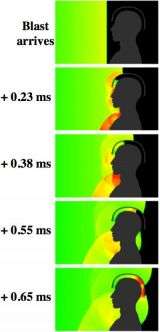
To understand this result, Mott and his colleagues at NRL ran computer simulations that modeled the physics of a large blast in much finer detail than could be measured experimentally. They used a digital version of a crash dummy head, a digital representation of a helmet, and a standard set of equations to predict the motion of the propagating blast wave.
What they discovered was that a helmet can act as a focusing mechanism. If a shockwave from a blast hits a helmeted head, it can penetrate the gap between the helmet and head, travel up inside the helmet, and come down the other side to focus on the side of the head facing away from the explosion. There, facing away from the blast, it can combine with other shock waves wrapping around the outside of the helmet and produce even greater pressures than the side facing into the blast.
It is not yet proven whether this redistribution of blast pressure to the opposite side of the head substantially contributes to risk for brain injury, says Mott. There were certain simplifications in his models that made the computation more manageable but may not completely represent the true physics of an explosion. For instance, he modeled the head as a rigid body and not a slightly malleable one as it is in reality. And he modeled the helmet with no support system -- just a gap between the head and helmet.
Before testing different helmet configurations, says Mott, he and his colleagues will have to verify that they are accurately reflecting the physics. They expect the helmet support system to mitigate the effects of the focusing to some extent, but the experimental data support the argument that this focusing is present in the blast tests as well. If this turns out to be the case, the research may help suggest ways to redesign helmets with flanges or shields that would redirect shockwaves from nearby explosions away from the opposite side of the head.
The talk, "Blast-Induced Pressure Fields Beneath a Military Helmet for Non-Lethal Threats" will take place on Tuesday, November 25, 2008. Abstract: meetings.aps.org/Meeting/DFD08/Event/90971
Source: American Institute of Physics


