To Make Better MRI Images, Let The Atoms Spin Out Of Control
November 25, 2008 To Make Better MRI Images, Let The Atoms Spin Out Of Control

Enlarge

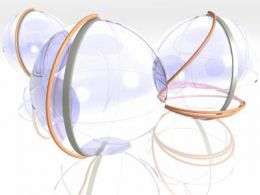
Scientists in Ohio and France have explained some strange atomic behavior, and made a discovery that could ultimately make MRI images sharper. This graphic depicts the quantum mechanical principal of super-adiabaticity, which was responsible for the behavior of atoms in some nuclear magnetic resonance experiments. If the trajectory of the atoms during an experiment were mapped on a globe, then the purpose of an adiabatic experiment is to move the atoms being studied from one point on the globe to another -- slowly, and following a very carefully designed path (gray line). With super-adiabaticity, the atoms follow a different -- sometimes, wildly different -- path (orange line), but still end up at the right destination. Image courtesy of Philip Grandinetti, Ohio State University

Researchers in Ohio and France have solved a longstanding scientific mystery involving magnetic resonance -- the physical phenomenon that allows MRI instruments in modern hospitals to image tissues deep within the human body. Their discovery, a new mathematical algorithm, should lead to new MRI techniques with more informative and sharper images.

As described in an article posted online today in the Journal of Chemical Physics, a peer-reviewed journal published by the American Institute of Physics (AIP), the work may even help scientists devise ways of using MRI without having to put people inside giant magnets -- an advance that could lead to portable and less costly MRIs.

The new work solves a mystery that has persisted for decades, says Philip Grandinetti, a professor of chemistry at The Ohio State University and one of the coauthors of the article. The solution to this mystery came as a result of their work in trying to optimize magnetic resonance pulse sequences. Specifically, they were looking for better ways of doing something known as an "inversion" in a magnetic resonance measurement.

Bathed in the magnetic field, atomic nuclei within water and other molecules throughout cells and tissues in a person's body will align themselves in the direction of the magnetic field. Inversion is an important process done in MRI scans that realigns the nuclei so they are against the magnetic field. When all is said and done, inverting the nuclei of people inside MRI scanners can reveal such things as cancer tumors, whose slightly different response to the changing field can be used to detect their presence amid surrounding healthy tissue.

These inversions of the nuclear spins are typically done "adiabatically". The method involves placing a patient inside the large donut-shaped magnet of an MRI instrument and applying low-power radio waves that sweep through a specific range of frequencies. If a frequency sweep is performed slowly enough then at the end of the process all the nuclei will be "inverted." The confounding thing, says Grandinetti, is that for decades adiabatic sweeps worked in many situations, even though the mathematics predicted that they should not have. Solving this mystery, Grandinetti and his colleagues turned to a new mathematical framework, called "superadiabaticity" that was discovered in the late 1980s by Michael Berry, a mathematical physicist at University of Bristol, but largely unappreciated until now.

The difference between the two processes is represented in the equations, and the upshot, says Grandinetti, is that now scientists have the correct mathematical framework to work with. This can help them design ways to better control MRI inversions and get more information out of MRI scans.

"We were just viewing the problem wrongly," says Grandinetti, who conducted the research in collaboration with his colleagues Michael Deschamps and Dominique Massiot at the National Center for Scientific Research (CNRS) in France and Gwendal Kervern, Guido Pintacuda, and Lyndon Emsley the University of Lyon in France.

"It is exciting because everyone missed this simple explanation," adds Grandinetti.

Grandinetti hopes to incorporate the algorithm into software for controlling MRI scans, where it would boost image resolution. One day, it might even help these instruments obtain signals from objects located outside of a magnet. Scientists, he adds, could also use superadiabaticity to exert better control over atoms for quantum computing, and to make more precise structural studies of complex biological molecules.

The article "Superadiabaticity in Magnetic Resonance" by Michael Deschamps et al. is being published online on November 25, 2008 in the Journal of Chemical Physics (Volume 129, issue 20). http://jcp.aip.org/

Source: American Institute of Physics


print this article email this article download pdf blog this article bookmark this article     Stumble it Digg this share on Facebook retweet share on Reddit add to delicious
Rate this story - 4.5 /5 (25 votes)

Rank Filter

Move the slider to adjust rank threshold, so that you can hide some of the comments.


Display comments: newest first

  • superhuman - Nov 25, 2008
    • Rank: 5 / 5 (2)
    This article fails to explain anything.
    What is "superadiabaticity"? How it differs from normal one? Why does it solve the problem?
  • localcooling - Nov 27, 2008
    • Rank: not rated yet
  • theophys - Nov 28, 2008
    • Rank: 1 / 5 (1)
    Ok...what exactly was this about?
    Better resolution for MRI's?
    Scientists just now starting to use equations discovered in the 80's?
    Some new principle in eclectomagnetic research?
    Pick a topic and stick with it!

November 25, 2008 all stories

Comments: 3

4.5 /5 (25 votes)
  • Stumble this up

  • Digg this

  • share this

  • hide
  • Related Stories

  • Study uses brain scans to discover how children 'read' faces
    created Nov 20, 2009 | popularity not rated yet | comments 0
  • UCSB physicists move one step closer to quantum computing
    created Nov 20, 2009 | popularity not rated yet | comments 0
  • The court will now call its expert witness: the brain
    created Nov 20, 2009 | popularity not rated yet | comments 0
  • Are teenagers wired differently than adults?
    created Nov 17, 2009 | popularity not rated yet | comments 0
  • Analyzing structural brain changes in Alzheimer's disease
    created Nov 16, 2009 | popularity not rated yet | comments 0


  • hide
  • Relevant PhysicsForums posts

  • moment of inertia and friction
    created 8 hours ago
  • two-dimensional collision
    created 10 hours ago
  • The acceleration of mass using light
    created 12 hours ago
  • Badminton
    created 14 hours ago
  • More from Physics Forums - General Physics

Other News

In the Brain, Seven Is A Magic Number

In the Brain, Seven Is A Magic Number

Physics / General Physics

created 16 hours ago | popularity 4.3 / 5 (22) | comments 7

Having a tough time recalling a phone number someone spoke a few minutes ago or forgetting items from a mental grocery list is not a sign of mental decline; in fact, it's natural.


Scientists react as they stand in front of a screen at CERN

First atoms reported smashed in Large Hadron Collider (Update)

Physics / General Physics

created 19 hours ago | popularity 4.7 / 5 (24) | comments 12

Two circulating beams on Monday produced the first particle collisions in the world's biggest atom smasher, the Large Hadron Collider (LHC), three days after its restart, scientists announced.


Straightening messy correlations with a quantum comb

Straightening messy correlations with a quantum comb

Physics / Quantum Physics

created 19 hours ago | popularity 4.8 / 5 (8) | comments 0

Quantum computing promises ultra-fast communication, computation and more powerful ways to encrypt sensitive information. But trying to use quantum states as carriers of information is an extremely delicate ...


New tool for helping pediatric heart surgery

Physics / General Physics

created 4 hours ago | popularity not rated yet | comments 0

A team of researchers at the University of California, San Diego and Stanford University has developed a way to simulate blood flow on the computer to optimize surgical designs. It is the basis of a new tool that may help ...


Visual assistance for cosmic blind spots

Visual assistance for cosmic blind spots

Physics / General Physics

created 20 hours ago | popularity 4.3 / 5 (3) | comments 0

A bit of imagination on the part of a measuring instrument wouldn't be a bad thing. It could help to add data from areas where the instrument is unable to measure. However, it must do so constructively. In ...