Meteorite search update: 10-ton rock responsible for fireball in Western Canada last week
November 25th, 2008 meteorite

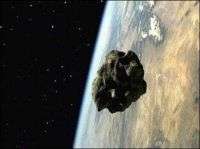
Investigation of the fireball that lit up the skies of Alberta and Saskatchewan on November 20 has determined that an asteroid fragment weighing approximately 10 tonnes entered the Earth's atmosphere over the prairie provinces last Thursday evening. And University of Calgary researcher Alan Hildebrand has outlined a region in western Saskatchewan where chunks of the desk-sized space rock are expected to be found.

The fireball first appeared approximately 80 kilometres above and just east of the border city of Lloydminster, Alberta/Saskatchewan, and traveled SSE towards the Battle River valley fragmenting spectacularly in a series of explosions.

The fireball penetrated the atmosphere at a steep angle of approximately 60 degrees from the horizontal and lasted about five seconds from 17:26:40 to 17:26:45 MST with the largest explosion at 17:26:44. The fireball was recorded on all-sky and security cameras scattered across Saskatchewan and Alberta in addition to being witnessed by tens of thousands of people who saw it streak across the sky, saw its arc- welding blue flash, or heard the subsequent explosions.

"Firstly, we are enormously appreciative of all the people who have volunteered information about the fireball. The public response to this fireball has been the largest that we have ever had in Canada." said Hildebrand, Canada Research Chair in Planetary Science and Coordinator of the Canadian Fireball Reporting Centre at the University of Calgary. Hildebrand said the fireball was like a billion-watt lightbulb shining in the sky, turning night into day with a bluish white light. It illuminated the ground for several hundred kilometers in all directions including as far south as Vauxhall, Alberta.

"Thanks to everyone's help we are now beginning to delineate the trajectory of the fireball, so that its prefall orbit can be determined. We have also outlined an area where its meteorites may have fallen, although we will have more precise predictions to come," Hildebrand added.

The asteroid fragment is now known to have weighed approximately 10 tonnes when it entered the Earth's atmosphere from an energy estimate derived from infrasound records by Dr. Peter Brown, Canada Research Chair in Meteor Physics at the University of Western Ontario. Infrasound is very low frequency sound produced by explosions that can travel thousands of kilometers.

"At least half a dozen infrasound stations ranging from Greenland to Utah, including Canada's Lac Du Bonnett, Manitoba and Elgin Field, Ontario stations, recorded energy from the fireball's explosions. The indicated energy is approximately one third of a kiloton of TNT," Brown said.

Dr. Brown also says that a fireball this size only occurs over Canada once every five years on average. About ten fireballs of this size occur somewhere over the Earth each year.

Dr. Hildebrand spent the weekend in the field interviewing witnesses and searching for security camera videos.

"We are now trying to get all the transient information about the fireball before it is lost. Many motels and gas stations only keep their security recordings for one week or less, so we urge everyone to check their systems to see if they recorded the fireball or the moving shadows that it cast," Hildebrand said. "Three gas stations and motels in Lloydminster, Lashburn and Maidstone are known to have records, but dozens of other businesses in the area probably have the fireball or its shadows recorded."

If fireball images are found, he suggests immediately saving a copy and contacting him. "With the security camera footage we can compute the fireball's trajectory in the sky to calculate the prefall orbit. Meteorites have only ever been recovered from known orbits nine times previously and we want to make that ten. "

Hildebrand estimates that hundreds of meteorites larger than 50 grams could have landed since the rock was large and its entry velocity was lower than average. The object's speed is calculated to be only roughly 14 km/sec when it entered the atmosphere versus the average of around 20 km/sec.

"We are now starting to reasonably constrain where the meteorites will have fallen. Many witnesses reported seeing a cluster of red fragments continuing downwards in the sky after the fireball exploded. These represent the rocks slowing down that will eventually fall to the ground as meteorites," Hildebrand said. "An outstanding thing about this fireball is that so many red fragments were seen and that they traveled so low to the ground before becoming invisible in the darkness."

The projected area of fall lies within Saskatchewan's Manitou Lake Rural Municipality north of Marsden and Neilburg, and just south of the Battle River in an area that is mostly cleared for cultivation.

"Several of the nearby eye witnesses describe sounds that could actually be from the meteorites falling through the sky, but we don't know that for sure yet. The eye witness descriptions are remarkably consistent with each other as to the location," Hildebrand said.

The remarkable consistency of the eyewitness accounts is probably partly explained by the dramatic dust clouds that marked the fireball's path. These clouds remained in the sky without much distortion for several minutes. From the fireball's characteristics Hildebrand thinks that it was a relatively strong rock and many rocks the size of a football or bigger are expected in addition to the more numerous small ones. Larger meteorites will have plunged into the ground if at all soft, making small pits with the meteorites at the bottom. Meteorites of common asteroids will have a dark gray or black coating covering their dimpled surface, be denser than the average rock, and will weakly attract a magnet, but other types of meteorites are possible.

The meteorites are expected to be scattered across a strewnfield approximately eight km long and three km wide with the larger stones to the southeast. Noting that they have a substantial commercial value, Hildebrand also advises that meteorites are the property of the landowner where they fall.

Hildebrand and Brown are both members of the Small Bodies Discipline Working Group that is funded by the Canadian Space Agency. Dr. Martin Beech at the University of Regina chairs this working group.

Hildebrand has returned to the field to continue gathering data and will be available only for pre-arranged phone interviews. Both Brown and Beech are available for comment at the contact information below.

See Google Map of search area at: http://maps.google.ca/maps/ms?ie=UTF8&hl=en&msa=0&msid=101407268858136267770.00045c7664e5121a35b7f&ll=52.957946,-109.741573&spn=1.111851,2.570801&z=9

Source: University of Calgary


print this article email this article download pdf blog this article bookmark this article     Digg this Stumble it share on Facebook share on Reddit add to delicious save to Yahoo! bookmarks
4.5/5 after 24 votes

Rank Filter

Move the slider to adjust rank threshold, so that you can hide some of the comments.


Display comments: newest first

  • Truth - Nov 25, 2008
    • Rank: 2 / 5 (5)
    This is highly unnerving. The fact that a 10 tonne rock can enter our atmosphere without being previously detected is a glaring testimonial to the utter uselessness of our meteor alert systems, if they even exist at all. Suppose this rock had hit Montreal, New York or Moscow...Yet we spend billions on cars, movies and cosmetics. What a total mockery of our priorities!
  • tkjtkj - Nov 26, 2008
    • Rank: 4.6 / 5 (5)
    This is highly unnerving. The fact that a 10 tonne rock can enter our atmosphere without being previously detected is a glaring testimonial to the utter uselessness of our meteor alert systems, if they even exist at all. Suppose this rock had hit Montreal, New York or Moscow...Yet we spend billions on cars, movies and cosmetics. What a total mockery of our priorities!


    You miss the point of searching
    for asteroids: it is not an
    effort to save any city: it is
    an effort to save the PLANET from
    the consequences of a mega-event.
    The technology for searching for
    football field sized asteroids
    has advanced significantly: soon
    a one-billion pixel telescope will
    go online .. and that represents
    a LOT of money! .. showing how
    important the effort is.
  • axemaster - Nov 26, 2008
    • Rank: 5 / 5 (4)
    Also note that a 10-ton rock is not capable of doing much damage, and is quite small. I can tell you, it is VERY difficult to detect something like that, especially if it has low albedo.
  • zevkirsh - Nov 26, 2008
    • Rank: 4 / 5 (4)
    This is highly unnerving. The fact that a 10 tonne rock can enter our atmosphere without being previously detected is a glaring testimonial to the utter uselessness of our meteor alert systems, if they even exist at all. Suppose this rock had hit Montreal, New York or Moscow...Yet we spend billions on cars, movies and cosmetics. What a total mockery of our priorities!


    alarmism. same reasons we went into iraq and the war on terror. next..the war on micro astroids.
  • denijane - Dec 03, 2008
    • Rank: not rated yet
    Searching for rocks heading for the Earth isn't that easy that movies make it look. The sky is simply too big. It's really troubling but that makes everyday stress more irrelevant. And in any case, the chance that a person dies from a car accident is significantly bigger than s/he dies from a meteor.

November 25th, 2008 all stories
Space & Earth / Space Exploration

Comments: 5
Rank: 4.5/5 after 24 votes

  • Stumble this up

  • Digg this

  • Share it:
  • share on Facebook
  • share on MySpace
  • share on Slashdot
  • rss-newsfeed
  • share on Google
  • share on Reddit
  • add to delicious
  • save to Yahoo! bookmarks
  • share on Windows Live
  • Add to Mixx!
Rating: 4.5/5 after 24 votes

  • Related Stories

  • Team Finds Riches in Meteorite Treasure Hunt
    created Mar 31, 2009 | popularity not rated yet | comments 0
  • How a cometary boulder lit up the Spanish sky
    created Feb 13, 2009 | popularity not rated yet | comments 0
  • University of Western Ontario cameras capture 'fireball'
    created Oct 24, 2008 | popularity not rated yet | comments 0
  • Scientist answers how Peruvian meteorite made it to Earth
    created Mar 11, 2008 | popularity not rated yet | comments 0
  • Canadian astronomers on hunt for meteor
    created Mar 07, 2008 | popularity not rated yet | comments 0


  • Physicists Demonstrate Quantum Memory with Matter Qubits
    Physicists Demonstrate Quantum Memory with Matter Qubits
    Physics / General Physics
    created Jul 03, 2009 | popularity 4.4 / 5 (17) | comments 1
  • 'Holey' Nanosheets for Wastewater Dye Removal
    Nanotechnology / Nanomaterials
    created Jul 01, 2009 | popularity 5 / 5 (5) | comments 1
  • Jellyfish Robot Swims Like its Biological Counterpart
    Jellyfish Robot Swims Like its Biological Counterpart
    Electronics / Robotics
    created Jun 26, 2009 | popularity 4.4 / 5 (8) | comments 1
  • Could Maxwell's Demon Exist in Nanoscale Systems?
    Could Maxwell's Demon Exist in Nanoscale Systems?
    Physics / General Physics
    created Jun 24, 2009 | popularity 4.4 / 5 (18) | comments 29
  • Living Safely with Robots, Beyond Asimov's Laws
    Living Safely with Robots, Beyond Asimov's Laws
    Electronics / Robotics
    created Jun 22, 2009 | popularity 4.6 / 5 (52) | comments 40
  • Other News

    Forty years ago man first walked on the moon

    Space & Earth / Space Exploration

    created 17 hours ago | popularity 4.3 / 5 (3) | comments 2

    Forty years ago on July 20, 1969, American astronaut Neil Armstrong realized the oldest dream of human civilizations when he became the first man to walk on the moon.


    The least sea ice in 800 years

    The least sea ice in 800 years

    Space & Earth / Earth Sciences

    created Jul 01, 2009 | popularity 4.2 / 5 (62) | comments 59

    New research, which reconstructs the extent of ice in the sea between Greenland and Svalbard from the 13th century to the present indicates that there has never been so little sea ice as there is now. The ...


    Gas around young galaxy

    Intense heat killed the Universe's would-be galaxies, researchers say

    Space & Earth / Astronomy

    created Jul 01, 2009 | popularity 3.4 / 5 (21) | comments 27

    (PhysOrg.com) -- Our Milky Way galaxy only survived because it was already immersed in a large clump of dark matter which trapped gases inside it, scientists led by Durham University's Institute for Computational ...


    Scientists' Drill Hits Magma: Only Third Time on Record

    Scientists' Drill Hits Magma: Only Third Time on Record

    Space & Earth / Earth Sciences

    created Jun 29, 2009 | popularity 4.7 / 5 (22) | comments 19

    (PhysOrg.com) -- Scientists drilling a borehole deep into Iceland’s rocky crust to explore new methods of using geothermal energy hit a major roadblock on Thursday: Their drill ran into molten rock at a depth ...


    NASA manager pitches a cheaper return-to-moon plan

    Space & Earth / Space Exploration

    created Jun 30, 2009 | popularity 4 / 5 (7) | comments 18

    (AP) -- Like a car salesman pushing a luxury vehicle that the customer no longer can afford, NASA has pulled out of its back pocket a deal for a cheaper ride to the moon.