New 'barcode chip' allows cheap, fast blood tests
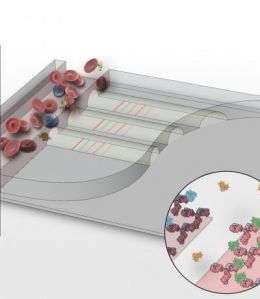
A new "barcode chip" developed by researchers at the California Institute of Technology (Caltech) promises to revolutionize diagnostic medical testing. In less than 10 minutes, and using just a pinprick's worth of blood, the chip can measure the concentrations of dozens of proteins, including those that herald the presence of diseases like cancer and heart disease.
The device, known as the Integrated Blood-Barcode Chip, or IBBC, was developed by a group of Caltech researchers led by James R. Heath, the Elizabeth W. Gilloon Professor and professor of chemistry, along with postdoctoral scholar Rong Fan and graduate student Ophir Vermesh, and by Leroy Hood, president of the Institute for Systems Biology in Seattle, Washington.
An IBBC, described in a paper in the advance online edition of Nature Biotechnology, is about the size of a microscope slide and is made out of a glass substrate covered with silicone rubber. The chip's surface is molded to contain a microfluidics circuit--a system of microscopic channels through which the pinprick of blood is introduced, protein-rich blood plasma is separated from whole blood, and a panel of protein biomarkers is measured from the plasma.
The chip offers a significant improvement over the cost and speed of standard laboratory tests to analyze proteins in the blood. In traditional tests, one or more vials of blood are removed from a patient's arm and taken to a laboratory, where the blood is centrifuged to separate whole blood cells from the plasma. The plasma is then assayed for specific proteins. "The process is labor intensive, and even if the person doing the testing hurries, the tests will still take a few hours to complete," says Heath. A kit to test for a single diagnostic protein costs about $50.
"We wanted to dramatically lower the cost of such measurements, by orders of magnitude," he says. "We measure many proteins for the cost of one. Furthermore, if you reduce the time it takes for the test, the test is cheaper, since time is money. With our barcode chip, we can go from pinprick to results in less than 10 minutes."
A single chip can simultaneously test the blood from eight patients, and each test measures many proteins at once. The researchers reported on devices that could measure a dozen proteins from a fingerprick of blood, and their current assays are designed for significantly more proteins. "We are aiming to measure 100 proteins per fingerprick within a year or so. It's a pretty enabling technology," Heath says.
To perform the assay, a drop of blood is added to the IBBC's inlet, and then a slight pressure is applied, which forces the blood through a channel. As the blood flows, plasma is skimmed into narrow channels that branch off from the main channel. This part of the chip is designed as if it were a network of resistors, which optimizes plasma separation.
The plasma then flows across the "barcodes." The barcodes consist of a series of lines, each 20 micrometers across and patterned with a different antibody that allows it to capture a specific protein from the plasma passing over. When the barcode is "developed," the individual bars emit a red fluorescent glow, whose brightness depends upon the amount of protein captured.
In the Nature Biotechnology paper, the researchers used the chip to measure variations in the concentration of human chorionic gonadotropin (hCG), the hormone produced during pregnancy. "The concentration of this protein increases by about 100,000-fold as a woman goes through the pregnancy cycle, and we wanted to show that we could capture that whole concentration range through a single test," Heath says.
The scientists also used the barcode chip to analyze the blood of breast and prostate cancer patients for a number of proteins that serve as biomarkers for disease. The types and concentrations of the proteins vary from disease to disease and between different individuals. A woman with breast cancer, for example, will produce a different suite of biomarkers than will a man with prostate cancer, while a woman with an aggressive form of cancer may produce proteins that are different from a woman with a less-deadly cancer.
Those proteins can also change as a patient receives therapy. Thus, determining these biomarker profiles can allow doctors to create individualized treatment plans for their patients and improve outcomes. The ease and the speed with which results can be obtained using the IBBC also will potentially allow doctors to assess their patients' responses to drugs and to monitor how those responses evolve with time, much as a diabetic patient might use a blood glucose test to monitor insulin delivery.
The barcode chip is now being tested in human clinical trials on patients with glioblastoma, a common and aggressive form of brain tumor. The researchers are also using the chips in studies of healthy individuals, to determine how diet and exercise change the composition of the proteins in the blood.
Currently, the barcoded information is "read" with a common laboratory scanner that is also used for gene and protein expression studies. "But it should be very easy to design something like a supermarket UPC scanner to read the information," making the process even more user-friendly, says Fan, the first author on the paper.
"As personalized medicine develops, measurements of large panels of protein biomarkers are going to become important, but they are also going to have to be done very cheaply," Heath says. "It is our hope that these IBBCs will enable such inexpensive and multiplexed measurements."
The paper, "Integrated barcode chips for rapid, multiplexed analysis of proteins in microliter quantities of blood," will be featured as the cover story in the December print edition of Nature Biotechnology.
Source: California Institute of Technology


