Nanomanufactured polymer film could lead to lower-cost solar cells
November 25th, 2008 By Bill Steele Nanomanufactured polymer film could lead to lower-cost solar cells

Enlarge

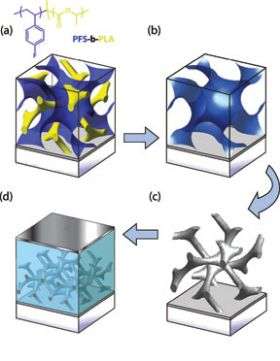
A self-assembled solar cell begins with one of two polymers forming a "gyroid" shape while the other fills in the space around it. The inner polymer is dissolved away to create a mold that is filled with a conductor of electrons. The outer polymer is then burned away, the conductor is coated with a photosensitive dye, and finally the surrounding space is filled with a conductor of positive "holes." A solar reaction takes place at all the interfaces throughout the material, and the interlocking gyroid structure efficiently carries away the current. Image: Wiesner Lab

(PhysOrg.com) -- You never know where basic research may lead. For decades materials scientists have been experimenting with a corkscrew-like polymer structure called a gyroid. Now an international team of researchers has shown that the gyroid structure can be used to "self-assemble" a low-cost photovoltaic cell.

The idea could lead to more economical solar collectors and more efficient fuel cells.
Nanomanufactured polymer film could lead to lower-cost solar cells

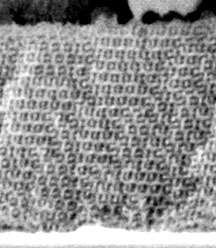
Scanning electron microscope photo of a thin film solar cell shows how the self-assembled gyroid structure interconnects in all directions, forming an easy path for current to flow out. Image: Wiesner Lab

The prototype is a variation on the Gräetzel solar cell, which uses an organic dye sandwiched between two conductors. Forming the conductors into an interlocking corkscrew allows current to be transported out efficiently. The team's first cell, made in a thin film 400 nanometers thick, has a conversion efficiency ranging from 0.7 to 1.7 percent -- low compared with silicon-based photocells, but "amazing" for such a thin film, said Ulrich Wiesner, the Spencer T. Olin Professor of Materials Science and Engineering at Cornell.

"The next step is to make it thicker" so more of the light falling on it can be captured, he said. "We hope that we will eventually get efficiencies that rival silicon-based devices." Currently available silicon-based solar cells convert about 15 percent of the energy of the light falling on them to electricity, although some new designs promise higher efficiencies.

The work by Wiesner and scientists at the Universities of Cambridge and Oxford in Britain, the Freiburg Institute for Advanced Studies in Germany, Institute Curie in France and the University of Minnesota, Minneapolis, is described in the online version of the journal Nano Letters and will appear in a forthcoming print issue.

The gyroid is one of four known structures that can be "self-assembled" at the nanoscale using block copolymers. A polymer is made up of organic molecules that chain together to form a solid or semisolid material. A block co-polymer is made by joining two molecules at the ends so that when they chain together, one forms a nanoscale pattern of repeating geometric shapes -- planes, spheres, cylinders or the twisted jungle-gym gyroid -- while the other fills the space in between.

Several years ago Wiesner's group showed that a block copolymer structure could be made in which just one of the polymers was a conductor of ions (charged atoms) and that the interconnected gyroid structure was the most efficient conductor.

To use this efficiency in a solar cell the researchers assembled a copolymer gyroid film, then dissolved away just the corkscrew part of the structure, leaving a corkscrew-shaped mold that they filled with titanium oxide. Heating then burned off the other polymer part and crystallized the titanium oxide into a solid structure that conducts electrons. This was coated with a light-sensitive dye, and finally the space around it was filled with a material that conducts "holes" (positive charges).

When light strikes the dye it knocks loose electrons, which flow into the titanium oxide framework, while the holes left behind flow into the other conductor. Electrodes above and below the film carry off the resulting current.

The secret of a solar cell, Wiesner explained, is that the electron-hole pairs must find the interface between the two conductors within 10 nanometers (about the width of 30 atoms) so they can separate and flow away, or they will recombine.

"This is why block copolymers are exciting," Wiesner said, "because that is the characteristic length scale of separation of the two blocks."

The experiments were done at Cambridge while Wiesner was on sabbatical there. Marleen Kamperman, a graduate student in Wiesner's group, used the facilities of the Cornell High-Energy Synchrotron Source (CHESS) for X-ray diffraction studies and interpreted transmission electron microscope images to show that the devices actually had the predicted gyroid structure.

Provided by Cornell University


print this article email this article download pdf blog this article bookmark this article     Digg this Stumble it share on Facebook share on Reddit add to delicious save to Yahoo! bookmarks
4.4/5 after 32 votes

Rank Filter

Move the slider to adjust rank threshold, so that you can hide some of the comments.


Display comments: newest first

  • TrustTheONE - Nov 26, 2008
    • Rank: not rated yet
    What I told you all yesterday????

    Everyday we hava some news about solar cells!!!
  • ShadowRam - Nov 26, 2008
    • Rank: not rated yet
    Wouldn't it make sense to create micro-prisms to divide the spectrum up, and have different materials that are better at absorbing different wavelengths laid out in a pattern?

November 25th, 2008 all stories
Nanotechnology / Nanomaterials

Comments: 2
Rank: 4.4/5 after 32 votes

  • Stumble this up

  • Digg this

  • Share it:
  • share on Facebook
  • share on MySpace
  • share on Slashdot
  • rss-newsfeed
  • share on Google
  • share on Reddit
  • add to delicious
  • save to Yahoo! bookmarks
  • share on Windows Live
  • Add to Mixx!
Rating: 4.4/5 after 32 votes


  • Physicists Demonstrate Quantum Memory with Matter Qubits
    Physicists Demonstrate Quantum Memory with Matter Qubits
    Physics / General Physics
    created Jul 03, 2009 | popularity 4.4 / 5 (17) | comments 1
  • 'Holey' Nanosheets for Wastewater Dye Removal
    Nanotechnology / Nanomaterials
    created Jul 01, 2009 | popularity 5 / 5 (5) | comments 1
  • Jellyfish Robot Swims Like its Biological Counterpart
    Jellyfish Robot Swims Like its Biological Counterpart
    Electronics / Robotics
    created Jun 26, 2009 | popularity 4.4 / 5 (8) | comments 1
  • Could Maxwell's Demon Exist in Nanoscale Systems?
    Could Maxwell's Demon Exist in Nanoscale Systems?
    Physics / General Physics
    created Jun 24, 2009 | popularity 4.4 / 5 (18) | comments 29
  • Living Safely with Robots, Beyond Asimov's Laws
    Living Safely with Robots, Beyond Asimov's Laws
    Electronics / Robotics
    created Jun 22, 2009 | popularity 4.6 / 5 (52) | comments 40
  • Other News

    A 'quantum of sol' -- how nanotechnology could hold the key to a solar-powered future

    A 'quantum of sol' -- how nanotechnology could hold the key to a solar-powered future

    Nanotechnology / Nanomaterials

    created Jun 30, 2009 | popularity 3.9 / 5 (14) | comments 16

    (PhysOrg.com) -- A new generation of 'nano-structured' millimetre-sized solar cells that could convert the sun's energy to electricity more than twice as efficiently as current technology, is the subject of ...


    Australian researchers are set to begin human trials of a tiny nano-cell that acts as a "Trojan horse" against cancer

    Hi-tech 'Trojan horse' can kill cancer cells: researchers

    Nanotechnology / Bio & Medicine

    created Jun 29, 2009 | popularity 4.6 / 5 (11) | comments 7

    Australian researchers are set to begin human trials of a tiny nano-cell that acts as a "Trojan horse" against cancer cells, a breakthrough they say may curb the need for debilitating chemotherapy.


    'Holey' Nanosheets for Wastewater Dye Removal

    Nanotechnology / Nanomaterials

    created Jul 01, 2009 | popularity 5 / 5 (5) | comments 1

    (PhysOrg.com) -- Researchers have discovered that extremely thin sheets of nickel oxide with hexagonally shaped holes can absorb hazardous dyes from wastewater nearly as well as the best traditional methods, but are recyclable. ...


    Harnessing Nanoparticles To Track Cancer Cell Changes

    Nanotechnology / Bio & Medicine

    created Jul 03, 2009 | popularity not rated yet | comments 1

    The more dots there are, the more accurate a picture you get when you connect them. Cancer researchers adopting that philosophy have developed a new imaging technology that could give scientists the ability to simultaneously ...


    Computer-Guided Nanoparticle Therapy Destroys Tumors

    Nanotechnology / Bio & Medicine

    created Jun 29, 2009 | popularity 5 / 5 (11) | comments 0

    Gold nanoshells are among the most promising new nanoscale therapeutics being developed to kill tumors, acting as antennas that turn light energy into heat that cooks cancer to death. Now, a multi-institutional research team ...