'Stress tests' probe nanoscale strains in materials
November 25, 2008 'Stress tests' probe nanoscale strains in materials

Enlarge

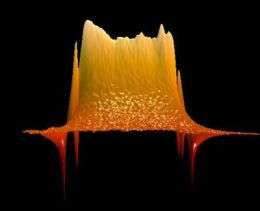
Confocal Raman microscopy image of stress in a silicon crystal caused by indentation with a 20-micrometer-long wedge. The image does not show the silicon but rather the magnitude of stress in the crystal, with compressive stress around the wedge going up from the base line. Vampiric red 'fangs' reveal tensile stress associated with cracking at the ends of the indentation. Credit: Stranick, NIST

Researchers at the National Institute of Standards and Technology have demonstrated their ability to measure relatively low levels of stress or strain in regions of a semiconductor device as small as 10 nanometers across. Their recent results* not only will impact the design of future generations of integrated circuits but also lay to rest a long-standing disagreement in results between two different methods for measuring stress in semiconductors.

Mechanical stress and strain in semiconductors and other devices is caused by atoms in the crystal lattice being compressed or stretched out of their preferred positions, a complex—and not always harmful—phenomenon. Stress in the underlying structure of light-emitting diodes and lasers can shift output colors and lower the device’s lifetime. Stress in microelectromechanical systems can lead to fracture and buckling that also truncates their lifespan.

On the other hand, stress is deliberately built into state-of-the-art microcircuits because properly applied it can increase the speed of transistors without making any other changes to the design. “Stress engineering has allowed the semiconductor industry to increase the performance of devices well beyond what was expected with the current materials set,” said NIST research physicist Robert Cook, “thus avoiding the significant engineering problems and expense associated with changing materials.”

Both the good and the bad stresses need to be measured, however, if they’re to be controlled by device designers. As the component size of microcircuits has become smaller and smaller, this has become more difficult—particularly since two different and widely used methods of stress measurement have been returning disparate results. One, electron back scattered diffraction (EBSD), deduces underlying stress by observing the patterns of electrons scattered back from the crystal planes. The other, confocal Raman microscopy (CRM), measures minute shifts in the frequency of photons that interact with the atomic bonds in the crystal—shifts that change depending on the amount of stress on the bond. The NIST team used customized, highly sensitive versions of both instruments in a series of comparison measurements to resolve the discrepancies.

The key issue, they found, was depth of penetration of the two techniques. Electron beams sample only the top 20 or 30 nanometers of the material, Cook explained, while the laser-generated photons used in CRM might penetrate as deep as a micrometer or more. The NIST researchers found that by varying the wavelength of the Raman photons and positioning the focus of the microscope they could select the depth of the features measured by the Raman technique—and when the CRM was tuned for the topmost layers of the crystal, the results were in close agreement with EBSD measurements.

The NIST instruments also demonstrate the potential for using the two techniques in combination to make reliable, nanoscale measurements of stress in silicon, which enables device developers to optimize materials and processes. EBSD, although confined to near-surface stress, can make measurements with resolutions as small as 10 nanometers. CRM resolution is about 10 times coarser, but it can return depth profiles of stress.

Citation: M.D. Vaudin, Y.B. Gerbig, S.J. Stranick and R.F. Cook. Comparison of nanoscale measurements of strain and stress using electron back scattered diffraction and confocal Raman microscopy. Applied Physics Letters 93, 193116. (2008)

Source: National Institute of Standards and Technology


print this article email this article download pdf blog this article bookmark this article     Stumble it Digg this share on Facebook retweet share on Reddit add to delicious
Rate this story - 5 /5 (1 vote)

Rank Filter

Move the slider to adjust rank threshold, so that you can hide some of the comments.


Display comments: newest first

  • Andy110 - Feb 13, 2009
    • Rank: not rated yet
    Stress%u2013strain measurements are reported for an elastomeric polyurea in uniaxial tension over a range of strain rates from 0.06 to 573 s%u22121. The experiments were carried out on a new drop weight test instrument, which provides mechanical data at strain rates up to 1000 s%u22121, filling the gap between conventional low speed instruments and split Hopkinson bar tests. The tensile data obtained herein are compared with recent high strain rate compression data on the same material [Yi et al. Polymer 2006;47:319%u201329]. Advantages of the present measurements include a more uniform strain rate and the ability to ensure homogeneous strain.

    ==================

    Anderson110

    Stock Market

November 25, 2008 all stories

Comments: 1

5 /5 (1 vote)
  • Stumble this up

  • Digg this

  • share this

  • hide
  • Related Stories


  • hide
  • Relevant PhysicsForums posts

  • Wave dispersion
    created 2 hours ago
  • Neutron
    created 3 hours ago
  • Obtaining research papers from journals
    created 7 hours ago
  • Vibration into Electricity?
    created 10 hours ago
  • More from Physics Forums - General Physics

Other News

Nanowire Formation

Nanowires key to future transistors, electronics

Nanotechnology / Nanophysics

created Nov 26, 2009 | popularity 4.8 / 5 (8) | comments 2

(PhysOrg.com) -- A new generation of ultrasmall transistors and more powerful computer chips using tiny structures called semiconducting nanowires are closer to reality after a key discovery by researchers ...


Water droplets direct self-assembly process in thin-film materials

Nanotechnology / Nanomaterials

created Nov 23, 2009 | popularity 5 / 5 (4) | comments 2

You can think of it as origami - very high-tech origami. Researchers at the University of Illinois have developed a technique for fabricating three-dimensional, single-crystalline silicon structures from thin films by coupling ...


Using superconducting probes to get a picture of what it's like inside CNTs

Nanotechnology / Nanophysics

created Nov 20, 2009 | popularity 4.4 / 5 (9) | comments 0

(PhysOrg.com) -- "Carbon nanotubes are exciting for fundamental physics, and for potential technological applications," Nadya Mason tells PhysOrg.com. "However, we are generally limited in the way that we can study them. ...


Peptides control crystal growth with 'switches, throttles and brakes'

Peptides control crystal growth with 'switches, throttles and brakes'

Nanotechnology / Bio & Medicine

created Nov 23, 2009 | popularity 4.8 / 5 (5) | comments 0

(PhysOrg.com) -- By producing some of the highest resolution images of peptides attaching to mineral surfaces, scientists have a deeper understanding how biomolecules manipulate the growth crystals. This research ...


Fast, easy, and highly sensitive arsenic detection with gold nanoparticles

Nanotechnology / Nanomaterials

created Nov 25, 2009 | popularity 5 / 5 (1) | comments 0

(PhysOrg.com) -- Mention of arsenic poisoning usually brings to mind underhanded murder. However, the danger of arsenic poisoning from contaminated drinking water is far greater. Low concentrations of arsenic are found in ...