A Best Friend of Humanity: The African Giant Pouched Rat
November 25, 2008 by Mary Anne Simpson
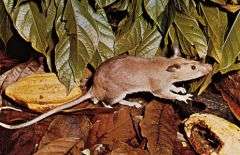
Giant Pouched Rat - Via Britannica Encyclopedia
(PhysOrg.com) -- The African Giant Pouched Rats, Cricetomys gambianus have been trained to methodically sniff out land mines in war-torn regions of Africa. Apopo International based in Antwerp, Belgium is a non-profit organization that trains and puts into action the raccoon size bomb sniffers. The Giant Pouched Rat is not a member of the rat subfamily Murinae, but is in fact a uniquely African radiation of muroid rodents.
The Giant Pouched Rat can weigh up to 9-pounds and in appearance resembles a hamster. Noted for large pouches located in their cheeks, the nocturnal Giant Pouched Rats are found in the wilds of Africa feasting on berries, nuts, insects and prefer palm fruit. A land mine clearing project in Mozambique using Apopo trained Pouched Rats has been operational for two-years and to date cleared 270 square miles of land in Southern Mozambique. Families dislocated from their land since the 1980s have been allowed to return to their villages and farms.
According to a spokesman trainer from Apopo the training is currently being done at Tanzania´s Sokoine University School of Agriculture. The training takes approximately 8 to 10 months at a cost of $3,000 to $5,000 per Pouched Rat. Canines have been trained to do the same work, however the cost for training can run up to $40,000. The additional advantage of using the Pouched Rats is their overall remarkable resistance to certain tropical disease and their weight does not trip land mines.
Tests to standardize the trained Pouched Rats were conducted by Sokoine University under the supervision of the Geneva International Centre for Humanitarian De-Mining. The trained rats are now officially licensed by the National De-Mining Institute of Mozambique. Numerous other African nations are joining in the effort to utilize the trained rats to clear land mine fields. Land mines are present on other continents as well.
The Giant Pouched Rats are indigenous to the lower parts of the Ulugura Mountains and known by natives as ´epanya bukui´. A distinct feature of the breed is its relatively long life-span that extends up to eight-years. Thus, the training, care and cost factors are greatly reduced as compared to rat sub-family breeds which is generally two to three years. The Apopo trained Pouched Rats work in early morning shifts before the Sun´s heat becomes unbearable. The Pouched Rats are able to sniff out plastic and metal mines. A Pouched Rat scratches the surface of a mine sight to signal to their handlers that a mine has been found. The handler then bestows a favorite treat to the mine sniffing victor.
The keen sense of smell possessed by the Giant Pouched Rats is being tapped to detect disease in sputum samples. Currently, trained Pouched Rats have detected more than 300 cases of tuberculosis in sputum samples that had not been diagnosed by the medical staff. Their extraordinary olfactory capabilities is currently under study for extending their usefulness to a myriad of circumstances.
Described as the "Hero Rat" by trainers and scientists, the Giant Pouched Rat does have some critics. Apparently, some private individuals have chosen to obtain the Pouched Rat as an exotic pet and then abandoned the pet in the wilds of the Florida Keys. The Pouched Rat is listed as an invasive species in Florida with a concern the rodent will impact the ecological balance of the Everglades. In 2003, the U.S. Centers for Disease Control and Prevention issued a ban on importing the Pouched Rat due to concerns of outbreaks of monkey-pox. The African breed is believed to be a carrier of monkey-pox.
Nevertheless, the keen sniffing, generally affable Giant Pouched Rat remains a hero to nations faced with the onerous tasks of ridding villages and farm land of mines. The Apopo trained Giant Pouched Rat is rigorously monitored by scientists and obviously cared for to the umph degree and poses no health concerns.
© 2008 PhysOrg.com
-
Sniffer 'hero rats' saving lives in war zones
Nov 08, 2010 |
4.9 / 5 (8) |
2
-
Will monkeypox be the next smallpox?
Sep 28, 2010 |
5 / 5 (3) |
0
-
Discovery of a 160-million-year-old fossil represents a new milestone in early mammal evolution
Aug 24, 2011 |
4.5 / 5 (17) |
4
-
Pouched killers not poor cousins of carnivores
Nov 24, 2010 |
5 / 5 (4) |
0
-
Naming evolution's winners and losers
Jul 29, 2009 |
3.3 / 5 (11) |
8
-
Engineers build first sub-10-nm carbon nanotube transistor
Feb 01, 2012 |
4.9 / 5 (33) |
30
-
Something old, something new: Evolution and the structural divergence of duplicate genes
Jan 31, 2012 |
4.6 / 5 (7) |
1
-
The hidden nanoworld of ice crystals: Revealing the dynamic behavior of quasi-liquid layers
Jan 30, 2012 |
5 / 5 (4) |
1
-
Stock market network reveals investor clustering
Jan 27, 2012 |
3.9 / 5 (23) |
8
-
Of microchemistry and molecules: Electronic microfluidic device synthesizes biocompatible probes
Jan 26, 2012 |
5 / 5 (2) |
0
-
Bohr-Einstein debate: why did Bohr not simply say...
Feb 06, 2012
-
Best/Worst U.S. Presidents
Jan 31, 2012
- More from Physics Forums - History & Humanities
More news stories
A frank discussion of the power law and linking correlation to causation
(PhysOrg.com) -- Michael Stumpf a mathematics professor at Imperial College in London, and Mason Porter a lecturer at Oxford have teamed together to write and publish a perspective piece in Science regarding the in ...
US workers are 'giving away the store,' costing firms billions
Nearly 70 percent of the nation's service employees give away free goods and services from hamburgers to cable TV costing companies billions of dollars a year, according to a groundbreaking study.
Other Sciences / Economics & Business
Feb 09, 2012 |
3 / 5 (5) |
11
Employers feel no love for unscrupulous practice of 'service sweethearting'
A new study led by two Florida State University marketing professors finds that some frontline service employees who are rewarded for hikes in customer loyalty and satisfaction also may engage in "service ...
Other Sciences / Economics & Business
Feb 10, 2012 |
3.3 / 5 (3) |
10
New insights into how to correct false knowledge
The abundance of false information available on the Internet, in movies and on TV has created a big challenge for educators.
Other Sciences / Social Sciences
Feb 07, 2012 |
4.9 / 5 (7) |
9
|
Neanderthal demise due to many influences, including cultural changes: study
As an ice age crept upon them thousands of years ago, Neanderthals and modern human ancestors expanded their territory ranges across Asia and Europe to adapt to the changing environment.
Other Sciences / Archaeology & Fossils
Feb 07, 2012 |
4.4 / 5 (5) |
8
|
Scientists discover molecular secrets of 2,000-year-old Chinese herbal remedy
For roughly two thousand years, Chinese herbalists have treated Malaria using a root extract, commonly known as Chang Shan, from a type of hydrangea that grows in Tibet and Nepal. More recent studies suggest that halofuginone, ...
New method to examine batteries -- MRI from the inside
There is an ever-increasing need for advanced batteries for portable electronics, such as phones, cameras, and music players, but also to power electric vehicles and to facilitate the distribution and storage of energy derived ...
A mitosis mystery solved: How chromosomes align perfectly in a dividing cell
Although the process of mitotic cell division has been studied intensely for more than 50 years, Whitehead Institute researchers have only now solved the mystery of how cells correctly align their chromosomes during symmetric ...
Google might launch Drive for cloud storage soon
(PhysOrg.com) -- Google's next big move, according to the Wall Street Journal, is a cloud storage service called Drive. Hardly first to the plate, Google is simply catching up to introducing its cloud reposi ...
Lab study raises questions over nano-particle impact
Tests involving chickens have raised questions about the impact on health from engineered nano-particles, the ultra-fine grains commonly used in drugs and processed foods, scientists said on Sunday.
Starve a virus, feed a cure? Findings show how some cells protect themselves against HIV
A protein that protects some of our immune cells from the most common and virulent form of HIV works by starving the virus of the molecular building blocks that it needs to replicate, according to research published online ...
Nov 25, 2008
Rank: 1 / 5 (3)
Nov 26, 2008
Rank: 1 / 5 (2)
http://xrl.in/14nw
Nov 26, 2008
Rank: 1 / 5 (1)
Nov 26, 2008
Rank: 1 / 5 (1)
i could *ask* that you don't rate someone down simply because you disagree with an opinion. Physorg recycles a a helluva lot of news articles.