Neutron Researchers Discover Widely Sought Property in Magnetic Semiconductor
November 25, 2008
Neutron Researchers Discover Widely Sought Property in Magnetic Semiconductor

Enlarge

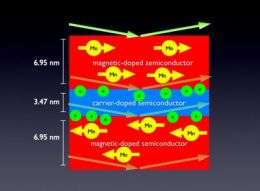
Researchers working at NIST have confirmed that thin magnetic layers (red) of a semiconductor separated by a nonmagnetic layer (blue) can exhibit a coveted phenomenon known as "antiferromagnetic coupling," in which manganese (Mn) atoms in successive magnetic layers spontaneously orient their magnetization in opposite directions. This discovery, made by scattering neutrons (arrows) from the material, raises the prospects of "spintronic logic circuits" that could both store and process data. Credit: Brian Kirby, NIST

(PhysOrg.com) -- Researchers working at the National Institute of Standards and Technology have demonstrated for the first time the existence of a key magnetic—as opposed to electronic—property of specially built semiconductor devices. This discovery raises hopes for even smaller and faster gadgets that could result from magnetic data storage in a semiconductor material, which could then quickly process the data through built-in logic circuits controlled by electric fields.

Magnetic data storage is currently utilized with great success in consumer products such as computer hard drives and MP3 players. But these storage devices are based on metallic materials. These conventional hard drives can only hold data; they have to send the data to a semiconductor-based device to process the data, slowing down performance.

In a new paper, researchers from NIST, Korea University and the University of Notre Dame have confirmed theorists’ hopes that thin magnetic layers of semiconductor material could exhibit a prized property known as antiferromagnetic coupling—in which one layer spontaneously aligns its magnetic pole in the opposite direction as the next magnetic layer. The discovery of antiferromagnetic coupling in metals was the basis of the 2007 Nobel Prize in Physics, but it is only recently that it has become conceivable for semiconductor materials. Semiconductors with magnetic properties would not only be able to process data, but also store it.

The most widely studied magnetic semiconductor is gallium arsenide (GaAs) with magnetic atoms (manganese) taking the place of some of the gallium atoms. Theorists had predicted that by creating thin films of this material separated by a nonmagnetic material of just the right thickness and electrical properties, one could engineer antiferromagnetic (AF) coupling. With magnetic fields, one could then switch the magnetization of one of the layers back and forth to create “spintronic” logic circuits, ones that operate not only under the usual control of electric fields but also the influence of magnetic fields (manipulating a property known as spin, which could be imagined as tiny internal bar magnets in particles such as electrons).

The team, working at the NIST Center for Neutron Research, studied these multilayer stacks using a technique known as polarized neutron reflectometry. In this technique, a beam of neutrons is bounced off the stacks. Since neutrons are magnetic, and are able to easily penetrate through the entire stack, the reflected neutrons provide information about the magnetic properties of the individual layers. At low temperatures and small magnetic fields, the polarized neutron data unambiguously confirm the existence of an antiparallel magnetic alignment of neighboring layers. When the magnetic field was increased, the neutron data indicated a parallel alignment of all layers. These results demonstrate that AF coupling is achievable in GaMnAs-based multilayers, a seminal property that now opens up a multitude of device possibilities for this novel material. While the phenomenon only occurs at very cold temperatures in the material (about 30 K), the researchers believe these results will help inform theorists who could then better understand how to create room-temperature devices with the same magnetic properties.

Citation: J.-H. Chung, S.J. Chung, S. Lee, B.J. Kirby, J.A. Borchers, Y.J. Cho, X.Liu and J.K. Furdyna, Carrier-mediated antiferromagnetic interlayer exchange coupling in diluted magnetic semiconductor multilayers Ga1-xMnxAs/GaAs:Be. Physical Review Letters, to be published.

Source: National Institute of Standards and Technology

4.4 /5 (21 votes)  

Filter


Move the slider to adjust rank threshold, so that you can hide some of the comments.


Display comments: newest first

zevkirsh
Nov 25, 2008

Rank: 1.5 / 5 (2)
this , combined with AI and magneti
cally reprogrammable circuitry will help expedite the beginning of a new phase of a-i chips.
theophys
Nov 28, 2008

Rank: not rated yet
Neato
This probably won't turn up any practical inventions for another decade or two, but neato none the less
Rank 4.4 /5 (21 votes)
Relevant PhysicsForums posts
  • Gauss' law cubes, how to prove
    created2 hours ago
  • A grandfather pulls his granddaughter, whose mass is 20.5 kg
    created3 hours ago
  • what is significance of torque
    created3 hours ago
  • Difference between volume displaced fluid and volume of the object
    created4 hours ago
  • Questions about Galileo statement?
    created5 hours ago
  • Question on Kirchoff's Laws
    created9 hours ago
  • More from Physics Forums - General Physics

More news stories

Borexino Collaboration succeeds in spotting pep neutrinos emitted from the sun

(PhysOrg.com) -- To learn more about how the sun works, scientists study particles that are emitted from it into space due to thermonuclear reactions that occur inside; by applying known physics principles, ...

Physics / General Physics

created 17 hours ago | popularity 4.6 / 5 (7) | comments 0 | with audio podcast report

Explained: Sigma

It's a question that arises with virtually every major new finding in science or medicine: What makes a result reliable enough to be taken seriously? The answer has to do with statistical significance -- but ...

Physics / General Physics

created 17 hours ago | popularity 5 / 5 (10) | comments 30

Physics research suggests new pathways for cancer progression

Observing that certain cancer cells may exhibit greater flexibility than normal cells, some scientists believe that this capability promotes rapid tumor growth. Now computer simulations developed by Boston University Biomedical ...

Physics / General Physics

created 15 hours ago | popularity 5 / 5 (1) | comments 0

Quantum physicist explains $100K offer for proof scaled-up quantum computing is impossible

(PhysOrg.com) -- MIT researcher Scott Aaronson has certainly riled the physics community with his offer this past Friday, of $100,000 to anyone who can prove that scaled-up quantum computing is impossible. ...

Physics / Quantum Physics

created Feb 08, 2012 | popularity 4.1 / 5 (11) | comments 32 | with audio podcast weblog

Physicists 'record' magnetic breakthrough

An international team of scientists has demonstrated a revolutionary new way of magnetic recording which will allow information to be processed hundreds of times faster than by current hard drive technology.

Physics / General Physics

created Feb 07, 2012 | popularity 4.5 / 5 (39) | comments 14 | with audio podcast


'Dark plasmons' transmit energy

Microscopic channels of gold nanoparticles have the ability to transmit electromagnetic energy that starts as light and propagates via "dark plasmons," according to researchers at Rice University.

FDA-approved drug rapidly clears amyloid from the brain, reverses Alzheimer's symptoms in mice

Neuroscientists at Case Western Reserve University School of Medicine have made a dramatic breakthrough in their efforts to find a cure for Alzheimer's disease. The researchers' findings, published in the journal Science, show t ...

Hydrogen from acidic water: Researchers develop potential low cost alternative to platinum for splitting water

A technique for creating a new molecule that structurally and chemically replicates the active part of the widely used industrial catalyst molybdenite has been developed by researchers with the Lawrence Berkeley ...

Ultraviolet protection molecule in plants yields its secrets

Lying around in the sun all day is hazardous not just for humans but also for plants, which have no means of escape. Ultraviolet (UV) radiation from the sun can damage proteins and DNA inside cells, leading ...

Anyone can learn to be more inventive, cognitive researcher says

There will always be a wild and unpredictable quality to creativity and invention, says Anthony McCaffrey, a cognitive psychology researcher at the University of Massachusetts Amherst, because an "Aha moment" is rare and ...

Soraa LED light may dim 50-watt halogen rivals

(PhysOrg.com) -- Soraa, a Fremont, California company founded in 2008, this week launched its first product, a light that uses LEDS (light emitting diodes). The "Soraa LED MR16 lamp" is the "perfect" replacement ...