Spider Payload on Space Station Becomes a Media Hit, Internet Music Video
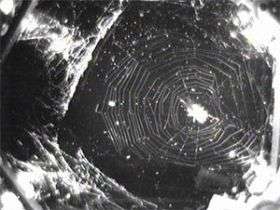
November 25, 2008 Spider on International Space Station

Enlarge

A spider launched to the International Space Station by CU-Boulder researchers as part of a K-12 outreach effort practices its web-spinning talents in the near-weightless environment of space. Image courtesy NASA

(PhysOrg.com) -- A University of Colorado at Boulder payload of web-spinning spiders and wannabe butterflies delivered to the International Space Station by the space shuttle Endeavour Nov. 14 has generated a buzz among scientists, astronauts, the news media and has even spawned an Internet video set to the music of "The Itsy-Bitsy Spider."

The story began Nov. 14 when a payload containing two orb-weaving spiders and six butterfly larvae was launched to the space station by CU-Boulder's BioServe Space Technologies. The project was designed to allow K-12 students to chart the behaviors of the creatures in the near-weightless environment of space and compare them with their earthbound counterparts.

Colorado and Texas students have their own spiders and butterfly larvae in their classrooms and are playing along at home, so to speak, comparing the differences using video and images beamed from the space station back to Earth by NASA.

The story literally "got some legs" following a news item in the Times of London Nov. 16 with a headline reading "NASA Loses Spider on the International Space Station." The report wasn't quite accurate -- the astronauts knew both spiders were in the payload compartment -- but could not see one of them because it was hidden from view.

The spider activity grabbed the attention of the public, appearing in national wire stories, on the MSNBC news Web site and on the Examiner.com Web site headquartered in San Francisco with regional links to dozens of large U.S. cities. The Examiner site posted a video featuring "space" spiders spinning weightless webs as NASA scientists described the behaviors in low gravity and a child's choir sings "The Itsy-Bitsy Spider."

"Don't forget about the butterflies," said Stefanie Countryman, BioServe's payload mission manager. The larvae -- some anchored to the habitat, others free-floating -- should enter the chrysalis, or pupa, stage by Thanksgiving, then emerge as full-fledged butterflies that hopefully will be flapping about in micro-gravity in about 10 days.

For more information on the project go to http://bioedonline.org/space/index.cfm

Provided by University of Colorado at Boulder


print this article email this article download pdf blog this article bookmark this article     Stumble it Digg this share on Facebook retweet share on Reddit add to delicious
Rate this story - 3.6 /5 (20 votes)

Rank Filter

Move the slider to adjust rank threshold, so that you can hide some of the comments.


Display comments: newest first

  • Ausjin - Nov 25, 2008
    • Rank: 5 / 5 (1)
    Well, more of a human interest story than news, but I have to admit that I am curious how flying insects will behave in microgravity. Does their instinctual navigation factor in gravity, or is it based purely on orientation and spacial relations?
  • Dinotron - Nov 25, 2008
    • Rank: 5 / 5 (1)
    I think they'll be a dit disoriented at first, then, like all creatures usually do, they'll adapt to their environment.
  • yOnsa - Nov 25, 2008
    • Rank: 1 / 5 (1)
    why is this a media hit? say it 'aint so momma!
  • _Scott_ - Nov 26, 2008
    • Rank: not rated yet
    And I for one welcome our new insect overlords
  • ShadowRam - Nov 26, 2008
    • Rank: not rated yet
    would insect wings even work in microgravity?
  • SMLinDC - Nov 26, 2008
    • Rank: not rated yet
    This is a "media hit" because people can relate to a spider or a butterfly. Anything that causes the general population to focus on space science and our men and women in the ISS is a very GOOD thing for the future of the space program "momma."
  • Going - Nov 28, 2008
    • Rank: not rated yet
    The web look a mess to me. What does this reveal about the part a direction of gravity has on the neural "program" the spider uses to weave an orb web? How dies the spider sense the direction of gravity? What is the minimum G a spider needs to weave a decent web? All these remain unanswered.
  • smiffy - Nov 28, 2008
    • Rank: not rated yet
    You're a hard man to please, Going.

    I don't think that the spider has done so bad. At least it hasn't lost its toolbag.
  • nevereverever - Dec 01, 2008
    • Rank: not rated yet
    So did this spider pass the exam....or did he muff the web.?

November 25, 2008 all stories

Comments: 9

3.6 /5 (20 votes)
  • Stumble this up

  • Digg this

  • share this

  • hide
  • Related Stories

  • CU-Boulder to launch butterfly, spider K-12 experiments Nov. 14 on space shuttle
    created Nov 10, 2008 | popularity not rated yet | comments 0
  • Engineers probe spiders' polymer art
    created Oct 30, 2006 | popularity not rated yet | comments 0
  • Tiny Wasp Saves Pacific Island Paradise
    created Jun 21, 2006 | popularity not rated yet | comments 0
  • Japan eyes solar station in space as new energy source
    created 21 hours ago | popularity not rated yet | comments 0
  • Station Prepares For New Spacecraft, Monitors Debris
    created Nov 06, 2009 | popularity not rated yet | comments 0


  • hide
  • Relevant PhysicsForums posts

  • The shape of our solar system's orbits.
    created Nov 07, 2009
  • Above or Below the Line of Nodes
    created Nov 07, 2009
  • Supernova vs. Nova?
    created Nov 07, 2009
  • Supernova's Gamma Rays and Comets
    created Nov 06, 2009
  • More from Physics Forums - General Astronomy

Other News

Deep creep means milder, more frequent earthquakes along Southern California's San Jacinto fault

Deep creep means milder, more frequent earthquakes along Southern California's San Jacinto fault

Space & Earth / Earth Sciences

created 14 hours ago | popularity 4.7 / 5 (3) | comments 0

With an average of four mini-earthquakes per day, Southern California's San Jacinto fault constantly adjusts to make it a less likely candidate for a major earthquake than its quiet neighbor to the east, the ...


Success in 'space elevator' competition (AP)

Success in 'space elevator' competition (Update 3)

Space & Earth / Space Exploration

created Nov 05, 2009 | popularity 4.3 / 5 (33) | comments 50

(AP) -- A robot powered by a ground-based laser beam climbed a long cable dangling from a helicopter on Wednesday to qualify for prize money in a $2 million competition to test the potential reality of the ...


In a Galaxy Far, Far Away...

In a Galaxy Far, Far Away...

Space & Earth / Astronomy

created Nov 06, 2009 | popularity 4.8 / 5 (5) | comments 17

(PhysOrg.com) -- Astronomers have published the discovery of the farthest known object in the cosmos: a star that exploded when the universe was only 630 million years old -- only 4.6% of its current age. ...


'Dropouts' pinpoint earliest galaxies

'Dropouts' pinpoint earliest galaxies

Space & Earth / Astronomy

created Nov 06, 2009 | popularity 4.2 / 5 (10) | comments 13

Astronomers, conducting the broadest survey to date of galaxies from about 800 million years after the Big Bang, have found 22 early galaxies and confirmed the age of one by its characteristic hydrogen signature ...


Space hotel taking bookings for 2012 opening

Space hotel taking bookings for 2012 opening

Space & Earth / Space Exploration

created Nov 05, 2009 | popularity 4.4 / 5 (21) | comments 11

(PhysOrg.com) -- The first orbiting space hotel is on track to open for its first customers in 2012, but hurry, as bookings are filling fast.