An emergency brake in the brain
Brain researchers at the University of Oslo in Norway have penetrated deeply into the innermost secrets of the brain to find out how brain cells can survive a stroke. Strokes are usually caused by occlusion of one of the blood vessels in the brain. When blood is prevented from supplying vital oxygen and energy to the brain cells, their electrochemical balance is upset, and they cause damage to themselves and to the surrounding brain cells before they collapse and die. Often this affects the memory centre, the hippocampus, where the cells are particularly vulnerable.
There is hope, however. New research results indicate that the brain cells are equipped with an ingenious mechanism that can save them in extreme emergencies.
"You can call it an emergency brake in the brain if you like," says Professor Johan Storm at the Institute for Basic Medical Sciences and the Centre for Molecular Biology and Neuroscience at the University of Oslo. For the last 25 years, he has studied this emergency brake and other vital functions of the brain cells.
"Our goal is to clarify how this emergency brake functions, and whether it protects against strokes or other extreme strains, like when a person nearly drowns or suffocates, or even in the case of extremely low blood-sugar levels," he says to the research magazine Apollon.
An incredible machinery
The brain cells float in a pool of brain fluid and have no direct contact with each other. Still, a single brain cell can communicate with more than 20 000 other brain cells.
As a means of communication, the brain cells use glutamate. The glutamate is stored in small vesicles at the end of the long, thin nerve fibres of the brain cell. When an electric impulse travels along the fibre, the vesicles release their content. The content spreads like a flash to the neighbouring cell, whereupon the vesicles are recharged.
"It is an incredible piece of machinery. The glutamate can be compared to a relay baton being passed on to the next cell."
The concentration of calcium ions (electrically charged calcium atoms) decides how many batons will be passed on. Therefore, it is essential to keep the electrochemical balance in the brain as stable as possible.
The brain cell possesses advanced mechanisms that can both accept and release calcium ions. Both of these mechanisms are equally essential.
There are sufficient calcium reserves available. The concentration of calcium ions in the surrounding brain fluid is twenty thousand times higher than inside the brain cell itself.
Calcium ions flow into the brain cell through thousands of minute ion channels in the ultra-thin membrane on the nerve endings. These channels consist of tube-shaped molecules. There are a large number of these ion channels and each will allow passage of only one particular type of atom. The channels that accept calcium ions are referred to as calcium channels. The calcium from the ion channels is essential for connecting nerve impulses in the brain.
To maintain a low concentration of calcium ions, the brain cells pump them back out. These pumps are dependent on energy. A stroke, blocking the energy supply, is therefore a dramatic event.
"The calcium piles up, causing the brain cell to be over-agitated and to release glutamate at random. An overdose of glutamate poisons the brain cells, and they risk dying."
Easing the crisis
Incredibly, the brain cells have developed an ingenious crisis-relief system. Johan Storm discovered the function of a specific emergency brake more than twenty years ago. The emergency brake serves to restrict the inflow of calcium ions.
Help is provided by the neighbouring channels of the calcium channels. The neighbouring channels are referred to as BK channels. Their job is to transport potassium out of the brain cell.
"In less than a millisecond the calcium streaming in through the calcium channels will activate the BK channels. The BK channels create a voltage change that feeds back to the calcium channels, causing the inflow of calcium to stop very rapidly."
There are many indications that the BK channels are closed when the brain functions normally. We may surmise, however, that the channels are in use during the dramatic seconds before an infant draws its first breaths of air moments after being born.
The brain cell is so wisely constructed that the BK channels open only when the energy supply stops.
In other words, if scientists are able to produce a drug that can keep the BK channels open for longer periods, the calcium channels could close even faster. This could serve to restrict the inflow of calcium in emergencies.
"That is why we refer to the BK channel as an emergency brake. You can compare it to having an extra drain in your bathroom. Usually, one drain is enough, but in emergencies, an extra drain could prove useful. Smart, isn’t it?"
The pharmaceutical industry is currently searching for drugs that can promote the opening of the BK channel and thereby make use of the natural braking mechanism in the treatment of stroke patients.
However, their success is far from taken for granted. There is the possibility that the BK channel already functions optimally.
Genetically modified mice
BK channels are not only found in the human brain. The channels have been discovered even in glandular and muscular cells and in peripheral nerve cells in snails, fruit flies and frogs.
"This means that for hundreds of millions of years the BK channel has served as an important regulatory mechanism in many types of nervous systems spread throughout the animal kingdom. The mechanism even has roots back to monocellular animals and bacteria. Our brain is therefore the result of an evolution that has gone on for more than two billion years."
In order to study the importance of BK channels, Johan Storm is collaborating with Professor Peter Ruth at the University of Tübingen on a project studying what happens when genetically modified mice without BK channels suffer from a stroke.
"Our main finding is that these mice have a lower survival rate following a stroke, and that more brain cells die among those who survive. The mice therefore suffer more strongly from a stroke than normal mice."
A stroke in a dish
The hypothesis is simultaneously tested using another scientific method. Because BK channels have been detected in the muscle cells of blood vessels, the emergency brake could be associated with the absence of BK channels in the vessels of the genetically modified mice.
To exclude this possibility, Johan Storm’s research group has undertaken research on stroke in a dish.
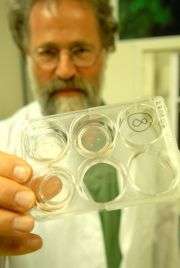
In this experiment, the researchers cut half-millimetre thick sections from the memory centre, the hippocampus, of normal mice as well as genetically modified mice without BK channels.
The brain samples in the dish are fed with oxygen and sugar. Then the supply is stopped, causing the samples to suffer from acute energy shortage, simulating an acute stroke. Subsequently, the researchers resume the energy supply to the brain samples, observing what happens to them over the next hours and days.
Even here, it appears as if the brain cells from mice without BK channels have a reduced survival rate. This could therefore confirm the hypothesis that the emergency brake in fact works.
Epilepsy
Epilepsy researchers benefit from Johan Storm’s studies. Two years ago his research team found that the BK channels at the root of the brain cell, where the nerve impulses are formed, do not function as an emergency brake. On the contrary.
"These BK channels can increase the frequency of nerve impulses, and they are also active under normal conditions, when the cells receive sufficient oxygen."
This could explain another interesting discovery made in the US: A mutation causing the BK channels to open more often than they normally do may cause epilepsy.
"It is therefore conceivable that closing the BK channels could prevent epilepsy. And vice versa: Promoting the opening of BK channels following a stroke may increase the risk of epilepsy," Johan Storm explains.
There is hope, however. Even though all BK channels have one gene in common, the BK channels have several variants. It is therefore conceivable that the BK channels are of a different nature in the various parts of the brain cell.
Using the HIV virus
Johan Storm now wishes to study what happens when different types of ion channels are turned off and on. Although we have a good overview of the active genes in the brain cells, the functions of the individual proteins and ion channels are still not conclusively established.
Genetically modified mice are costly, and isolating the manipulation to a specific location in the brain is complicated. In addition, breeding mice with new properties takes a long time. Johan Storm therefore has started to use viruses to change the genetic composition of the brain. This allows him to decide exactly what to manipulate in the brain cells.
"We start with a reconstructed HIV virus. After the virus has been stripped of most of its normal genes, they are weakened, unable to proliferate and so harmless that they hardly can be referred to as viruses anymore. We can still use them to insert the desired genes. When the virus enters the cell, it injects its genes and modifies the genome in the cell core. In this manner, we can switch the ion channels on and off. This allows us to investigate the roles filled by the channels and the individual brain cells."
"In the future, we can envisage using this method for purposes of medical treatment. We could correct congenital genetic disorders and manipulate the channels and proteins in the brain. It is an intriguing vision, but there is still a long way to go, Professor Johan Storm concludes to the research magazine Apollon at University of Oslo in Norway."
Provided by University of Oslo


