It takes guts to build bone, Columbia scientists discover
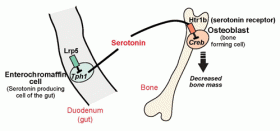
(PhysOrg.com) -- Bone growth is controlled in the gut through serotonin, the same naturally present chemical used by the brain to influence mood, appetite and sleep, according to a new discovery from researchers at Columbia University Medical Center. Until now, the skeleton was thought to control bone growth, and serotonin was primarily known as a neurotransmitter acting in the brain. This new insight could transform how osteoporosis is treated in the future by giving doctors a way to increase bone mass, not just slow its loss. Findings are reported in the Nov. 26, 2008 issue of Cell.
Researchers have known that 95 percent of the body's serotonin is produced by a part of the gastrointestinal tract known as the duodenum, where it was presumed to be involved in digestion. The brain is where the remaining five percent of the body's serotonin is produced.
The Columbia research group, led by Gerard Karsenty, M.D., Ph.D., chair of the Department of Genetics and Development at Columbia University College of Physicians and Surgeons, had originally set out to elucidate two rare human diseases affecting bone that are both caused by a mutation in a gene called Lrp5. To their surprise, Dr. Karsenty and his team found that Lrp5 regulates synthesis of serotonin in the gut, and that by turning on or turning off the production of this chemical within the gut, they could control bone formation. Specifically, they found that serotonin tells cells in the skeleton to slow production of new bone. By turning off the intestine's release of serotonin, the team was able to prevent osteoporosis in mice undergoing menopause.
"This proof-of-principle paper shows, to our amazement, that bone formation is regulated to a significant extent by the gut! Through our observations of two rare and severe forms of osteoporosis, one that causes drastic bone loss and one that causes extremely high bone mass, we were able to see clearly what happens with over-production or under-production of serotonin," said Dr. Karsenty. "Our hope is that this novel discovery will inform the development of new therapies for the millions of people with osteoporosis."
Challenging Fundamental Understanding of Bone Formation
Far from being inert, bone constantly undergoes renovation, with some cells responsible for removing old material and other cells responsible for creating new bone. In humans, after age 20, the balance between bone formation and breakdown tips toward breakdown, and bone mass starts to decline. In women, the rate of decline increases after menopause, when estrogen levels drop and cells that tear down old bone become overactive. Osteoporosis is a disease in which bones become fragile and porous, increasing the risk of breaks. It is diagnosed when bone mass drops below a certain level.
This discovery that intestinal serotonin is central to bone formation will likely challenge previously held beliefs among researchers in the field, who have thought for years that the majority of hormones that control bone mass had been identified.
A crucial clue uncovered in Dr. Karsenty's lab turned his attention to the small intestine. His research team found that the gene Lrp5, which had been previously linked to a rare form of osteoporosis, controls the production of serotonin in the gut, and that serotonin is an inhibitor of bone formation. Indeed, by inactivating Lrp5 in the small intestine of mice and thereby turning on the production of serotonin, bone mass decreased. While in contrast, the deletion of the same gene in the bone cells of mice, on the other hand, had no effect on bone mass.
"The findings demonstrate without a doubt that serotonin from the gut is acting as a hormone to regulate bone mass," said Dr. Karsenty. "As an endocrinologist, I have spent a large part of my career investigating the interplay between energy metabolisms and bone mass. This demonstration of the vital function of bone proliferation stemming from the gut gives pause to those in my field who perhaps have not given the gut its due examination or the credit it deserves for how much it controls in the body, and that includes me."
Though all the experiments were conducted in mice, the findings apply to humans, according to Dr. Karsenty, since this work was prompted by the elucidation of the two human genetic bone diseases. Indeed, Dr. Karsenty's group verified that circulating serotonin levels were abnormal in human patients with both diseases.
Implications for the Treatment of Osteoporosis
Most osteoporosis drugs, including those currently under clinical investigation, do not generate new bone but prevent the breakdown of old bone. Only one drug currently on the market can generate new bone, but due to reports that it may increase the risk of bone cancer, its use is restricted for short-term use in women with severe osteoporosis.
"This lack of bone promoting drugs is a major concern because osteoporosis is often diagnosed when the damage to bone is already significant and fracture risk is already too high," said Dr. Karsenty. "We need something to build bone, not just prevent or repair its loss."
Reducing serotonin release from the small intestine should be relatively simple to achieve with a drug, according to Dr. Karsenty, because the cells that produce serotonin come into direct contact with drugs that pass through the gastrointestinal tract. An inhibitor of gut-derived serotonin synthesis would not need to enter the general circulation, thereby avoiding many potential side effects.
Dr. Karsenty and his colleagues did not find any gastrointestinal problems in mice unable to produce serotonin in their guts, suggesting that a serotonin inhibitor would not produce any such side effects in humans.
Source: Columbia University


