'The photon force is with us': Harnessing light to drive nanomachines
November 26, 2008 Photonic Circuit

Enlarge

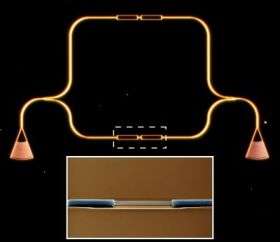
Photonic circuit in which optical force is harnessed to drive nanomechanics (inset) Credit: Tang/Yale

Science fiction writers have long envisioned sailing a spacecraft by the optical force of the sun's light. But, the forces of sunlight are too weak to fill even the oversized sails that have been tried. Now a team led by researchers at the Yale School of Engineering & Applied Science has shown that the force of light indeed can be harnessed to drive machines — when the process is scaled to nano-proportions.

Their work opens the door to a new class of semiconductor devices that are operated by the force of light. They envision a future where this process powers quantum information processing and sensing devices, as well as telecommunications that run at ultra-high speed and consume little power.

The research, appearing in the November 27 issue of Nature, demonstrates a marriage of two emerging fields of research — nanophotonics and nanomechanics. – which makes possible the extreme miniaturization of optics and mechanics on a silicon chip.

The energy of light has been harnessed and used in many ways. The "force" of light is different — it is a push or a pull action that causes something to move.

"While the force of light is far too weak for us to feel in everyday life, we have found that it can be harnessed and used at the nanoscale," said team leader Hong Tang, assistant professor at Yale. "Our work demonstrates the advantage of using nano-objects as "targets" for the force of light — using devices that are a billion-billion times smaller than a space sail, and that match the size of today's typical transistors."

Until now light has only been used to maneuver single tiny objects with a focused laser beam — a technique called "optical tweezers." Postdoctoral scientist and lead author, Mo Li noted, "Instead of moving particles with light, now we integrate everything on a chip and move a semiconductor device."

"When researchers talk about optical forces, they are generally referring to the radiation pressure light applies in the direction of the flow of light," said Tang. "The new force we have investigated actually kicks out to the side of that light flow."

While this new optical force was predicted by several theories, the proof required state-of-the-art nanophotonics to confine light with ultra-high intensity within nanoscale photonic wires. The researchers showed that when the concentrated light was guided through a nanoscale mechanical device, significant light force could be generated — enough, in fact, to operate nanoscale machinery on a silicon chip.

The light force was routed in much the same way electronic wires are laid out on today's large scale integrated circuits. Because light intensity is much higher when it is guided at the nanoscale, they were able to exploit the force. "We calculate that the illumination we harness is a million times stronger than direct sunlight," adds Wolfram Pernice, a Humboldt postdoctoral fellow with Tang.

"We create hundreds of devices on a single chip, and all of them work," says Tang, who attributes this success to a great optical I/O device design provided by their collaborators at the University of Washington.

It took more than 60 years to progress from the first transistors to the speed and power of today's computers. Creating devices that run solely on light rather than electronics will now begin a similar process of development, according to the authors.

"While this development has brought us a new device concept and a giant step forward in speed, the next developments will be in improving the mechanical aspects of the system. But," says Tang, "the photon force is with us."

Source: Yale University


print this article email this article download pdf blog this article bookmark this article     Stumble it Digg this share on Facebook retweet share on Reddit add to delicious
Rate this story - 4 /5 (25 votes)

Rank Filter

Move the slider to adjust rank threshold, so that you can hide some of the comments.


Display comments: newest first

  • Under_Educated - Nov 26, 2008
    • Rank: 1 / 5 (4)
    That is interesting stuff, but since I don't know; how far could this push you from just the power of light in space before you needed some sort of fuel?
  • abadaba - Nov 30, 2008
    • Rank: 3 / 5 (1)
    did you read the article, or just like half of the bold intro paragraph?
  • NeilFarbstein - Dec 22, 2008
    • Rank: 1 / 5 (1)
    That's not hard to do. Shine a light onto a Crookes radiometer and the vanes will spin around like they are being blown in the wind.

November 26, 2008 all stories

Comments: 3

4 /5 (25 votes)
  • Stumble this up

  • Digg this

  • share this

  • hide
  • Related Stories

  • Scientists solve decade-long mystery of nanopillar formations
    created Oct 22, 2009 | popularity not rated yet | comments 0
  • Researchers create molecular diode
    created Oct 22, 2009 | popularity not rated yet | comments 0
  • Touch screen gamble: which technology to use
    created Oct 15, 2009 | popularity not rated yet | comments 0
  • Quantum-limited Measurement Method for Nanosensors
    created Oct 14, 2009 | popularity not rated yet | comments 0
  • Researchers create molecular diode
    created Oct 13, 2009 | popularity not rated yet | comments 0


  • hide
  • Relevant PhysicsForums posts

  • Work done on femur
    created 3 hours ago
  • Magnet and Motors?
    created 4 hours ago
  • Effect of Volume on Revolution
    created 4 hours ago
  • Hydrostatic pressure
    created 6 hours ago
  • More from Physics Forums - General Physics

Other News

Findings show nanomedicine promising for treating spinal cord injuries

Findings show nanomedicine promising for treating spinal cord injuries

Nanotechnology / Bio & Medicine

created 6 hours ago | popularity 5 / 5 (1) | comments 0

(PhysOrg.com) -- Researchers at Purdue University have discovered a new approach for repairing damaged nerve fibers in spinal cord injuries using nano-spheres that could be injected into the blood shortly ...


New Digital 'Electronics' Concept May Continue Moore's Law

New Digital 'Electronics' Concept May Continue Moore's Law

Nanotechnology / Nanophysics

created Nov 05, 2009 | popularity 4.6 / 5 (53) | comments 9

(PhysOrg.com) -- Computers of the future could be operating not on electrons, but on tiny waves traveling through an electron "fluid," if a new proposal is successful. The new circuit design, recently introduced ...


Nanoparticles for gene therapy improve

Nanoparticles for gene therapy improve

Nanotechnology / Bio & Medicine

created Nov 06, 2009 | popularity 5 / 5 (4) | comments 3

(PhysOrg.com) -- About five years ago, Professor Janet Sawicki at the Lankenau Institute in Pennsylvania read an article about nanoparticles developed by MIT's Robert Langer for gene therapy, the insertion ...


Breakthrough in industrial-scale nanotube processing

Breakthrough in industrial-scale nanotube processing

Nanotechnology / Nanomaterials

created Nov 02, 2009 | popularity 4.9 / 5 (20) | comments 3

(PhysOrg.com) -- Rice University scientists today unveiled a method for the industrial-scale processing of pure carbon-nanotube fibers that could lead to revolutionary advances in materials science, power ...


Scientists witness nature's complexity unfold in self-assembling quasicrystals

Scientists witness nature's complexity unfold in self-assembling quasicrystals

Nanotechnology / Nanomaterials

created Oct 31, 2009 | popularity 4.9 / 5 (16) | comments 3

(PhysOrg.com) -- Just a few decades ago, scientists believed that all ordered matter consists of self-repeating building blocks -- atoms, ions or molecules. In this view, the ordinary solids of everyday life ...