Plate tectonics started over 4 billion years ago, geochemists report
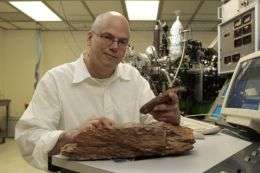
(PhysOrg.com) -- A new picture of the early Earth is emerging, including the surprising finding that plate tectonics may have started more than 4 billion years ago — much earlier than scientists had believed, according to new research by UCLA geochemists reported Nov. 27 in the journal Nature.
"We are proposing that there was plate-tectonic activity in the first 500 million years of Earth's history," said geochemistry professor Mark Harrison, director of UCLA's Institute of Geophysics and Planetary Physics and co-author of the Nature paper. "We are reporting the first evidence of this phenomenon."
"Unlike the longstanding myth of a hellish, dry, desolate early Earth with no continents, it looks like as soon as the Earth formed, it fell into the same dynamic regime that continues today," Harrison said. "Plate tectonics was inevitable, life was inevitable. In the early Earth, there appear to have been oceans; there could have been life — completely contradictory to the cartoonish story we had been telling ourselves."
"We're revealing a new picture of what the early Earth might have looked like," said lead author Michelle Hopkins, a UCLA graduate student in Earth and space sciences. "In high school, we are taught to see the Earth as a red, hellish, molten-lava Earth. Now we're seeing a new picture, more like today, with continents, water, blue sky, blue ocean, much earlier than we thought."
The Earth is 4.5 billion years old. Some scientists think plate tectonics — the geological phenomenon involving the movement of huge crustal plates that make up the Earth's surface over the planet's molten interior — started 3.5 billion years ago, others that it began even more recently than that.
The research by Harrison, Hopkins and Craig Manning, a UCLA professor of geology and geochemistry, is based on their analysis of ancient mineral grains known as zircons found inside molten rocks, or magmas, from Western Australia that are about 3 billion years old. Zircons are heavy, durable minerals related to the synthetic cubic zirconium used for imitation diamonds and costume jewelry. The zircons studied in the Australian rocks are about twice the thickness of a human hair.
Hopkins analyzed the zircons with UCLA's high-resolution ion microprobe, an instrument that enables scientists to date and learn the exact composition of samples with enormous precision. The microprobe shoots a beam of ions, or charged atoms, at a sample, releasing from the sample its own ions, which are then analyzed in a mass spectrometer. Scientists can aim the beam of ions at specific microscopic areas of a sample and conduct a high-resolution isotope analysis of them without destroying the object.
"The microprobe is the perfect tool for determining the age of the zircons," Harrison said.
The analysis determined that some of the zircons found in the magmas were more than 4 billion years old. They were also found to have been formed in a region with heat flow far lower than the global average at that time.
"The global average heat flow in the Earth's first 500 million years was thought to be about 200 to 300 milliwatts per meter squared," Hopkins said. "Our zircons are indicating a heat flow of just 75 milliwatts per meter squared — the figure one would expect to find in subduction zones, where two plates converge, with one moving underneath the other."
"The data we are reporting are from zircons from between 4 billion and 4.2 billion years ago," Harrison said. "The evidence is indirect, but strong. We have assessed dozens of scenarios trying to imagine how to create magmas in a heat flow as low as we have found without plate tectonics, and nothing works; none of them explain the chemistry of the inclusions or the low melting temperature of the granites."
Evidence for water on Earth during the planet's first 500 million years is now overwhelming, according to Harrison.
"You don't have plate tectonics on a dry planet," he said.
Strong evidence for liquid water at or near the Earth's surface 4.3 billion years ago was presented by Harrison and colleagues in a Jan. 11, 2001, cover story in Nature.
"Five different lines of evidence now support that once radical hypothesis," Harrison said. "The inclusions we found tell us the zircons grew in water-saturated magmas. We now observe a surprisingly low geothermal gradient, a low rate at which temperature increases in the Earth. The only mechanism that we recognize that is consistent with everything we see is that the formation of these zircons was at a plate-tectonic boundary. In addition, the chemistry of the inclusions in the zircons is characteristic of the two kinds of magmas today that we see at place-tectonic boundaries."
"We developed the view that plate tectonics was impossible in the early Earth," Harrison added. "We have now made observations from the Hadean (the Earth's earliest geological eon) — these little grains contain a record about the conditions under which they formed — and the zircons are telling us that they formed in a region with anomalously low heat flow. Where in the modern Earth do you have heat flow that is one-third of the global average, which is what we found in the zircons? There is only one place where you have heat flow that low in which magmas are forming: convergent plate-tectonic boundaries."
Three years ago, Harrison and his colleagues applied a technique to determine the temperature of ancient zircons.
"We discovered the temperature at which these zircons formed was constant and very low," Harrison said. "You can't make a magma at any lower temperature than what we're seeing in these zircons. You look at artists' conceptions of the early Earth, with flying objects from outer space making large craters; that should make zircons hundreds of degrees centigrade hotter than the ones we see. The only way you can make zircons at the low temperature we see is if the melt is water-saturated. There had to be abundant water. That's a big surprise because our longstanding conception of the early Earth is that it was dry."
Source: University of California - Los Angeles


