Source of geysers on Saturn's moon may be underground water
November 26, 2008 Enceladus Jets: Are They Wet or Just Wild?

Enlarge

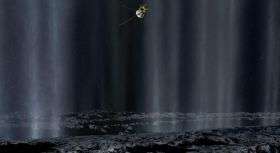
In this artist's concept, the Cassini spacecraft makes a close pass by Saturn's inner moon Enceladus to study plumes from geysers that erupt from giant fissures in the moon's southern polar region. Image copyright: Karl Kofoed

Saturn's moon Enceladus may indeed hide an underground reservoir of water. Scientists at Jet Propulsion Lab in California, the University of Colorado and the University of Central Florida in Orlando teamed up to analyze the plumes of water vapor and ice particles spewing from the moon. They used data collected by the Cassini spacecraft's Ultraviolet Imaging Spectrograph (UVIS). Cassini was launched from the Kennedy Space Center in 1997 and has been orbiting Saturn since July 2004.

The team, including UCF Assistant Professor Joshua Colwell, found that the source of plumes may be vents on the moon that channel water vapor from a warm, probably liquid source to the surface at supersonic speeds.

The team's findings are reported in the Nov. 27 issue of the journal Nature.

"There are only three places in the solar system we know or suspect to have liquid water near the surface," Colwell said. "Earth, Jupiter's moon Europa and now Saturn's Enceladus. Water is a basic ingredient for life, and there are certainly implications there. If we find that the tidal heating that we believe causes these geysers is a common planetary systems phenomenon, then it gets really interesting."

The team's findings support a theory that the plumes observed are caused by a water source deep inside Enceladus. This is not a foreign concept. On earth, liquid water exists beneath ice at Lake Vostok, Antarctica.

Scientists suggest that in Enceladus's case, the ice grains would condense from the vapor escaping from the water source and stream through the cracks in the ice crust before heading into space. That's likely what Cassini's instruments detected in 2005 and 2007, the basis for the team's investigation.

The team's work also suggests that another hypothesis is unlikely. That theory predicts that the plumes of gas and dust observed are caused by evaporation of volatile ice freshly exposed to space when Saturn's tidal forces open vents in the south pole. But the team found more water vapor coming from the vents in 2007 at a time when the theory predicted there should have been less.

"Our observations do not agree with the predicted timing of the faults opening and closing due to tidal tension and compression," said Candice Hansen, the lead author on the project. "We don't rule it out entirely . . . but we also definitely do not substantiate this hypothesis."

Instead, their results suggest that the behavior of the geysers supports a mathematical model that treats the vents as nozzles that channel water vapor from a liquid reservoir to the surface of the moon. By observing the flickering light of a star as the geysers blocked it out, the team found that the water vapor forms narrow jets. The authors theorize that only high temperatures close to the melting point of water ice could account for the high speed of the water vapor jets.

Although there is no solid conclusion yet, there may be one soon. Enceladus is a prime target of Cassini during its extended Equinox Mission, underway now through September 2010.

The team of researchers also includes Brad Wallis, and Amanda Hendrix from Jet Propulsion Laboratory; Larry Esposito (principal investigator of the UVIS investigation), Bonnie Meinke and Kris Larsen from the University of Colorado; Wayne Pryor from Central Arizona College; and Feng Tian, from NASA's postdoctoral program.

"We still have a lot to discover and learn about how this all works on Enceladus," Colwell said. "But this is a good step in figuring it all out."

Source: University of Central Florida


print this article email this article download pdf blog this article bookmark this article     Stumble it Digg this share on Facebook retweet share on Reddit add to delicious
Rate this story - 4 /5 (14 votes)

Rank Filter

Move the slider to adjust rank threshold, so that you can hide some of the comments.


Display comments: newest first

  • deatopmg - Nov 26, 2008
    • Rank: 1.6 / 5 (7)
    "There are only three places in the solar system we know or suspect to have liquid water near the surface," Colwell said. "Earth, Jupiter's moon Europa and now Saturn's Enceladus. Water is a basic ingredient for life, and there are certainly implications there. If we find that the tidal heating that we believe causes these geysers is a common planetary systems phenomenon, then it gets really interesting."

    And what is the source of the myriad of photographs of obvious geysers on Mars? Liquid CO2 - NO, liquid hydrocarbon - NO, Liquid ammonia - NO but just like the man behind the green curtain we are commanded to ignore the liquid water and all it's implications so that it will just go away.

    Purposely omitting the obvious is a lie and for our space agency; "The lies are different at every level" - RCH
  • Omnitheo - Nov 26, 2008
    • Rank: 5 / 5 (4)
    "And what is the source of the myriad of photographs of obvious geysers on Mars? Liquid CO2 - NO, liquid hydrocarbon - NO, Liquid ammonia - NO but just like the man behind the green curtain we are commanded to ignore the liquid water and all it's implications so that it will just go away."


    Mars does not have liquid water anywhere near the surface. All water on mars is frozen. while there is significant evidence that water flowed on mars in the past, this water has long since escaped or become frozen and covered over. Not to mention that mars is geologically dead, so there have been no geysers on mars for quite a few (million) years.

    I think you need to relax and not jump to conclusions about conspiracies.
  • brant - Nov 26, 2008
    • Rank: 1 / 5 (2)
    Not!!!!
  • RHill - Nov 27, 2008
    • Rank: not rated yet
    "deatopmg" may be confusing geysers with the well known and almost as interesting dust devils that roam the Martian surface.

November 26, 2008 all stories

Comments: 4

4 /5 (14 votes)
  • Stumble this up

  • Digg this

  • share this

  • hide
  • Related Stories

  • Successful Flight Through Enceladus Plume (w/ Video)
    created Nov 04, 2009 | popularity not rated yet | comments 0
  • LADEE Mission to Study the Moon's Fragile Atmosphere
    created Oct 26, 2009 | popularity not rated yet | comments 0
  • Cooking Up Water From the Moon? NASA Studies Water Extraction With Microwaves
    created Oct 19, 2009 | popularity not rated yet | comments 0
  • Microwaving Water from Moondust (w/ Video)
    created Oct 08, 2009 | popularity not rated yet | comments 0
  • Hot Debate over Icy Moon
    created Oct 08, 2009 | popularity not rated yet | comments 0


  • hide
  • Relevant PhysicsForums posts

  • The shape of our solar system's orbits.
    created Nov 07, 2009
  • Above or Below the Line of Nodes
    created Nov 07, 2009
  • Supernova vs. Nova?
    created Nov 07, 2009
  • Supernova's Gamma Rays and Comets
    created Nov 06, 2009
  • More from Physics Forums - General Astronomy

Other News

Antarctica glacier retreat creates new carbon dioxide store

Antarctica glacier retreat creates new carbon dioxide store

Space & Earth / Earth Sciences

created 20 minutes ago | popularity not rated yet | comments 0

Large blooms of tiny marine plants called phytoplankton are flourishing in areas of open water left exposed by the recent and rapid melting of ice shelves and glaciers around the Antarctic Peninsula. This ...


Deep creep means milder, more frequent earthquakes along Southern California's San Jacinto fault

Deep creep means milder, more frequent earthquakes along Southern California's San Jacinto fault

Space & Earth / Earth Sciences

created 21 hours ago | popularity 4.5 / 5 (4) | comments 0

With an average of four mini-earthquakes per day, Southern California's San Jacinto fault constantly adjusts to make it a less likely candidate for a major earthquake than its quiet neighbor to the east, the ...


Success in 'space elevator' competition (AP)

Success in 'space elevator' competition (Update 3)

Space & Earth / Space Exploration

created Nov 05, 2009 | popularity 4.3 / 5 (33) | comments 51

(AP) -- A robot powered by a ground-based laser beam climbed a long cable dangling from a helicopter on Wednesday to qualify for prize money in a $2 million competition to test the potential reality of the ...


In a Galaxy Far, Far Away...

In a Galaxy Far, Far Away...

Space & Earth / Astronomy

created Nov 06, 2009 | popularity 4.8 / 5 (5) | comments 15

(PhysOrg.com) -- Astronomers have published the discovery of the farthest known object in the cosmos: a star that exploded when the universe was only 630 million years old -- only 4.6% of its current age. ...


'Dropouts' pinpoint earliest galaxies

'Dropouts' pinpoint earliest galaxies

Space & Earth / Astronomy

created Nov 06, 2009 | popularity 4.2 / 5 (10) | comments 13

Astronomers, conducting the broadest survey to date of galaxies from about 800 million years after the Big Bang, have found 22 early galaxies and confirmed the age of one by its characteristic hydrogen signature ...