Collective solution to accessing the internet via satellite
(PhysOrg.com) -- In many rural areas, getting on the internet means putting up with sluggish dial-up connections or, at best, erratic mobile services. A new satellite-based solution developed by European researchers promises to change that.
Plugging the gaps in broadband internet access via two-way satellite is not a new idea, but to date there have been relatively few examples of successful commercial deployments in areas where cable and dsl services have yet to reach. The fact that the signal has to travel 36,000 kilometres into space and back typically causes high latency, making applications such as voiceover internet protocol (VoIP) erratic, while the cost of the connection is often prohibitive for farmers and other rural residents who may just want to send email and check the weather forecast.
Part of the problem is that many previous initiatives focused on providing each home, ranch or farm with an individual satellite connection via their own two-way dish and developing new protocols to ensure quality of service, further pushing up implementation costs.
The researchers behind the EU-funded UNIC project took a different approach.
One dish serves all
Instead of individual dishes, they use a single dish to create a collective satellite gateway for a whole village or rural area. Local homes and businesses can then connect to the gateway via cables or wireless technologies, such as wimax, while more remote homes can access the internet with their own dishes.
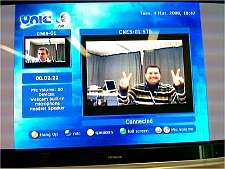
Instead of reinventing the wheel when it came to ensuring quality of service, they adapted existing protocols and standards for new uses. And they focused on offering more services than internet access alone, including interactive digital television and video conferencing.
“We estimate that the monthly cost for users would be somewhere between 50 and 100 percent more than they would pay if they lived in a town or city that had DSL coverage. That may sound like a lot, but it is still reasonable if there are no alternatives,” explains Marco Luise who is in charge of the UNIC project’s dissemination activities at the University of Pisa in Italy.
He foresees the UNIC system being cost effective in villages with populations of up to a thousand people, at which point more traditional broadband access technologies, such as cable and DSL, become competitive - despite the cost of laying lines and setting up telephone exchanges.
The satellite connection offers data transfer rates of between one and two megabits per second compared to the eight Mb/s now common with DSL, but Luise notes that such transfer speeds are acceptable for most users.
“We carried out field trials at Montignoso, a village in Tuscany, Italy, where previously they had only telephone lines and the reaction of the test users was very positive,” notes project manager Jean-Michel Merour at Thales Alenia Space in Toulouse, France.
Other trials took place in Paris, Marseille, Cambridge and Hamburg with similarly positive results.
The UNIC system improves data rates and services by prioritising access depending on what each user is doing, thereby overcoming many of the quality of service issues that have dogged previous attempts at satellite broadband.
Using a technology called Adaptive Coding and Modulation (ACM), originally developed as part of the DVB-S2 (Digital Video Broadcasting - Satellite Second Generation) standard to improve satellite reception in bad weather, the team have been able to make the UNIC system automatically adapt to users’ bandwidth requirements.
“Someone making a video conference or VoIP call, for example, will take priority over someone surfing the internet,” Luise explains.
Bridging the urban-rural digital divide
Digital television is provided on top of the bandwidth used for internet access, while the system also offers ample scope for other services to be added. These could include environmental and crop monitoring - applications of particular interest to farmers - or educational services and tourism information. In addition, because connections are made via a set-top box and TV, it allows people without computers or with little computer experience to access services just by pressing buttons on a remote control, thereby avoiding a steep learning curve.
“UNIC bridges the digital divide not just by giving rural residents broadband access but also by making it easier for people without computers to get online,” Luise says.
Besides Europe’s rural areas, the system’s ease of access and scalability makes it a strong candidate for providing telecommunication services in developing countries.
“Many areas of Africa, for example, have no telecommunications links. The focus now is on providing them with mobile phone coverage. However, satellite offers a viable alternative,” Luise notes.
Though the UNIC project has demonstrated the ability of satellite broadband to bridge the digital divide between rural and urban areas and developed and developing regions, there are still obstacles that need to be overcome before the technology can be deployed commercially. The principal factor is the initial implementation cost, something that Luise argues would have to be covered by a public-sector institutional partner, such as a town council or regional government to ensure the costs for end users are acceptable.
“Public funding would be needed to give it sufficient initial momentum,” Luise says, noting that the project consortium is currently looking for just such a partner.
The UNIC project received funding under the EU’s Sixth Framework Programme.
Provided by ICT Results


