It takes two to tango: Not only the receiving, but also the transmitting terminal of a nerve cell's synapse is higly ada
(PhysOrg.com) -- Where would we be without our ability to remember important information or, for that matter, to forget irrelevant details? Thanks to the flexibility of the nerve cell's communication units, called synapses, we are good at both. Up to now, only the receiving side of a synapse was believed to play an active role in this reorganization of the brain, which is thought to underlie our ability to learn but also to forget. An incorrect assumption, as scientists at the Max Planck Institute of Neurobiology in Martinsried could now show.
In the prestigious scientific journal Neuron, they report that the neurotransmitter-releasing part of a synapse dramatically remodels itself in response to electrical stimulation. It may thus make a decisive contribution to the adaptability of the brain to ever-changing environments.
Communication is the be-all and end-all of the brain. Every one of the hundred billion nerve cells that comprise our brain is a master of data exchange, with contacts to thousands of neighbouring cells. At these points of contact, known as synapses, the neuronal information flows along a one-way channel; from the upstream cell to the downstream cell. The brain can deal with its complicated tasks only when the nerve cells manage to exchange information at the right time and place via their synapses.
It therefore comes as no surprise that one of the most outstanding attributes of the brain is its great adaptability. This is due to the versatility of the synapses, which, depending on whether they are required or not, can proliferate or are pruned accordingly. Most scientists are of the opinion that this flexible exchange of information is what makes learning and memory possible in the first place.
The two sides of information transmission
The receiver side of the points of contact, the spines, plays an active role in the assembly and break-down of new synapses. The more information to be processed, the more receiver stations the nerve cell will set up. New spines grow towards neighbouring cells to form new synapses. If the flow of information weakens, the synapses disappear and the spines can regress. By comparison, the other side of the synapse, the transmitter unit, also known as bouton, was believed to play only a passive role in the formation of synapses.
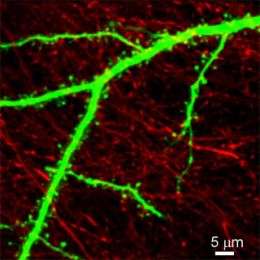
However, this presumption turned out to be false, as scientists at the Max Planck Institute of Neurobiology have now shown. They are the first to successfully observe both the receiver side and the transmitter terminal of a synapse over an extended period of time. This involved tagging a number of nerve cells with a red fluorescent dye and labelling the connected cells in green. Using a high-resolution two-photon microscope, changes on both sides could be observed in time-lapse sequences. It soon became clear that the transmitter unit of a synapse played a considerably more active role in the assembly and disintegration of the synapse than hitherto assumed. Once the flow of information to be passed on by a cell is reduced, many of the meanwhile superfluous transmitter stations are broken down. Furthermore, since this novel experimental approach enabled them to watch the contacts between boutons and spines breaking down directly under the microscope, the scientists were able to verify that the reduction in the number of spines does, in fact, result in the loss of synapses.
The brain's reorganization is unexpectedly complex
"What is particularly exciting is that, all in all, the number of transmitter terminals remains constant", project leader Valentin Nägerl explains. While the number of synapses is reduced when the flow of information weakens, new transmitter terminals emerge elsewhere in a seemingly balanced fashion. Since only those cells that originally communicated with each other were tagged, the scientists do not know whether the new transmitters pass the information on to nerve cells that were hitherto not involved in the communication.
"Perhaps the cells form new synapses to inhibitory nerve cells, which would reduce the transmission of synaptic information even more", Nadine Becker speculates on her results. The scientists now aim to investigate precisely this possibility by also visualizing synapses formed with inhibitory neurons. One thing is for certain: The processing of information is not exclusive to the receiver cell. The transmitter cell reacts actively to the situation at hand and therefore plays an important role in our ability to learn and remember things.
Citation: Nadine Becker, Corette Wierenga, Rosalina Fonseca, Tobias Bonhoeffer, U. Valentin Nägerl, LTD induction causes morphological changes in presynaptic boutons and reduces their contacts with spines, Neuron, November 26, 2008
Provided by Max Planck Institute of Neurobiology


