Boosting the power of solar cells
November 26, 2008
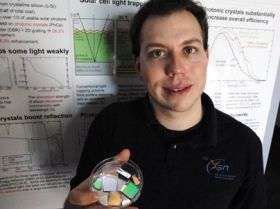
Research Lab of Electronics post-doc Peter Bermel. Photo / Donna Coveney
(PhysOrg.com) -- New ways of squeezing out greater efficiency from solar photovoltaic cells are emerging from computer simulations and lab tests conducted by a team of physicists and engineers at MIT.
Using computer modeling and a variety of advanced chip-manufacturing techniques, they have applied an antireflection coating to the front, and a novel combination of multi-layered reflective coatings and a tightly spaced array of lines -- called a diffraction grating -- to the backs of ultrathin silicon films to boost the cells' output by as much as 50 percent.
The carefully designed layers deposited on the back of the cell cause the light to bounce around longer inside the thin silicon layer, giving it time to deposit its energy and produce an electric current. Without these coatings, light would just be reflected back out into the surrounding air, said Peter Bermel, a postdoctoral researcher in MIT's Research Laboratory of Electronics who has been working on the project.
"It's critical to ensure that any light that enters the layer travels through a long path in the silicon," Bermel said. "The issue is how far does light have to travel [in the silicon] before there's a high probability of being absorbed" and knocking loose electrons to produce an electric current.
The team began by running thousands of computer simulations in which they tried out variations in the spacing of lines in the grid, the thickness of the silicon and the number and thicknesses of reflective layers deposited on the back surface. "We use our simulation tools to optimize overall efficiency and maximize the power coming out," Bermel said.
"The simulated performance was remarkably better than any other structure, promising, for 2-micrometer-thick films, a 50 percent efficiency increase in conversion of sunlight to electricity," said Lionel Kimerling, the Thomas Lord Professor of Materials Science and Engineering, who directed the project.
The simulations were then validated by actual lab-scale tests. "The final and most important ingredient was the relentless dedication of graduate student Lirong Zeng, in the Department of Materials Science and Engineering, to refining the structure and making it," Kimerling said. "The experiments confirmed the predictions, and the results have drawn considerable industry interest."
The team will report the first reduction to practice of their findings on Dec. 2 at the Materials Research Society's annual meeting in Boston. A paper on their findings has been accepted for publication in Applied Physics Letters.
The work is just a first step toward actually producing a commercially viable, improved solar cell. That will require additional fine-tuning through continuing simulations and lab tests, and then more work on the manufacturing processes and materials. "If the solar business stays strong," Kimerling said, "implementation within the next three years is possible."
The MIT Deshpande Center selected the project for an "i-team" study to evaluate its business potential. The team analyzed the potential impact of this efficient thin solar cell technology and found significant benefits in both manufacturing and electrical power delivery, for applications ranging from remote off-grid to dedicated clean power.
And the potential for savings is great, because the high-quality silicon crystal substrates used in conventional solar cells represent about half the cost, and the thin films in this version use only about 1 percent as much silicon, Bermel said.
This project, along with other research work going on now in solar cells, has the potential to get costs down "so that it becomes competitive with grid electricity," Bermel said. While no single project is likely to achieve that goal, he said, this work is "the kind of science that needs to be explored in order to achieve that."
Provided by MIT
-
Sun-free photovoltaics
Jul 29, 2011 |
4.9 / 5 (11) |
6
-
Researchers boost solar cell efficiency
Nov 24, 2008 |
4.7 / 5 (46) |
6
-
Solar start-ups set new efficiency records
12 hours ago |
4.9 / 5 (10) |
9
-
New kind of solar cell could capture significantly more energy than current cells
7 hours ago |
4.8 / 5 (5) |
10
-
Flipping a light switch in the cell: Quantum dots used for targeted neural activation
6 hours ago |
5 / 5 (2) |
0
-
Engineers build first sub-10-nm carbon nanotube transistor
Feb 01, 2012 |
4.9 / 5 (32) |
30
-
Something old, something new: Evolution and the structural divergence of duplicate genes
Jan 31, 2012 |
4.6 / 5 (7) |
1
-
The hidden nanoworld of ice crystals: Revealing the dynamic behavior of quasi-liquid layers
Jan 30, 2012 |
5 / 5 (4) |
1
-
Stock market network reveals investor clustering
Jan 27, 2012 |
3.9 / 5 (23) |
8
-
Of microchemistry and molecules: Electronic microfluidic device synthesizes biocompatible probes
Jan 26, 2012 |
5 / 5 (2) |
0
-
Need help reading 3-D
19 hours ago
-
A way to send and receive wireless data
Feb 11, 2012
-
Calling function with no input argument
Feb 10, 2012
-
Force free body diagram problem on gym equipment
Feb 10, 2012
-
Empirical data regarding shower heads and water
Feb 10, 2012
-
feed hold button on CNC lathe
Feb 09, 2012
- More from Physics Forums - General Engineering
More news stories
Iran blocks email, restricts net access: reports
Iran has further restricted access to the Internet and blocked popular email services for the past few days, in a move a top lawmaker said could "cost the regime dearly," media reports said on Sunday.
31 minutes ago |
5 / 5 (1) |
2
Google might launch Drive for cloud storage soon
(PhysOrg.com) -- Google's next big move, according to the Wall Street Journal, is a cloud storage service called Drive. Hardly first to the plate, Google is simply catching up to introducing its cloud reposi ...
Love a click away in Indonesia's Twitter Republic
He was a geeky kid from Yogyakarta, she a glamorous city girl in Jakarta. In a country with one of the world's most vibrant social networking scenes they fell in love on Twitter.
8 hours ago |
4 / 5 (1) |
0
Walney offshore wind farm is world's biggest (for now)
(PhysOrg.com) -- The Walney wind farm on the Irish Sea--characterized by high tides, waves and windy weather--officially opened this week. The farm is treated in the press as a very big deal as the Walney ...
Navy to begin tests on electromagnetic railgun prototype launcher
The Office of Naval Research (ONR)'s Electromagnetic (EM) Railgun program will take an important step forward in the coming weeks when the first industry railgun prototype launcher is tested at a facility ...
Feb 06, 2012 |
4.7 / 5 (16) |
93
|
Scientists discover molecular secrets of 2,000-year-old Chinese herbal remedy
For roughly two thousand years, Chinese herbalists have treated Malaria using a root extract, commonly known as Chang Shan, from a type of hydrangea that grows in Tibet and Nepal. More recent studies suggest that halofuginone, ...
New method to examine batteries -- MRI from the inside
There is an ever-increasing need for advanced batteries for portable electronics, such as phones, cameras, and music players, but also to power electric vehicles and to facilitate the distribution and storage of energy derived ...
A mitosis mystery solved: How chromosomes align perfectly in a dividing cell
Although the process of mitotic cell division has been studied intensely for more than 50 years, Whitehead Institute researchers have only now solved the mystery of how cells correctly align their chromosomes during symmetric ...
Starve a virus, feed a cure? Findings show how some cells protect themselves against HIV
A protein that protects some of our immune cells from the most common and virulent form of HIV works by starving the virus of the molecular building blocks that it needs to replicate, according to research published online ...
Researchers find extensive RNA editing in human transcriptome
In a new study published online in Nature Biotechnology, researchers from BGI, the world's largest genomics organization, reported the evidence of extensive RNA editing in a human cell line by analysis of RNA-seq data, demons ...
The proteins ensuring genome protection
Researchers from the University of Geneva (UNIGE), Switzerland, have discovered the crucial role of two proteins in developing a cell 'anti-enzyme shield'. This protection system, which operates at the level of molecular ...