Researcher reveals humpback whales' dining habits -- and costs
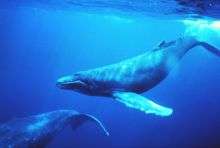
As most American families sit down to Thanksgiving dinner, a University of British Columbia researcher is revealing how one of the largest animals on earth feasts on the smallest of prey – and at what cost.
Some large marine mammals are known for their extraordinarily long dive times. Elephant seals, for example, can stay underwater for an hour at a time by lowering their heartbeat and storing large amounts of oxygen in their muscles.
"Weighing up to 40 tons, humpback whales and their close relatives have relatively short dive times given their large body size," says UBC zoology PhD candidate Jeremy Goldbogen, whose study is featured on the cover of the current issue of The Journal of Experimental Biology. "Our study suggests that this has to do with the enormous energy costs of its unique foraging behaviours."
Humpbacks belong to a group of whales – called rorquals – that includes the fin whale and the blue whale, the largest animal that has ever lived. Characterized by an accordion-like blubber layer that goes from the snout to the naval, these whales take deep dives in search of dense patches of tiny zooplankton, such as krill or copepods.
While foraging, the whales literally drop their jaws during a high-speed dive – called a lunge – creating enormous drag akin to a race car driver opening a parachute. The drag forces the blubber to expand around a large volume of prey-laden water, which is then filtered out through a comb-like structure called baleen when the mouth closes.
Goldbogen and colleagues from the University of California, San Diego and Cascadia Research Collective, a non-profit organization in Washington, recorded the foraging behaviour of two humpback whales off the coast of California using a non-invasive, temporary digital tag that records depth, body angle and other acoustic data. After multiple tagging attempts, the team successfully recorded data over an eight-hour period; one whale performed 43 dives and 362 lunges while the other executed 15 dives and 89 lunges.
The team found that lunge-feeding requires a large amount of energy compared to other behaviours – humpback whales breathe three times harder after returning to the surface from a foraging dive than from singing. Lunge-feeding whales also spent half as much time under water compared to singing whales.
Not surprisingly, the team found that the longer the dive, the more lunges were taken – and more time and breaths were required before the next dive. The whales also stuck to the uppermost level of dense krill patches to maximize prey catch for its energy expenditure, according to the study.
By integrating tag data and hydrodynamic theory inspired from parachute inflation studies, Goldbogen now plans to compare lunge-feeding performance among blue, fin and humpback whales to determine whether the energy cost of a lunge is higher for bigger rorquals.
"We believe lunge feeding is related to the overall evolutionary and ecological success of rorquals, but the high energy cost may impose a physical limit on how big, and also how small, a whale can get."
Source: University of British Columbia


