Fluid ''Stripes'' May Be Essential for High-Temperature Superconductivity
 on undoped copper sites. Alternating "stripes" of holes and magnetic regions may be necessary for superconductivity.")
UPTON, NY - Scientists at the U.S. Department of Energy’s Brookhaven National Laboratory, in collaboration with researchers at the Rutherford Appleton Laboratory in the United Kingdom and Tohoku University in Japan, have discovered evidence supporting a possible mechanism for high-temperature superconductivity that had previously appeared incompatible with certain experimental observations. The finding, which hinges paradoxically on what the scientists observed in a particular material that loses its superconductivity for a special composition of atoms, is bound to be controversial in this dynamic field. It is described in the June 3, 2004 issue of Nature.
“We definitely expect some controversy,” said Brookhaven physicist John Tranquada, lead author on the paper, “because our data suggest that some popular ideas are wrong.”
The scientists were studying a material composed of lanthanum, barium, copper and oxygen (LBCO). The parent compound, LCO, which lacks the barium, is not a superconductor (a material through which current moves with no resistance), nor even a regular conductor. This is because the repulsive forces between the like-charged electrons on adjacent copper atoms keep them separated and somewhat locked into position – unable to carry a current. In this arrangement, the electrons on adjacent atoms align themselves so that their spins alternate in an up, down, up, down fashion, producing a condition scientists call antiferromagnetism.
When barium is substituted for some of the lanthanum atoms, however, the material starts to exhibit superconductivity. Barium has one fewer electron than lanthanum to contribute to atomic interactions, so adding barium adds electron “holes,” or the absence of electrons, to the system. The more barium, the more holes, and the greater the superconductivity – until the composition reaches a point where there is exactly one barium atom for every eight copper atoms: Then the superconductivity disappears. Above this point, as more “holes” (barium atoms) are added, the superconductivity reappears but then gradually declines.
From previous experiments, the scientists know that, at the point where the superconductivity disappears, narrow antiferromagnetic regions of the material are separated by regions with holes, forming alternating “stripes.” Other scientists have proposed that such stripes might be important for superconductivity if the stripes could flow – that is, if the stripes made of electron holes could wiggle through the crystal lattice. But trying to study these materials in their superconducting form is “like looking at the stripes on a waving flag from a great distance using soda bottles as binoculars,” Tranquada said. Because everything is fluid, the pattern is hard to identify.
But when the scientists measured the magnetic excitations of the static, non-superconducting form of LBCO (the one with the 1:8 ratio), which they know has stripes, they came upon a surprise. The pattern of magnetic excitations – how much energy it takes to flip the spins of the electrons – looked remarkably similar to that observed in another well-known copper-oxide superconductor made with yttrium in place of lanthanum (YBCO). Some scientists had predicted such a pattern would not be possible for a material with stripes.
The finding that the striped material produces magnetic excitations so similar to the well-known superconductor suggests that the stripes might very well be there all along when the materials act as superconductors, not just in the static case of LBCO 1:8.
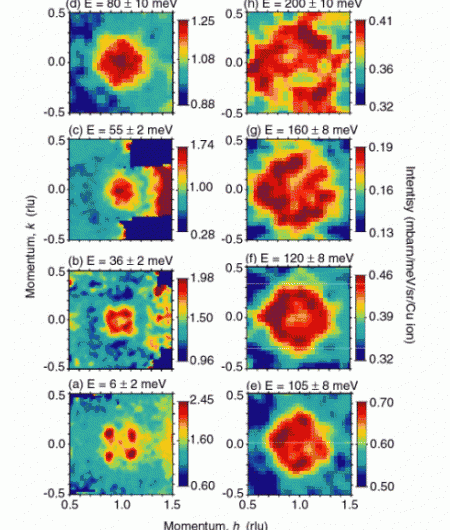
“The magnetic excitations are almost like fingerprints that say these things must be similar in some way,” Tranquada said. “In fact, our results support the concept that stripe correlations might be essential to high-transition-temperature superconductivity.”
The scientists have not yet demonstrated experimentally how the stripes contribute to the high-temperature superconductivity, but Tranquada says the quest for such evidence is likely to generate great interest in the field.
For this study, the crystals of LBCO were grown at Brookhaven Lab and analyzed using neutron scattering at the ISIS facility at the Rutherford Appleton Lab. By scattering a beam of neutrons off the crystalline sample, the scientists can measure the positions of the atoms, the alignment of the electron spins, the energy it takes to “flip” a spin, and how the spins interact.
The research was funded by the Office of Basic Energy Sciences within the U.S. Department of Energy’s Office of Science, the U.S.-Japan Cooperative Research Program on Neutron Scattering, and the Japanese Ministry of Education, Culture, Sports, Science, and Technology.
Full paper, Quantum Magnetic Excitations from Stripes in Copper-Oxide Superconductors (PDF)
Find the original news release here.


