Finding a meteorite's final resting place
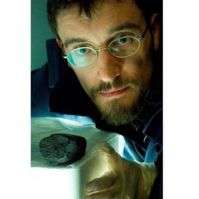
(PhysOrg.com) -- University of Alberta researcher Chris Herd doesn't want people craning their necks, worrying about giant rocks falling from space. But he's unleashed new technology that could prove meteorite impacts with Earth aren't as rare as we think.
Herd, an associate professor of earth and atmospheric science agrees that "yes," a giant meteorite, almost 10 kilometres wide, likely ended the age of the dinosaurs, but will it happen again? "Something that big only happens every tens of millions of years," he said. "It's possible, but only remotely."
If you're counting, the so-called dinosaur-killing meteorite hit Earth 65 million years ago.
And about the Nov. 20 meteorite, estimated to be the size of an office desk, which blazed across the prairie sky and landed somewhere in Saskatchewan? Herd is confident we're safe. "The chances of actually being hit by a meteorite are almost incalculable," he said.
Putting meteorite impacts in perspective was a major concern this week as Herd released details of a new technique to locate undiscovered meteorite craters. The breakthrough came when Herd analyzed a meteorite crater near Whitecourt, 200 kilometres west of Edmonton.
Herd and his colleagues decided they needed an aerial view of the 36 metre-wide crater. "You can't spot it from the air because of the trees," He said, although the solution was close at hand. "We bought Light Detection and Ranging aerial images of the area that already existed."
LiDAR equipment is attached to an aircraft and beams of laser light capture 3-D images of the ground below. The forest industry uses the technology to count trees and determine the topography, but Herd wasn't interested in the trees.
"We asked for the Bare Earth model," he said. "That's terrain with the images of the trees and vegetation stripped away."
It was the breakthrough Herd was hoping for. The image of Whitecourt meteorite crater was clear as day.
Herd sees a bright future for crater counting. "We should be able to look through LiDAR data from wherever it's been acquired and find more undiscovered craters."
Current theories on Earth impacts say meteorites the size and age of the rock that made the crater near Whitecourt happen every 10 years. That's every 10 years for the last 10,000 years. When scientists adjust the numbers to account for meteorite hits in oceans and crater evidence erased by land erosion Herd is still encouraged.
"There should be dozens, maybe a hundred, meteorite craters like Whitecourt."
A meteorite crater can tell a scientist when it came to Earth and what it was made of.
The Whitecourt meteorite fell to Earth about 1,100 years ago. Herd estimates it was about a metre wide. He knows the rock was composed of iron and nickel and that it started its journey through space in the core of a 4.5 billion-year-old asteroid. That asteroid broke apart and pieces of the core became meteorites. So far only half a dozen meteorite craters the age and size of the Whitecourt site have been located.
To find more of them Herd and others are negotiating access for more existing LiDAR surveys. He's already getting tips from people on where to start looking. "People are calling and say they remember seeing a bowl shaped depression in the Earth and we're building a file based on those accounts."
While some people might be looking skyward these days with a little concerned these are great times for Herd.
"I can't get enough of it. Meteorites are all good with me."
Provided by University of Alberta


