Researchers Say Tides Can Cut Life Short On Planets Orbiting Smaller Stars
November 27, 2008 Researchers Say Tides Can Cut Life Short On Planets Orbiting Smaller Stars

Enlarge

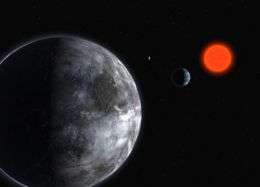
Artist's impression of the planetary system around the red dwarf Gliese 581. The five Earth-mass planet in the foreground, Gliese 581 c, is just inside the habitable zone. (European Space Agency)

(PhysOrg.com) -- Planet hunters searching for planets suitable for life will likely find them first around low-mass stars because it's technically easier than finding such planets around hotter, more massive stars, researchers predict.

But Earth-like planets around stars smaller than our sun won't be liveable for long, according to a study led by Rory Barnes, a research associate with The University of Arizona's Lunar and Planetary Laboratory. Such planets can face "tidal extinction" within about a billion years.

A star only a quarter-to-a-tenth as massive as our sun is also cooler than our sun, so the "habitable zone" for its planets – where water is liquid – also will be closer in, Barnes said.

"This close proximity results in accelerated tidal evolution," Barnes said. "Tides will be so powerful that the Earth-like planet's orbit will shrink. In some cases, orbits can shrink so much and so quickly that the planet may pulled through the inner edge of the habitable zone in less than a billion years, and all the planet's water will boil away."

If habitable planets around low-mass stars are massive enough and, say, have more circular, less eccentric orbits, they could last 4.5 billion years – the age of the Earth – before the star's tidal forces tugs them closer in to roast.

"Planet hunters may detect planets in habitable zones that are doomed to become uninhabitable in the future," Barnes said. "Alternatively, they may find planets today that were liveable in the past, but where any life was wiped out by this process of tidal extinction."

Barnes, Brian Jackson and Professor Richard Greenberg, all with the UA Lunar and Planetary Laboratory, and Sean Raymond of the Center for Astrophysics and Space Astronomy at the University of Colorado, published their study in the article "Tides and the Evolution of Planetary Habitability," in Astrobiology magazine earlier this year.

Jackson, Barnes and Greenberg recently published another paper on the major role tidal forces play in pulling planets into and out of solar system habitable zones. One conclusion in that paper, published in the Monthly Notices of the Royal Astronomical Society, is that the first Earth-like planets found will likely be strongly heated and very volcanically active.

Barnes will talk about it at a departmental colloquium on Tuesday, Dec. 2.

Provided by University of Arizona


print this article email this article download pdf blog this article bookmark this article     Stumble it Digg this share on Facebook retweet share on Reddit add to delicious
Rate this story - 4.3 /5 (14 votes)


November 27, 2008 all stories

Comments: 0

4.3 /5 (14 votes)
  • Stumble this up

  • Digg this

  • share this

  • hide
  • Related Stories

  • New definition could further limit habitable zones around distant suns
    created Jun 10, 2009 | popularity not rated yet | comments 0
  • Tides Have Major Impact on Planet Habitability
    created Oct 13, 2008 | popularity not rated yet | comments 0
  • The Case for Habitable Exoplanet Moons
    created Apr 27, 2006 | popularity not rated yet | comments 0
  • M Dwarfs: The Search For Life Is On
    created Aug 30, 2005 | popularity not rated yet | comments 0
  • Discovery of a Retrograde or Highly Tilted Extrasolar Planet
    created Nov 18, 2009 | popularity not rated yet | comments 0


  • hide
  • Relevant PhysicsForums posts

  • Sideral question
    created 18 hours ago
  • Doppler shifted blackbody spectrum
    created 20 hours ago
  • Earth v. Moon
    created 23 hours ago
  • help me with coordinates and orbits
    created 23 hours ago
  • More from Physics Forums - General Astronomy

Other News

Astronauts finish another spacewalk, still no baby (AP)

Astronauts finish another spacewalk, still no baby

Space & Earth / Space Exploration

created 9 hours ago | popularity 3 / 5 (2) | comments 0

(AP) -- A spacewalking astronaut put aside the impending birth of his daughter and blazed through his first-ever venture outside the International Space Station on Saturday.


Unseasonably hot and dry weather combined with strong winds to fan scores of blazes in the country's southeastern states

Australia issues 'catastrophic' alerts as fires rage

Space & Earth / Environment

created 15 hours ago | popularity 4 / 5 (3) | comments 0

Australia has issued "catastrophic" alerts after record-breaking temperatures and wild lightning storms sparked more than 100 fires across the country, officials said Saturday.


Commuters wait on the platform shrouded by fog in London

Climate change not man-made, say majority of Britons: poll

Space & Earth / Environment

created Nov 15, 2009 | popularity 3.3 / 5 (15) | comments 46

Less than half of Britons believes that human activity is to blame for global warming, according to a poll carried out for The Times newspaper and published on Saturday.


Mysteriously warm times in Antarctica

Mysteriously warm times in Antarctica

Space & Earth / Earth Sciences

created Nov 18, 2009 | popularity 4.2 / 5 (21) | comments 28

(PhysOrg.com) -- A new study of Antarctica's past climate reveals that temperatures during the warm periods between ice ages (interglacials) may have been higher than previously thought. The latest analysis ...


UN: Fight climate change with free condoms (AP)

UN: Fight climate change with free condoms

Space & Earth / Environment

created Nov 18, 2009 | popularity 3.1 / 5 (11) | comments 24

(AP) -- The battle against global warming could be helped if the world slowed population growth by making free condoms and family planning advice more widely available, the U.N. Population Fund said Wednesday.