Biologists find new environmental threat in North American lakes
November 27, 2008 Biologists find new environmental threat in North American lakes

Enlarge

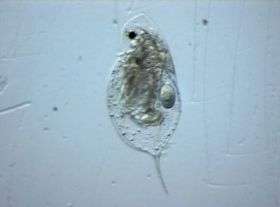
Water flea, Daphnia, is known to be a key component of many aquatic foodwebs. Credit: Shelley Arnott

A new and insidious environmental threat has been detected in North American lakes by researchers from Queen's and York universities.

Along with scientists from several Canadian government laboratories, the team has documented biological damage caused by declining levels of calcium in many temperate, soft-water lakes.

Calling the phenomenon "aquatic osteoporosis," Queen's PhD candidate Adam Jeziorski, lead author of the study, notes that calcium is an essential nutrient for many lake-dwelling organisms. "Once calcium declines below a certain threshold, some keystone species can no longer reproduce," he says. "These species and other organisms that feed on them are endangered."

The study is published today in the prestigious journal Science.

The researchers examined a water flea, Daphnia, known to be a key component of many aquatic foodwebs. Having identified the calcium levels that would damage Daphnia in a laboratory setting, they worked with government scientists to assemble hundreds of "water quality time series" from across the province, explains Biology professor Norman Yan from York University, the Canadian research lead on the threat to aquatic life of calcium decline. "Our hope was to determine if damage was already occurring at key sites, and then see how common these conditions were across the province," he says.

However, calcium decline occurred in many lakes before people knew about the problem and monitoring programs had been put in place. By studying tiny fossils and other indicators in sediment accumulated at the bottom of each lake, Queen's paleoecologist professor John Smol, Canada Research Chair in Environmental Change, and his colleagues were able to reconstruct environmental trends over the past 200 years. The researchers found that key invertebrate species were disappearing in the lakes with declining calcium levels, often starting in the 1970s.

Linking the problem to the long-term effects of acid rain on forest soils, as well as to logging and forest re-growth, the researchers note that, despite signs of chemical recovery from recent reductions in sulphur dioxide emissions, lower calcium levels may delay the biological recovery of lakes from acidification. "This has important management implications," says team member Dr. Andrew Paterson of the Ontario Ministry of the Environment and adjunct professor at Queen's University. "It was a combination of experimental work, paleoecological research and long-term monitoring that helped to identify this emerging threat," he adds.

The authors conclude that the phenomenon of calcium decline is causing widespread transformation of aquatic food webs in boreal lakes in North America, and in other acid-sensitive regions of the globe. While their work focuses on the water flea Daphnia, they note that all life in lakes requires calcium, and many creatures including crayfish, mollusks and fish have quite high calcium demands. They are all at risk, say the researchers, but we don't yet know if calcium levels have fallen to the point of damage.

"This is all very worrisome," concludes Dr. Smol, recipient of the 2004 NSERC Herzberg Gold Medal as Canada's top scientist and co-director of Queen's Paleoecological Environmental Assessment and Research Laboratory (PEARL). "The good news is that we have found the 'miner's canary' in the form of these water fleas that track the decline in calcium levels. The bad news is that many lakes have already passed these critical thresholds."

Source: Queen's University


print this article email this article download pdf blog this article bookmark this article     Stumble it Digg this share on Facebook retweet share on Reddit add to delicious
Rate this story - 4.2 /5 (33 votes)

Rank Filter

Move the slider to adjust rank threshold, so that you can hide some of the comments.


Display comments: newest first

  • jeffsaunders - Nov 27, 2008
    • Rank: 3 / 5 (3)
    Just the thing to show physorg still does report on some science.
  • bmcghie - Nov 27, 2008
    • Rank: 1.8 / 5 (6)
    That PhD candidate would have a much better chance at attaining his degree if he didn't use silly terms like 'aquatic osteoporosis.' Come on now... lakes don't have bones, and you know it. I prefer my articles without the cutesy terms.
  • Mercury_01 - Nov 27, 2008
    • Rank: 3.3 / 5 (3)
    Oh yeah, well I prefer them WITH cutesy terms, Mr smartypants!
  • farmdexter - Nov 27, 2008
    • Rank: 2.3 / 5 (6)
    A walk on the waters edge of lake ontario sounds like walking on delicate glass because of all the zebra muscle shells. the little pests houses clog water treatment pipes. and then after they stop paying their mortgages and their houses have been condemned, my guess is that this contributes to the equivilent of calcium sequestration.kinda like carbon sequestration. but not. if we want to see what the great lakes will look like in a hundred years, check out the black sea near the baltic states.
  • Lord_jag - Nov 28, 2008
    • Rank: 3.5 / 5 (2)
    The black sea has no outlet to the ocean. The great lakes do have fresh water inlets and one big outlet. It takes a long, long time, but it does wash out the garbage to the ocean. The lakes will never be like the black sea.
  • Lord_jag - Nov 28, 2008
    • Rank: 2 / 5 (2)
    no, sorry I was thinking Dead sea. Ignore that last post.
  • Velanarris - Nov 28, 2008
    • Rank: 1 / 5 (3)
    no, sorry I was thinking Dead sea. Ignore that last post.
    Dead sea has such a high salt content that nothing can live under the surface due to buoyancy. Not due to anything other than that.
  • bugmenot23 - Nov 28, 2008
    • Rank: 2.3 / 5 (3)
    is this news? Is Americans really slow or something? thought people new this was happening a decade ago? WAKE UP AMERICANS!! the world is going to %#&#!! start to take your resposibility for the enviroment!!
  • Velanarris - Nov 28, 2008
    • Rank: 1 / 5 (1)
    is this news? Is Americans really slow or something?

    HAHAHAHA
  • superhuman - Dec 01, 2008
    • Rank: 2.5 / 5 (2)
    Dead sea has such a high salt content that nothing can live under the surface due to buoyancy. Not due to anything other than that.


    Nonsense. Life can readily attach itself to almost any surface so buoyancy is not a problem. Dehydration due to osmosis is much more problematic but still some bacteria and fungi managed to survive there so its not completely dead.
  • Velanarris - Dec 18, 2008
    • Rank: not rated yet
    Do you understand what buoyancy is?

    The waters of the dead sea are 33.7% saline, they're so dense with salt that asphalt floats on the surface of the waters. There are no living organisms able to sink into the dead sea to absorb the salt in the first place.

November 27, 2008 all stories

Comments: 11

4.2 /5 (33 votes)
  • Stumble this up

  • Digg this

  • share this

  • hide
  • Related Stories

  • Scientists: Global warming has already changed oceans
    created Jun 10, 2009 | popularity not rated yet | comments 0
  • New map outlines risk of zebra mussel invasion
    created Dec 03, 2007 | popularity not rated yet | comments 0
  • Tropical Atlantic Cooling and African Deforestation Correlate to Drought, Report Scientists
    created Dec 02, 2005 | popularity not rated yet | comments 0
  • Let them eat snail
    created Nov 19, 2009 | popularity not rated yet | comments 0
  • The benefits of stress ... in plants
    created Nov 19, 2009 | popularity not rated yet | comments 0


Other News

The Monarchs' annual migration ritual has yet to be scientifically explained

Tree-eating bugs threaten Monarch butterfly in Mexico

Biology / Ecology

created 2 hours ago | popularity not rated yet | comments 0

The mysterious Monarch butterfly, which migrates en masse annually between Canada and Mexico, is now facing a new peril: another insect thriving in Western Mexican forests.


Extinct goat Myotragus balearicus

Extinct goat was cold-blooded

Biology / Plants & Animals

created Nov 18, 2009 | popularity 4.9 / 5 (29) | comments 10

(PhysOrg.com) -- An extinct goat that lived on a barren Mediterranean island survived for millions of years by reducing in size and by becoming cold-blooded, which has never before been discovered in mammals.


Bigger not necessarily better, when it comes to brains

Bigger not necessarily better, when it comes to brains

Biology / Plants & Animals

created Nov 17, 2009 | popularity 4.4 / 5 (16) | comments 10

(PhysOrg.com) -- Tiny insects could be as intelligent as much bigger animals, despite only having a brain the size of a pinhead, say scientists at Queen Mary, University of London.


Right-handed chimpanzees provide clues to the origin of human language

Biology / Plants & Animals

created Nov 16, 2009 | popularity 3 / 5 (1) | comments 7

Most of the linguistic functions in humans are controlled by the left cerebral hemisphere. A study of captive chimpanzees at the Yerkes National Primate Research Center (Atlanta, Georgia), reported in the January 2010 issue ...


The creature was found at a depth of 161 metres

Japanese researchers film rare baby fish 'fossil'

Biology / Plants & Animals

created Nov 17, 2009 | popularity 4.7 / 5 (7) | comments 4

Japanese marine researchers said Tuesday they had found and successfully filmed a young coelacanth -- a rare type of fish known as "a living fossil" -- in deep water off Indonesia.