Wilkins Ice Shelf under threat
November 28, 2008 Wilkins Ice Shelf under threat

Enlarge

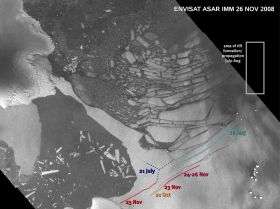
This image, acquired by Envisat’s Advanced Synthetic Aperture Radar (ASAR) sensor on 26 November 2008, shows new rifts on the Wilkins Ice Shelf that developed from 10 August to 26 November 2008. These rifts joined previously existing rifts (denoted by blue-dotted line). The development of these rifts threatens to collapse the ice bridge that has been preventing the ice shelf from disintegrating and breaking away from the Antarctic Peninsula. Dr Angelika Humbert from the Institute of Geophysics, Münster University, provided the interpretations on the image. Credits: A. Humbert, Münster University, Germany (based on ESA Envisat images)

(PhysOrg.com) -- New rifts have developed on the Wilkins Ice Shelf that could lead to the opening of the ice bridge that has been preventing the ice shelf from disintegrating and breaking away from the Antarctic Peninsula.

The ice bridge connects the Wilkins Ice Shelf to two islands, Charcot and Latady. As seen in the Envisat image above acquired on 26 November 2008, new rifts (denoted by colourful lines and dates of the events) have formed to the east of Latady Island and appear to be moving in a northerly direction.

Dr Angelika Humbert from the Institute of Geophysics, Münster University, and Dr Matthias Braun from the Center for Remote Sensing, University of Bonn, spotted the newly formed rifts during their daily monitoring activities of the ice sheet via Envisat Advanced Synthetic Aperture Radar (ASAR) acquisitions.

"These new rifts, which have joined previously existing rifts on the ice shelf (blue dotted line), threaten to break up the chunk of ice located beneath the 21 July date, which would cause the bridge to lose its stabilisation and collapse," Humbert explained. "These recent changes are happening slower and more continuously than the events we saw earlier this year."

In February 2008 an area of about 400 km² broke off from the ice shelf, narrowing the ice bridge down to a 6 km strip. At the end of May 2008 an area of about 160 km² broke off, reducing the ice bridge to just 2.7 km. Between 30 May and 9 July 2008, the ice shelf experienced further disintegration and lost about 1 350 km².

The Wilkins Ice Shelf, a broad plate of floating ice south of South America on the Antarctic Peninsula, had been stable for most of the last century before it began retreating in the 1990s. The peninsula has been experiencing extraordinary warming in the past 50 years of 2.5°C.

If the ice shelf breaks away from the peninsula, it will not cause a rise in sea level since it is already floating. However, ice shelves on the Antarctic Peninsula are sandwiched by extraordinarily raising surface air temperatures and a warming ocean, making them important indicators for on-going climate change.

Long-term satellite monitoring over Antarctica is important because it provides authoritative evidence of trends and allows scientists to make predictions. Over the last 17 years, ESA’s ERS and Envisat satellite missions have been the main vehicles for testing and demonstrating the use of Earth Observation data in Polar Regions.

In the past 20 years, seven ice shelves along the Antarctic Peninsula have retreated or disintegrated, including the most spectacular break-up of the Larsen B Ice Shelf in 2002, which Envisat captured within days of its launch.

Envisat’s ASAR instrument is particularly suited to acquire images over Antarctica during the local winter period because it is able to produce high-quality images through bad weather and darkness, conditions often found in the area.

Daily ASAR images of Antarctica are easily accessible to scientists. ESA will publish an update about the status of the Wilkins Ice Shelf in the event of a break-up.

Provided by ESA


print this article email this article download pdf blog this article bookmark this article     Stumble it Digg this share on Facebook retweet share on Reddit add to delicious
Rate this story - 3.1 /5 (23 votes)

Rank Filter

Move the slider to adjust rank threshold, so that you can hide some of the comments.


Display comments: newest first

  • GrayMouser - Nov 28, 2008
    • Rank: 2.7 / 5 (7)
    It is summer down there so I'd expect some melting.
  • Velanarris - Nov 28, 2008
    • Rank: 3 / 5 (8)
    It is summer down there so I'd expect some melting.
    I blame pirates.
  • GrayMouser - Nov 28, 2008
    • Rank: 3 / 5 (8)
    I blame pirates.


    Ice Pirates?
  • barakn - Nov 29, 2008
    • Rank: 3.3 / 5 (4)
    That's the largest image I've seen directly hosted on Physorg. It's almost 1 MB.
  • mikiwud - Nov 29, 2008
    • Rank: 5 / 5 (3)
    As the icecap collects more weight it flows outwards (glaciers etc). If it did not break up at the edges on a regular basis it would expand forever until it melted in warmer climes.Antarctica would be even bigger.
  • MikeB - Nov 29, 2008
    • Rank: 4 / 5 (4)
    So there apparently will be some icebergs floating around. This IS unprecedented. What are we to do?
  • MikeB - Nov 29, 2008
    • Rank: 4 / 5 (4)
    Now that the Arctic Sea Ice is reforming in the Northern Hehisphere's winter, the story shifts to the Antarctic Sea Ice which is , strangely enough, melting in the Southern Hemisphere's winter. It looks like Global Warming really is cyclical.


    Arctic Sea Ice:
    http://arctic.atm....365.jpg

    Antarctic Sea Ice:
    http://arctic.atm...outh.jpg


  • GrayMouser - Nov 30, 2008
    • Rank: 5 / 5 (2)
    So there apparently will be some icebergs floating around. This IS unprecedented. What are we to do?


    Move them to the north pole to make up for the excessive melting?
  • MikeB - Dec 01, 2008
    • Rank: 5 / 5 (2)
    "Wilkins Ice Shelf under threat"

    Yeah... from a volcaano:

    http://www.scienc...0720.htm

    The really sad part... this has been known since February. I wonder why this bit of knowledge was not included of referred to in the article. Perhaps physorg will now update the article with this older news.

November 28, 2008 all stories

Comments: 9

3.1 /5 (23 votes)
  • Stumble this up

  • Digg this

  • share this

  • hide
  • Related Stories

  • Ships warned about icebergs headed for New Zealand
    created 3 hours ago | popularity not rated yet | comments 0
  • Peering under the ice of a collapsing polar coast
    created Oct 07, 2009 | popularity not rated yet | comments 0
  • What's Holding Antarctic Sea Ice Back From Melting?
    created Sep 02, 2009 | popularity not rated yet | comments 0
  • Icebergs break away from Antarctic iceshelf
    created Apr 28, 2009 | popularity not rated yet | comments 0
  • Catastrophic sea levels 'distinct possibility' this century: study
    created Apr 15, 2009 | popularity not rated yet | comments 0


  • hide
  • Relevant PhysicsForums posts

  • The IPCC and the term "most"
    created Nov 23, 2009
  • Is global warming a fact?
    created Nov 23, 2009
  • Random variability of wind patterns
    created Nov 23, 2009
  • Record precipitation in the UK
    created Nov 22, 2009
  • More from Physics Forums - Earth

Other News

Aqua satellite sees Tropical Storm Bongani approaching Mozambique Channel

Aqua satellite sees Tropical Storm Bongani approaching Mozambique Channel

Space & Earth / Earth Sciences

created 16 minutes ago | popularity not rated yet | comments 0

NASA's Aqua satellite flew over Cyclone Bongani today and provided some important data that have helped forecasters figure out where the storm is headed, and helped them see that it has changed course.


NASA Aircraft Flies Calif. Wildfire Post-Burn Mission

Space & Earth / Environment

created 59 minutes ago | popularity not rated yet | comments 0

(PhysOrg.com) -- NASA's remotely piloted Predator B aircraft, named Ikhana, recently conducted post-burn assessments of two Southern California wildfire sites, the Piute Fire in Kern County and the Station Fire in the Angeles ...


Cosmic 'dig' reveals vestiges of the Milky Way's building blocks

Cosmic 'Dig' Reveals Vestiges of the Milky Way's Building Blocks

Space & Earth / Astronomy

created 2 hours ago | popularity 5 / 5 (6) | comments 0

(PhysOrg.com) -- Peering through the thick dust clouds of our galaxy's "bulge" (the myriads of stars surrounding its center), a team of astronomers has unveiled an unusual mix of stars in the stellar grouping ...


Oceanic crust formation is dynamic after all

Oceanic crust formation is dynamic after all

Space & Earth / Earth Sciences

created 1hour ago | popularity 4 / 5 (1) | comments 0

Imagine the Earth's crust as the planet's skin: Some areas are old and wrinkled while others have a fresher, more youthful sheen, as if they had been regularly lathered with lotion.


NASA's Aqua satellite sees Nida explode into a category 5 Super typhoon

NASA's Aqua satellite sees Nida explode into a category 5 Super typhoon

Space & Earth / Earth Sciences

created 1hour ago | popularity 5 / 5 (1) | comments 0

Typhoon Nida is in a favorable environment that has enabled it to intensify faster and stronger than previously forecast, and has now exploded into a Super typhoon. NASA's Aqua satellite passed over Nida and ...